

Someone just replied to your message with “ty,” and now you’re wondering what those two letters mean. Did they appreciate what you said, or are they trying to end the conversation?
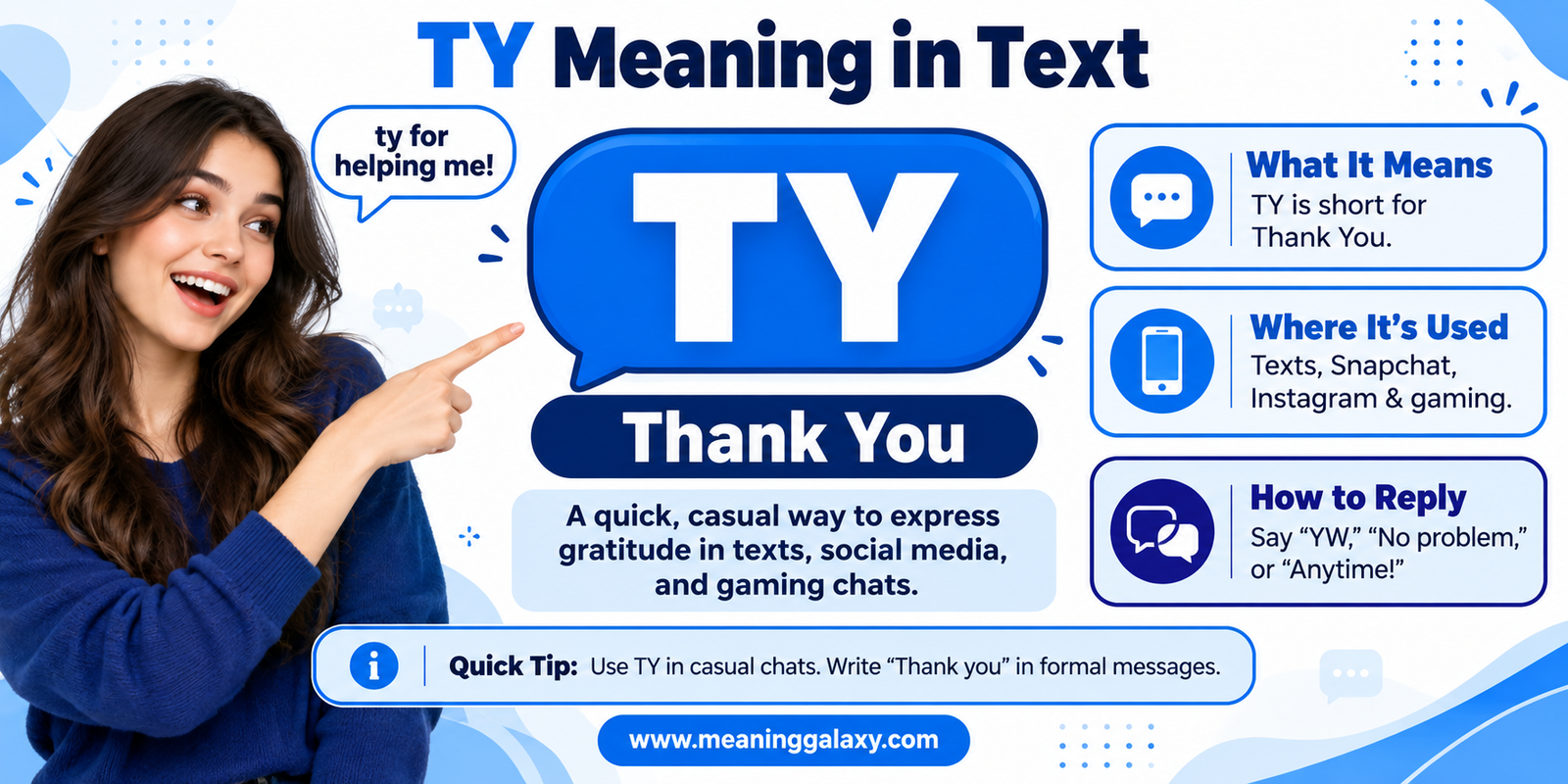
TY means “thank you” in texting and online conversations. It’s a quick, informal way to express gratitude without typing the entire phrase.
You’ll commonly see TY in text messages, Snapchat conversations, Instagram DMs, TikTok comments, Discord servers, and online games. People use it when someone shares information, offers help, gives a compliment, or does something thoughtful.
Although its meaning is straightforward, the way someone writes TY can sometimes affect how their message feels.
Here’s everything you need to know about what TY means, how to use it naturally, and what to say when someone sends it to you.
What Does TY Mean in Text?
TY stands for “thank you.” It’s a common texting abbreviation used to show appreciation, acknowledge someone’s help, or politely respond to a kind gesture.
For example, if your friend sends you the homework assignment you missed, you might reply:
Friend: “Here’s the assignment from today’s class.”
You: “ty!”
Your response simply means “thank you.”
TY is generally friendly and informal. However, it can sometimes feel brief or emotionally neutral, especially when someone expects a more personal response.
The abbreviation doesn’t automatically suggest that someone is annoyed, uninterested, or being sarcastic. Its tone depends on the conversation.
Quick Meaning Breakdown
| Feature | Explanation |
| Abbreviation | TY |
| Full Form | Thank you |
| Primary Meaning | Expressing gratitude or appreciation |
| Typical Tone | Casual, friendly, or neutral |
| Common Platforms | Snapchat, Instagram, TikTok, Discord, WhatsApp, and gaming chats |
| Common Situations | Receiving help, compliments, gifts, or information |
| Example | “ty for helping me!” |
| Formal or Informal? | Informal |
Common Examples of TY in Texting
Here are some natural ways people use TY in everyday conversations.
1. Thanking someone for information
“Got the address. ty!”
The sender appreciates receiving the information.
2. Responding to a compliment
“Aw, ty! That’s so sweet.”
The person feels appreciated and responds warmly.
3. Acknowledging someone’s help
“ty for explaining that!”
The sender is grateful for someone’s assistance.
4. Responding to a reminder
“Almost forgot about the meeting. ty!”
The abbreviation acknowledges a helpful reminder.
5. Expressing appreciation in a game
“Nice save, ty!”
A player thanks a teammate for helping during gameplay.
6. Responding to a favor
“ty, I owe you one.”
The sender expresses gratitude and recognizes the favor.
In each example, TY communicates appreciation without requiring a lengthy response.
Where Did TY Come From?
TY developed as a shortened way of writing “thank you” in digital communication.
Before smartphones made typing easier, people frequently used abbreviations in text messages, online chat rooms, instant messaging services, and internet forums.
Short expressions such as LOL, BRB, and TY helped users communicate quickly.
TY follows a simple abbreviation pattern: the first letter of each word in “thank you.”
Unlike some internet slang expressions, TY doesn’t have a widely documented individual creator or a verified date of invention.
How TY Became Common Online
As digital conversations became part of everyday life, short abbreviations became convenient ways to communicate.
TY fits naturally into conversations where someone wants to acknowledge a message without writing a longer response.
For example:
“Sent you the file.”
“ty!”
That exchange communicates everything necessary in just a few words.
The abbreviation also works well in fast-moving conversations, especially gaming chats and group messages.
Has the Meaning of TY Changed?
The main meaning of TY has remained consistent: “thank you.”
What changes is how people use it.
In a personal conversation, TY might express warm appreciation.
In a busy group chat, it might simply acknowledge someone’s contribution.
In a game, it can communicate gratitude without distracting players from what’s happening.
These differences reflect conversational context rather than entirely new definitions.
What Does TY Mean on Snapchat?
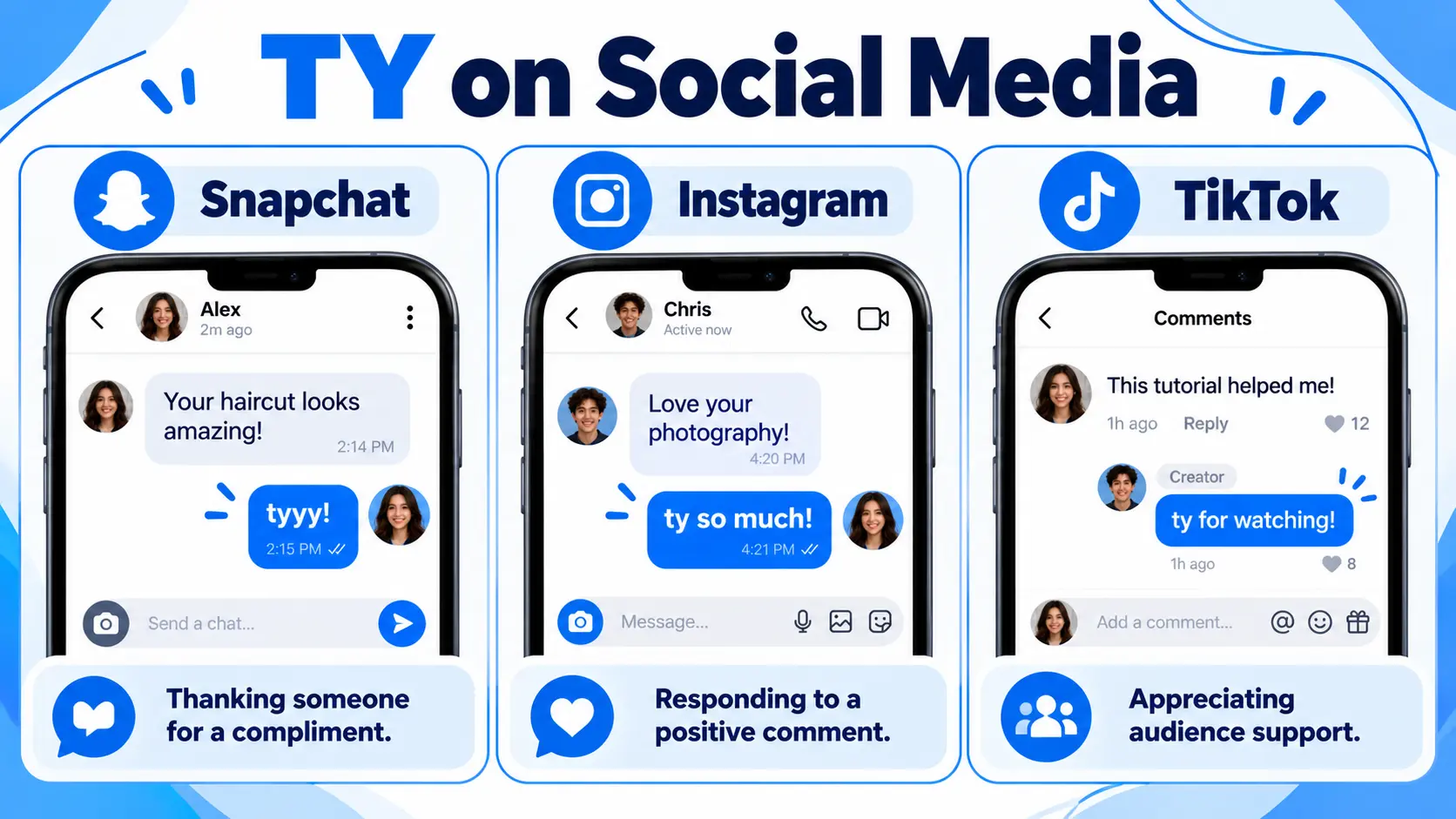
On Snapchat, TY usually means “thank you,” just as it does in ordinary texting.
People use it when responding to compliments, receiving information, or acknowledging something thoughtful.
Example:
Alex: “Your new haircut looks amazing!”
Jordan: “tyyy ❤️”
Here, the extra letters and heart emoji make the response feel enthusiastic and affectionate.
A shorter reply such as “ty” still means thank you, but it may appear more neutral.
Neither response automatically reveals how the sender feels about the other person.
Snapchat conversations are often casual, so TY generally fits naturally into the platform’s communication style.
What Does TY Mean on Instagram?
On Instagram, TY is commonly used in direct messages, comments, and replies to Stories.
Someone might use it to acknowledge a compliment, thank a follower, or respond to a helpful suggestion.
Instagram DM example:
Friend: “That outfit looks so good on you!”
You: “omg ty!!”
The response expresses excitement and appreciation.
Instagram comment example:
Follower: “Your photography is incredible.”
Creator: “ty so much!”
Here, the creator is thanking someone for a positive comment.
TY is particularly useful when responding to several messages because it communicates appreciation quickly.
However, writing a more personal reply can feel warmer when someone has taken the time to leave a thoughtful comment.
What Does TY Mean on TikTok?
On TikTok, TY usually appears in comments and replies.
Creators and viewers may use it when someone compliments a video, shares useful advice, or answers a question.
Example:
Comment: “This tutorial actually helped me!”
Creator: “ty for watching!”
The creator is thanking the viewer for their support.
Another example:
Comment: “Where did you get that hoodie?”
Reply: “It’s from a thrift store!”
Comment: “ty!!”
The person appreciates receiving an answer.
The abbreviation has the same basic meaning across TikTok, Instagram, and other social platforms.
What Does TY Mean in Gaming?
In online gaming, TY means “thank you.”
Players use it to acknowledge helpful teammates, successful teamwork, shared resources, and useful information.
Because games often require quick communication, short abbreviations are especially convenient.
Example 1: Thanking a Teammate
Player 1: “I dropped some ammo for you.”
Player 2: “ty”
The second player appreciates receiving the ammunition.
Example 2: Recognizing a Good Play
Player 1: “I got your back!”
Player 2: “ty!”
The response acknowledges the teammate’s support.
Example 3: Receiving Help
Player 1: “The objective is on the left side.”
Player 2: “ty”
The second player thanks their teammate for the information.
TY is common in gaming because it communicates gratitude without requiring players to stop and type a long message.
Related expressions include GG, meaning “good game,” and WP, meaning “well played.”
Unlike TY, those expressions focus primarily on the match or someone’s performance.
Real-Life Conversations Using TY
Understanding an abbreviation becomes easier when you see it in realistic conversations.
Here are four situations where TY fits naturally.

1. WhatsApp Conversation
Emma: “I sent you the notes from yesterday.”
Liam: “ty! I really needed those.”
Emma: “No problem!”
Meaning: Liam appreciates Emma sharing the notes.
The exclamation mark and additional sentence make his gratitude feel more expressive.
2. Instagram Direct Message
Mia: “Your birthday pictures are so cute!”
Sophie: “aww ty ❤️”
Mia: “You’re welcome!”
Meaning: Sophie responds warmly to a compliment.
The word “aww” and heart emoji add affection.
3. TikTok Comment
Viewer: “This recipe looks amazing!”
Creator: “ty!! Hope you try it!”
Meaning: The creator thanks the viewer and encourages further interaction.
The response feels friendly and enthusiastic.
4. Conversation Between Friends
Ryan: “I saved you a seat.”
Chris: “ty bro”
Ryan: “Got you.”
Meaning: Chris casually thanks his friend.
Adding “bro” makes the exchange sound familiar and relaxed.
These examples show that TY works in many everyday situations, from simple favors to friendly social media interactions.
What Emotion Does TY Express?
TY primarily expresses gratitude.
However, gratitude can sound different depending on the words, punctuation, emojis, and relationship involved.
For example:
- “ty” — A simple, neutral expression of thanks.
- “ty!” — May sound more enthusiastic.
- “TY!!” — Can emphasize excitement or strong appreciation.
- “ty ❤️” — Often feels warm or affectionate.
- “ty so much” — Communicates more explicit gratitude.
- “ty…” — May sound hesitant or awkward in certain contexts.
These are possible interpretations, not fixed rules.
Some people naturally use lowercase letters and minimal punctuation. Others prefer emojis and exclamation marks.
A short reply doesn’t necessarily indicate a negative emotion.
Can TY Sound Sarcastic?
Yes, TY can sometimes be sarcastic, but the abbreviation itself isn’t sarcastic.
Consider this conversation:
Person A: “I accidentally deleted your game save.”
Person B: “Wow, ty.”
In this situation, the response likely communicates frustration rather than genuine appreciation.
The word “wow” and the negative situation help establish the sarcastic meaning.
Compare that with:
Person A: “I fixed your game settings.”
Person B: “Wow, ty!”
Here, the same abbreviation expresses genuine gratitude.
Context matters more than the abbreviation alone.
Does a Dry “TY” Mean Someone Is Upset?
Not necessarily.
If someone replies with only “ty,” they might be busy, distracted, or simply comfortable using short messages.
Some people communicate with very little punctuation or emotional expression.
A brief thank-you is not reliable evidence that someone is annoyed.
If the person’s overall behavior seems different, the broader conversation may offer more information.
Avoid making assumptions based on two letters alone.
How to Use TY in Different Situations
TY is versatile, but it works better in some situations than others.
Using TY With Friends
TY fits naturally into casual conversations between friends.
Examples:
“ty for the ride!”
“ty bestie ❤️”
“ty for reminding me.”
These messages sound relaxed and familiar.
You can make them warmer by adding someone’s name, a compliment, or a few extra words.
Using TY in Romantic Conversations
TY can also appear in conversations between romantic partners.
For example:
“ty for making today special ❤️”
“aww ty babe”
“ty for always listening to me.”
In these situations, the surrounding words communicate affection.
The abbreviation itself still means thank you.
Using TY in Group Chats
In group conversations, TY is useful for quickly acknowledging someone’s contribution.
For example:
Group member: “I uploaded the presentation.”
You: “ty!”
The message confirms that you appreciate their effort without interrupting the discussion.
Using TY at Work
TY can be appropriate in informal workplace chats when coworkers already use casual language.
For example:
Coworker: “Updated the spreadsheet.”
You: “ty!”
However, in a formal email to a client, manager, or unfamiliar business contact, writing “thank you” is usually a better choice.
Compare:
Casual team chat: “ty for the update!”
Professional email: “Thank you for the update. I appreciate your help.”
Both communicate gratitude, but the second is more suitable for formal communication.
When Should You Avoid Using TY?
Although TY is harmless in most situations, there are times when writing the complete phrase is more appropriate.
Formal Business Communication
Avoid using TY in formal emails, job applications, business proposals, and official correspondence.
Instead of:
“TY for considering my application.”
Write:
“Thank you for considering my application.”
The full phrase sounds more professional and respectful.
Serious Emotional Conversations
If someone shares difficult personal news or provides meaningful emotional support, a two-letter response may feel insufficient.
For example, if a friend spends an hour helping you through a difficult situation, saying “Thank you for listening. It really means a lot” communicates more appreciation.
TY isn’t inherently disrespectful, but a thoughtful response may better match the moment.
Conversations With Unfamiliar People
Not everyone recognizes texting abbreviations.
Someone unfamiliar with internet slang might misunderstand TY or wonder what it means.
When communicating with a new client, teacher, older relative, or anyone whose texting preferences you don’t know, “thank you” is generally clearer.
Situations Where Tone Matters
Short messages sometimes lack emotional context.
If you want someone to understand that you’re sincerely grateful, consider adding a few words.
Instead of:
“ty”
Try:
“ty! That really helped me.”
The longer version makes your appreciation clearer.
TY vs. Other Texting Abbreviations
TY belongs to a group of popular expressions used to communicate gratitude and respond to appreciation.
Although these abbreviations are related, they aren’t always interchangeable.
| Expression | Meaning | Typical Tone | Common Usage |
| TY | Thank you | Casual, neutral, or friendly | Texts, social media, gaming |
| TYSM | Thank you so much | Warm, enthusiastic | Strong appreciation |
| THX | Thanks | Casual | Quick acknowledgments |
| THNX | Thanks | Informal | Friendly conversations |
| TKS | Thanks | Brief, informal | Texting and online chats |
| TIA | Thanks in advance | Polite, anticipatory | Requests for help |
| YW | You’re welcome | Friendly, neutral | Responding to thanks |
| NP | No problem | Relaxed, reassuring | Responding to thanks |
TY vs. TYSM
The main difference is intensity.
TY means “thank you.”
TYSM means “thank you so much.”
For example:
“ty for helping.”
“tysm for helping me! You’re amazing!”
The second message expresses stronger appreciation.
TY vs. THX
TY and THX communicate nearly the same idea.
TY is an abbreviation of “thank you,” while THX is a shortened spelling of “thanks.”
Both are informal and commonly understood in digital conversations.
TY vs. YW
TY and YW serve different purposes.
TY expresses gratitude.
YW means “you’re welcome” and is used to respond to gratitude.
Example:
Alex: “ty!”
Sam: “yw!”
This exchange means:
Alex: “Thank you!”
Sam: “You’re welcome!”
Popular Variations of TY
People sometimes modify TY to make their messages feel more expressive.
Here are several recognizable variations and combinations.
1. ty
Meaning: Thank you.
Tone: Simple and casual.
Example: “Got it, ty.”
This is the basic form of the abbreviation.
2. TY!
Meaning: Thank you!
Tone: Often more enthusiastic.
Example: “TY! That worked perfectly.”
The exclamation mark can make the message feel more energetic.
3. TYYY
Meaning: An expressive version of thank you.
Tone: Playful, excited, or affectionate.
Example: “omg tyyy ❤️”
Repeating the final letter is an informal way to add emphasis. It isn’t a separate standardized abbreviation.
4. TYSM
Meaning: Thank you so much.
Tone: Warm and appreciative.
Example: “tysm for the birthday gift!”
This abbreviation emphasizes gratitude.
5. TYVM
Meaning: Thank you very much.
Tone: Appreciative, sometimes slightly more formal or playful.
Example: “tyvm for your help!”
The expression can also sound sarcastic in certain conversations.
6. TY Bro
Meaning: Thank you, bro.
Tone: Friendly and relaxed.
Example: “ty bro, you’re the best.”
This is a casual phrase combining TY with a familiar form of address.
7. TY ❤️
Meaning: Thank you, with added affection.
Tone: Warm and personal.
Example: “ty ❤️ I appreciate you.”
The heart emoji adds emotional warmth.
These variations all preserve the basic meaning of TY while changing how the message may feel.
How to Respond to TY
If someone sends you TY, they’re usually thanking you for something.
Your response can be short, friendly, funny, or polite, depending on your relationship and the situation.
Casual Replies to TY
These responses work well in everyday texting:
- “np!”
- “yw!”
- “No worries!”
- “Anytime!”
- “All good!”
For example:
Friend: “ty for sending that.”
You: “np!”
Here, NP means “no problem.”
Friendly Replies to TY
If you want to sound warmer, try:
- “Of course!”
- “Happy to help!”
- “Always here for you.”
- “You got it!”
- “Glad I could help!”
Example:
Friend: “ty for listening.”
You: “Of course! Always here for you.”
This response feels more personal than a simple abbreviation.
Funny Replies to TY
Humorous responses work best with people who understand your sense of humor.
Examples include:
- “That’ll be $5.”
- “I accept payment in snacks.”
- “Your gratitude has been received.”
- “Just remember me when you’re famous.”
- “I’m basically a superhero.”
Example:
Friend: “ty for saving my assignment.”
You: “I accept payment in pizza.”
The response keeps the conversation playful.
Polite Replies to TY
In respectful or professional conversations, use:
- “You’re very welcome.”
- “My pleasure.”
- “Happy to assist.”
- “I’m glad I could help.”
- “You’re most welcome.”
Example:
Coworker: “Thank you for reviewing the document.”
You: “My pleasure. I’m glad I could help.”
Choose your response based on the relationship rather than trying to match every abbreviation exactly.
Common Misunderstandings About TY
Even simple abbreviations can cause confusion.
Here are some misunderstandings worth clearing up.
Does TY Mean “Take Your Time”?
No. In ordinary texting, TY most commonly means “thank you.”
The abbreviation for “take your time” is typically TYT.
For example:
“tyt, no rush.”
This means:
“Take your time, no rush.”
Because TY and TYT look similar, people unfamiliar with texting abbreviations may confuse them.
Does TY Mean “Thinking of You”?
Not usually.
“Thinking of you” is more commonly abbreviated as TOY in some messaging contexts, although many people simply write the phrase out.
TY alone is generally understood as “thank you.”
If someone uses it differently, the surrounding conversation should clarify their intention.
Is TY Always Friendly?
TY is generally polite, but it can appear in sarcastic conversations.
For example:
“ty for ruining the surprise.”
The speaker probably isn’t expressing genuine gratitude.
The negative context changes how the message is understood.
Does TY Mean Someone Wants to End the Conversation?
Not necessarily.
Sometimes TY naturally concludes an exchange because the person has received the help or information they needed.
For example:
“Here’s the link.”
“ty!”
The conversation may end because its purpose has been fulfilled, not because someone is upset.
How Different Generations Use TY
TY can be used by people of different ages.
However, familiarity with internet abbreviations often depends more on someone’s communication habits than their generation.
Gen Z
Gen Z users may encounter TY in social media comments, messaging apps, gaming communities, and group chats.
A casual message might look like:
“tysm bestie 😭❤️”
The additional abbreviation and emojis make the gratitude more expressive.
Millennials
Millennials may recognize TY from text messaging, online forums, and earlier instant messaging services.
A typical example might be:
“ty! I’ll send it over later.”
The abbreviation works naturally in both personal and informal professional conversations.
Older Generations
Some older adults use TY regularly, while others prefer writing “thank you.”
For someone unfamiliar with texting slang, the full phrase may be easier to understand.
These differences aren’t universal. People of any generation can use or recognize TY.
Is TY Safe for Kids?
Yes. TY is generally a harmless abbreviation meaning “thank you.”
It doesn’t have an inherently offensive, sexual, or inappropriate meaning in ordinary texting.
Children and teenagers may use TY when thanking friends, classmates, or teammates.
For example:
“ty for helping with my homework!”
Parents who see TY in a message generally don’t need to interpret the abbreviation itself as a warning sign.
However, any message should be understood in its full context.
The abbreviation alone doesn’t reveal whether an entire conversation is appropriate.
Is TY Rude or Disrespectful?
TY isn’t inherently rude.
In most conversations, it’s a perfectly acceptable way to say thank you.
However, it may feel too brief in situations where someone expects a more thoughtful response.
For example, if a friend spends several hours helping you move, responding with only “ty” might seem less appreciative than:
“Thank you so much for helping today. I really appreciate it.”
That doesn’t mean the abbreviation is disrespectful.
It simply means the amount of gratitude you express should fit the situation.
When in doubt, adding a few sincere words is an easy way to avoid misunderstandings.
FAQs About TY
What does TY mean in texting?
TY means “thank you” in texting. People use it to express gratitude, acknowledge someone’s help, or respond to a kind gesture. It’s an informal abbreviation commonly found in personal messages, social media conversations, and gaming chats.
What does TY mean on Snapchat?
On Snapchat, TY means “thank you.” Someone might send it after receiving a compliment, helpful information, or a thoughtful message. Variations such as “ty!” and “tyyy ❤️” can make the response feel more enthusiastic or affectionate.
What does TY mean on Instagram?
TY means “thank you” on Instagram. It’s commonly used in comments, direct messages, and Story replies. For example, if someone compliments your photo, replying “ty!” is a casual way to acknowledge their kindness.
What does TY mean from a girl?
When a girl sends TY, it usually means “thank you.” The abbreviation doesn’t have a special meaning based on the sender’s gender. Whether it sounds friendly, affectionate, or neutral depends on the conversation, surrounding words, and relationship.
What does TY mean from a guy?
When a guy texts TY, he’s usually saying “thank you.” It doesn’t automatically indicate romantic interest, annoyance, or a desire to end the conversation. Consider what happened before the message rather than interpreting the abbreviation on its own.
Is TY rude in texting?
TY isn’t normally rude. It’s a common, informal expression of gratitude. However, it may seem overly brief in serious or formal situations. If you want to sound especially appreciative, write “thank you so much” or add a personal message.
What’s the difference between TY and TYSM?
TY means “thank you,” while TYSM means “thank you so much.” Both express gratitude, but TYSM typically emphasizes stronger appreciation. For example, “ty for helping” is casual, while “tysm, you’re amazing!” sounds more enthusiastic.
How should I respond when someone says TY?
You can respond with “you’re welcome,” “no problem,” “anytime,” or “happy to help.” In casual texting, YW and NP are also common replies. Choose a response that matches your relationship with the person and the tone of the conversation.
Final Thoughts on What TY Means
TY means “thank you,” and it’s one of the simplest ways to express gratitude in digital conversations.
Whether someone sends it through Snapchat, Instagram, WhatsApp, Discord, or a gaming chat, the meaning is usually the same.
Punctuation, emojis, and surrounding messages can influence whether TY feels enthusiastic, affectionate, neutral, or occasionally sarcastic.
It’s perfectly suitable for casual conversations, but writing “thank you” is generally better in formal or emotionally important situations.
The next time someone sends you TY, you’ll know they’re most likely expressing appreciation. A simple “you’re welcome” or “no problem” is usually all you need to say.

Welcome to Meaning Galaxy! I’m Muhammad Talha, a language enthusiast and meaning explorer dedicated to helping people discover the true meanings behind words, names, phrases, and concepts.
I help users understand words better, explore hidden meanings, and learn new information in a simple and easy way. My goal is to make learning meanings interesting, clear, and accessible for everyone.
Let’s explore the world of words together!