
You may already know that NVM means “never mind,” but that often does not answer the real question. If someone sends you “NVM.” in a text, DM, game chat, or social app, you may still wonder if they are annoyed, if you should reply, or if the meaning changes with the situation. From the usage patterns reviewed in real chat examples and competitor research, the biggest source of confusion is usually not the abbreviation itself. It is the context and tone around it.
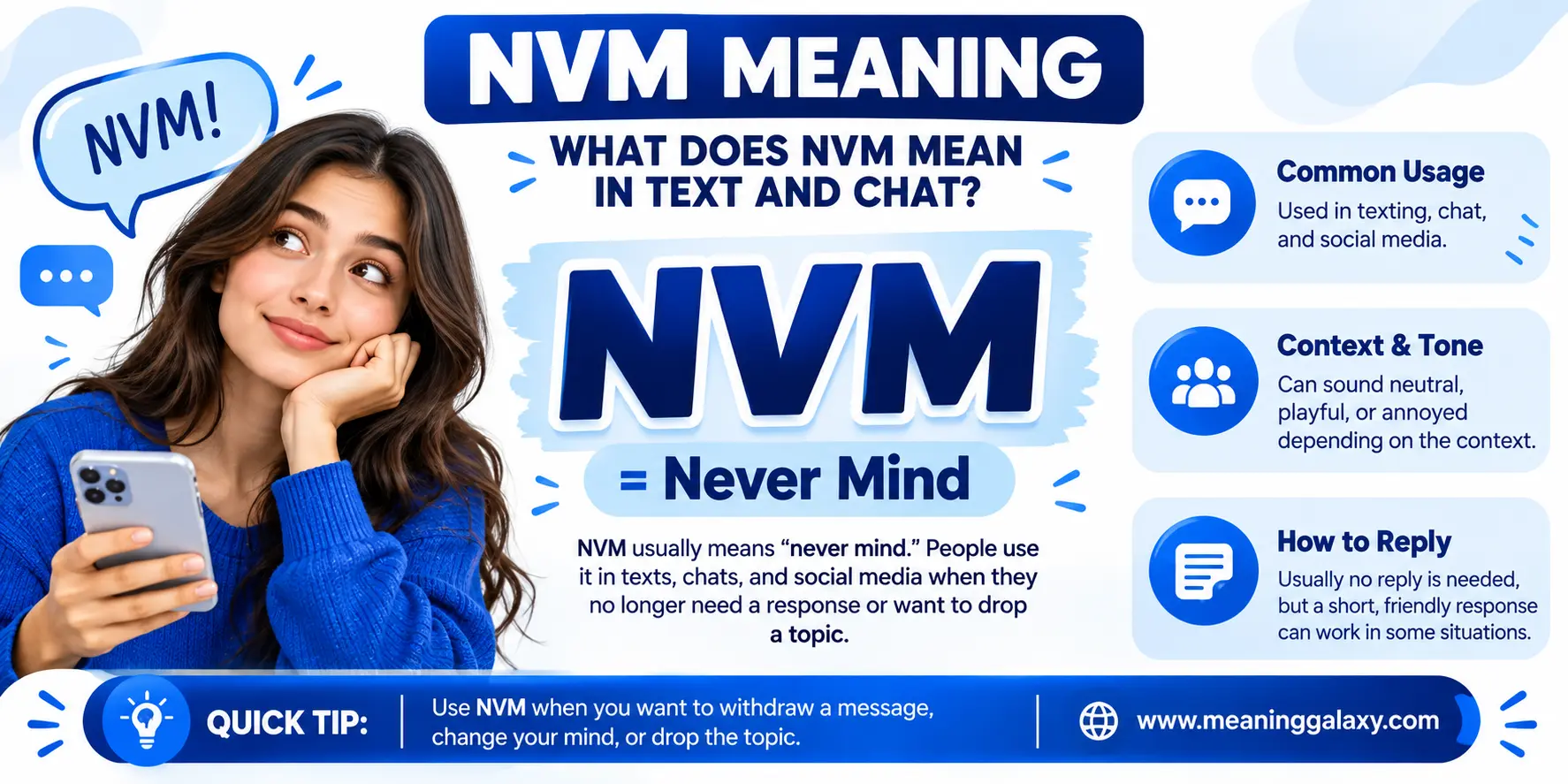
The NVM meaning is usually simple: it stands for “never mind.” People use it when they no longer need an answer, want to drop a topic, change their mind, or correct something they said. The safest way to understand it is to read the messages around it instead of guessing from the three letters alone. This guide explains the common uses, tone differences, platform contexts, and reply options so you can understand what NVM means in the situation you actually saw.
NVM Meaning at a Glance
Here is the quick answer if you only need to understand NVM fast.
| NVM Meaning | Never mind |
|---|---|
| Full Form | Never mind |
| Common Use | To cancel a question, withdraw a request, or say something no longer matters |
| Used In | Texting, chat, DMs, Snapchat, TikTok, Instagram, WhatsApp, Discord, and gaming |
| Typical Tone | Usually casual or neutral, but context can make it sound annoyed, playful, or abrupt |
| Is NVM Rude? | Not usually. The surrounding message and tone matter more than the abbreviation itself |
| Example | “Can you send me the link? Nvm, I found it.” |
| Simple Reply | “No worries,” “All good,” or “Let me know if you still need help” |
Quick rule: In a normal text or social media conversation, NVM usually means “never mind.” Check the surrounding messages if you are unsure about the sender’s tone.
What Does NVM Mean in Text & Chat?
NVM means “never mind” in most texts, chats, DMs, and social media conversations. It is an informal abbreviation that lets someone quickly withdraw or dismiss something they just said.
If you only need the quick answer, read NVM as “never mind” first. Then look at the messages around it if you need to understand the sender’s tone or intention.
Dictionary.com identifies NVM as an informal form of “never mind.”
| Quick Question | Answer |
| What does NVM mean? | Never mind |
| What does NVM stand for? | Never mind |
| Where is it used? | Texts, chats, DMs, social media, gaming |
| Is it formal? | Usually no |
| Is NVM rude? | Not automatically |
| Main purpose | To cancel, dismiss, or move past something |
NVM Slang Meaning
In internet slang, NVM usually tells the other person:
- Ignore what I just said.
- I do not need an answer anymore.
- I figured it out.
- I changed my mind.
- Forget about the topic.
- It is no longer important.
For example:
Alex: “What time does the movie start?”
Alex: “Nvm, I found it.”
Here, NVM simply means Alex no longer needs an answer.
If someone sends only “NVM” with no explanation, the literal meaning is still usually “never mind.” You may need the earlier messages to understand why they said it.
Full Form & Short Meaning of NVM
The full form of NVM is “never mind.”
Its short meaning can be understood as:
Forget what I just said or asked.
You may see it written as:
- NVM
- nvm
- Nvm
The capitalization does not normally change the dictionary meaning.
NVM is often called an acronym in everyday use. Under the stricter linguistic distinction, it is an initialism because people normally pronounce the letters separately as “N-V-M.”
Simple Chat Examples
“Can you send me that link? Nvm, I found it.”
Meaning: I no longer need the link.
“Do you know where Sarah is? nvm.”
Meaning: I no longer need the answer.
“I was going to ask you something, but nvm.”
Meaning: I changed my mind about asking.
“Nvm 😂 I read your message wrong.”
Meaning: Ignore my previous reaction.
Why Do People Use NVM Online?
People mainly use NVM because online conversations move quickly. Instead of writing a full sentence such as “Never mind, I do not need your help anymore,” they can type three letters.
The reason matters because it can help you understand what the sender wants you to do next.
To Cancel a Question
This is one of the most common uses.
“What was the homework? Nvm, I found it in the group chat.”
The sender asked a question but solved the problem before receiving an answer.
You usually do not need to answer the original question after this.
To End a Topic
Someone may also use NVM when they no longer want to continue a discussion.
“What did you want to tell me?”
“Nvm, it’s not important.”
This can be neutral, but the tone may depend on what happened before it.
To Avoid Explaining
Sometimes a person begins to explain something and decides it is not worth continuing.
“I thought you meant something else… nvm.”
The person is choosing not to explain the thought further.
To Save Time
Texting slang is often about speed.
Instead of:
“Never mind. I have already found the answer, so you do not need to check.”
someone may simply write:
“Nvm, got it.”
If your site covers other abbreviations such as IDK, BRB, TBH, or IMO, a texting abbreviations guide would be a natural internal link here.
How People Use NVM in Daily Conversations
The same three letters can perform several different jobs in conversation.
When They Found the Answer
“Where is the meeting link?”
“Nvm, found it.”
This is usually neutral. The sender is saving the other person from answering.
When They Change Their Mind
“Can you call me later? Actually nvm.”
The request has been withdrawn.
When They Feel Embarrassed
NVM may appear after someone makes a mistake.
“Wait, I thought that was tomorrow. Nvm 😅”
The emoji makes the self-correction feel lighter.
When They Feel Slightly Upset
Sometimes the same abbreviation can sound more emotional.
“I wanted to talk about something, but nvm.”
This could suggest frustration, disappointment, embarrassment, or simply a change of mind.
You cannot know which one from NVM alone.
If your main concern is “Are they mad at me?”, look at the conversation before NVM rather than treating the abbreviation itself as proof of anger.
In Funny Conversations
NVM can also work as comic timing.
“I was about to give you advice, then I remembered who I’m talking to. Nvm 😂”
The humor comes from the context, not from a different meaning of NVM.
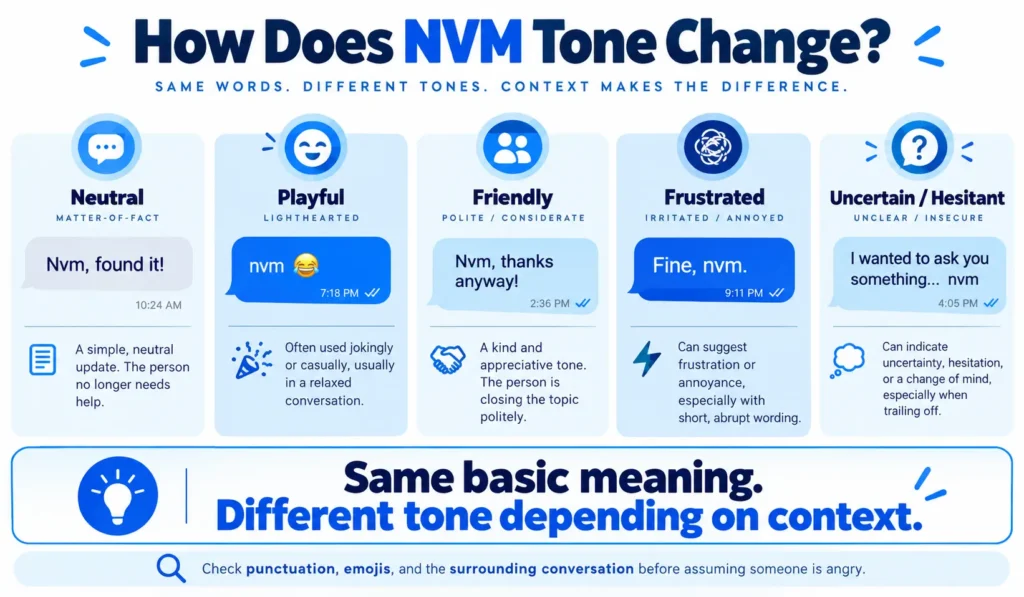
Does NVM Always Sound the Same in Text?
No. NVM normally keeps the same basic meaning, but its tone can change.
The words before and after it matter. So do punctuation, emojis, and the relationship between the people talking.
This is especially important if you already know NVM means “never mind” but are trying to understand what the sender meant emotionally.
Tone & Context Variations
| Message | Possible Tone |
| “Nvm, found it!” | Neutral or upbeat |
| “nvm 😂” | Playful |
| “Nvm, thanks anyway” | Friendly |
| “NVM.” | Brief or possibly annoyed |
| “Fine, nvm.” | Frustrated |
| “I wanted to ask you something… nvm” | Hesitant or uncertain |
These are possible interpretations, not fixed rules.
Funny Tone
“Can you remind me what 2 + 2 is? Nvm, my brain is working again 😂”
The joke and emoji make the tone obvious.
Sarcastic Tone
“Thanks for replying three hours later. Nvm.”
Here, the surrounding sentence creates the sarcasm.
Romantic Tone
“I was going to tell you something cute, but nvm 🙈”
This may sound shy or playful, but NVM itself does not have a romantic definition.
Angry Tone
“NVM. I’ll handle it myself.”
The capitalization, period, and second sentence may make the message feel more frustrated.
Playful Tone
“Guess who I saw today… actually nvm 😂”
Again, the surrounding conversation carries the playful feeling.
Is Using NVM Rude or Polite?
NVM is not automatically rude.
In many conversations, it is simply practical:
“Nvm, I figured it out.”
There is nothing obviously rude about that.
However, NVM can feel abrupt when it appears alone:
“NVM.”
Compare that with:
“Nvm, no worries! I found it.”
The second version gives the reader more context and sounds warmer.
If you want to avoid misunderstanding, add a few words:
- “Nvm, I got it.”
- “Nvm, thanks anyway!”
- “Nvm, all good.”
- “Nvm, I figured it out.”
Do not assume someone is angry just because they wrote NVM. Look at the whole conversation.
If you received a short “NVM.” and are unsure what to do, a neutral response such as “Okay, no worries” is often enough unless the earlier conversation suggests something is wrong.
What Does NVM Mean From a Girl or Guy?
NVM normally means the same thing whether it comes from a girl, guy, friend, partner, coworker, or stranger: “never mind.”
Gender does not create a separate definition.
What matters is the conversation.
For example:
“I wanted to ask you something, but nvm.”
That message could mean:
- They changed their mind.
- They became nervous.
- They no longer think the question matters.
- They do not want to explain.
- They felt ignored.
- They realized they already had the answer.
You should not assume romantic interest, anger, rejection, or hidden feelings from three letters alone.
If you searched “NVM meaning from a girl” or “NVM meaning from a guy,” the most useful question is not the sender’s gender. Ask what happened immediately before they sent NVM.
NVM Meaning in Love
NVM does not have a special “love” meaning.
In romantic conversations, however, the message may feel more personal because the topic itself is emotional.
For example:
“Do you still want to go out this weekend?”
“Actually nvm.”
That could indicate a changed plan, disappointment, frustration, or something else entirely.
The safest interpretation comes from the messages around it.
If you are unsure, avoid making a big emotional assumption from NVM alone. A simple follow-up such as “Everything okay?” can clarify the situation without putting pressure on the other person.
NVM Meaning on Snapchat, TikTok, Instagram & WhatsApp
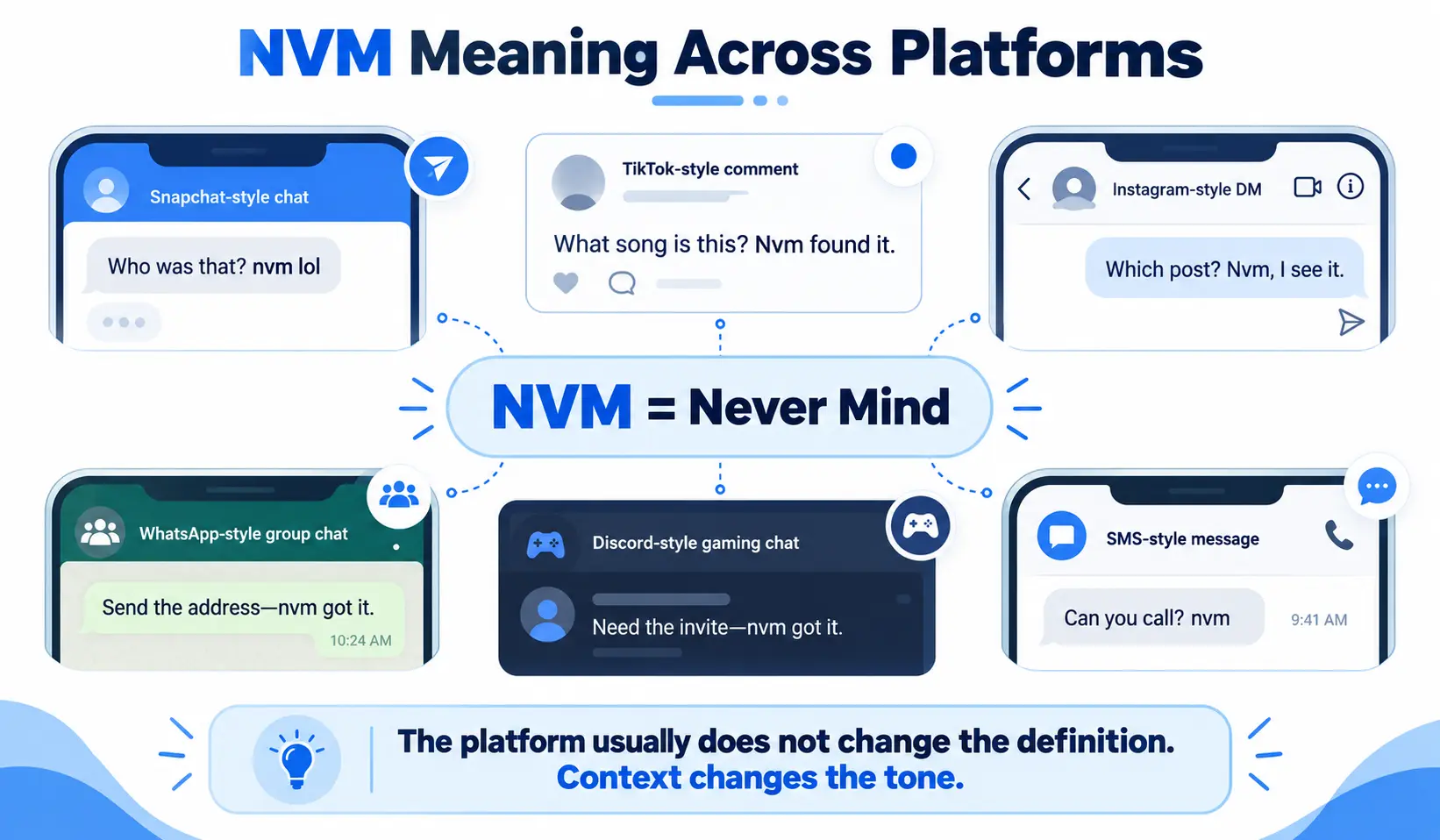
The meaning of NVM does not usually change from one social platform to another.
In most cases, it still means “never mind.”
If you searched for NVM because you saw it on a specific app, the platform usually changes the situation, not the definition.
| Platform | Usual NVM Meaning | Example |
| Snapchat | Never mind | “Who was that? nvm lol” |
| TikTok | Never mind | “What song is this? Nvm found it” |
| Never mind | “Where is that post? nvm I see it” | |
| Never mind | “Send me the address—nvm got it” | |
| Discord | Never mind | “Need the invite—nvm, got it.” |
| SMS | Never mind | “Can you call? nvm” |
Snapchat
On Snapchat, NVM may appear in snaps, messages, or quick conversations.
“Who was in your story? Nvm.”
Its meaning still depends on the context rather than Snapchat itself.
TikTok
On TikTok, someone may use NVM in a comment or message after answering their own question.
“What filter is this? Nvm, it says it in the caption.”
Instagram users may type NVM in DMs or comments.
“Which post did you mean? Nvm, found it.”
On WhatsApp, NVM is common in fast one-to-one or group conversations.
“Can someone resend the PDF? Nvm, got it.”
Discord
On Discord, NVM usually keeps the same “never mind” meaning. It may appear when someone answers their own question, finds a link, solves a problem, or no longer needs help.
“Can someone send the server invite? Nvm, got it.”
The platform does not create a separate meaning. The surrounding chat still determines the tone.
SMS
The traditional texting meaning is the same:
NVM = never mind.
NVM in Group Chats and Online Communities
NVM is useful in busy group conversations because it can quickly close a question or request.
“Does anyone have the Zoom link?”
“Nvm, found it.”
That tells everyone else they no longer need to respond.
For someone reading a fast group chat, NVM can therefore work as a simple signal that the original request is finished.
Gaming Communities
In gaming chats, NVM often keeps its normal meaning.
“Where is the next objective?”
“Nvm, I see it.”
“Can someone revive me? nvm, respawning.”
Because gaming uses many abbreviations, always check the context before assuming what a term means.
Business or Work Chats
NVM may appear in casual workplace tools such as Slack or Teams, especially between coworkers who know each other well.
For example:
“Can you send the client deck? Nvm, found it in Drive.”
This is usually understandable, but a more professional version would be:
“Never mind, I found the file. Thanks.”
NVM in Formal and Informal English
NVM belongs mainly to informal digital communication.
It is fine in:
- Casual texts
- Friend groups
- Family chats
- Social media messages
- Gaming chats
- Informal coworker messages
It is less suitable in:
- Formal emails
- Job applications
- Client communication
- Academic writing
- Official reports
Formal vs Informal
Informal:
“Nvm, I found the document.”
More professional:
“Never mind, I found the document.”
Formal:
“Please disregard my previous message. I have located the document.”
For a school group chat with friends, NVM may be completely normal. In an email to a teacher, professor, employer, or client, writing the phrase in full is usually clearer and more professional.
When to Use & Avoid
Use NVM when the relationship and setting are casual.
Avoid it when clarity and professionalism matter more than speed.
The full phrase “never mind” is standard English, while the shortened NVM form is strongly associated with informal digital communication.
Examples of NVM in Real Chat Situations
Friendly Examples
Friend: “Do you need the address?”
You: “Nvm, I found it. Thanks!”
Funny Examples
You: “How do I turn this thing on?”
You: “Nvm. There’s literally a giant power button 😂”
Gaming Examples
Player 1: “Where did the enemy go?”
Player 2: “Behind you.”
Player 1: “Nvm, found them.”
Relationship Chat Examples
Person A: “I wanted to ask you about yesterday.”
Person A: “Nvm.”
That may sound more emotionally loaded because the topic is personal. Still, the exact feeling cannot be determined without more context.
Workplace Example
Coworker: “Can you send the latest report?”
Coworker: “Nvm, I found the updated version.”
This is clear, though “Never mind, I found it” may sound more polished in professional communication.
How to Reply When Someone Says NVM
You often do not need a complicated response. Match your answer to the situation. If you are unsure what tone the sender intended, a neutral reply is usually safest.

| Situation | Possible Reply |
| They found the answer | “No worries!” |
| They solved the problem | “Glad you got it.” |
| Casual chat | “All good.” |
| They changed their mind | “Okay, no problem.” |
| They might still need help | “Let me know if you need anything.” |
| They sound upset | “Everything okay?” |
| Workplace | “No problem. Let me know if anything else comes up.” |
Casual Replies
- “Okay!”
- “Got it.”
- “No worries.”
- “All good.”
Friendly Replies
- “No problem!”
- “Glad you found it.”
- “Anytime.”
- “Let me know if you still need help.”
Funny Replies
- “Mystery solved 😂”
- “That was fast.”
- “Crisis avoided 😅”
Use humor only when the conversation already feels light.
Serious Replies
If the message seems emotional:
- “Okay. Let me know if you want to talk.”
- “Are you sure?”
- “No problem. I’m here if you need me.”
Do not force someone to explain if they clearly want to drop the topic.
Flirty Replies
In an already flirty conversation, you might say:
- “Now I’m curious 👀”
- “You can’t just say nvm after that 😂”
Again, this only works when the existing tone supports it.
Common Confusions & Mistakes
Thinking NVM Is Rude
A common mistake is assuming a short message must be angry.
“Nvm, got it” is usually practical rather than rude.
If you are worried about the sender’s mood, compare NVM with the message before it instead of judging the abbreviation by itself.
Confusing NVM With NM
NVM and NM are not always interchangeable.
NVM most clearly means “never mind.”
NM can also mean:
- Never mind
- Not much
- Nothing much
For example:
“What are you doing?”
“NM.”
Here, NM probably means “not much,” not “never mind.”
That makes NVM clearer when you specifically want to say “never mind.”
Using It in Formal Situations
Writing:
“NVM my last email.”
to a client may sound too casual.
A better option is:
“Please disregard my previous email.”
Misreading Emotional Tone
Do not assume:
“NVM.” = angry
or:
“nvm” = friendly
Punctuation can influence how a message feels, but context is more important.
Overusing It
If you keep saying NVM after asking questions, the other person may become confused.
Instead of:
“Can you help? Nvm. Actually can you help? Nvm.”
wait until you know whether you still need the answer.
Different Meanings of NVM in Other Contexts
Although “never mind” is the most common texting meaning, NVM can mean something else in technical settings.
If you found NVM outside a normal conversation, check the topic around it before assuming it means “never mind.”
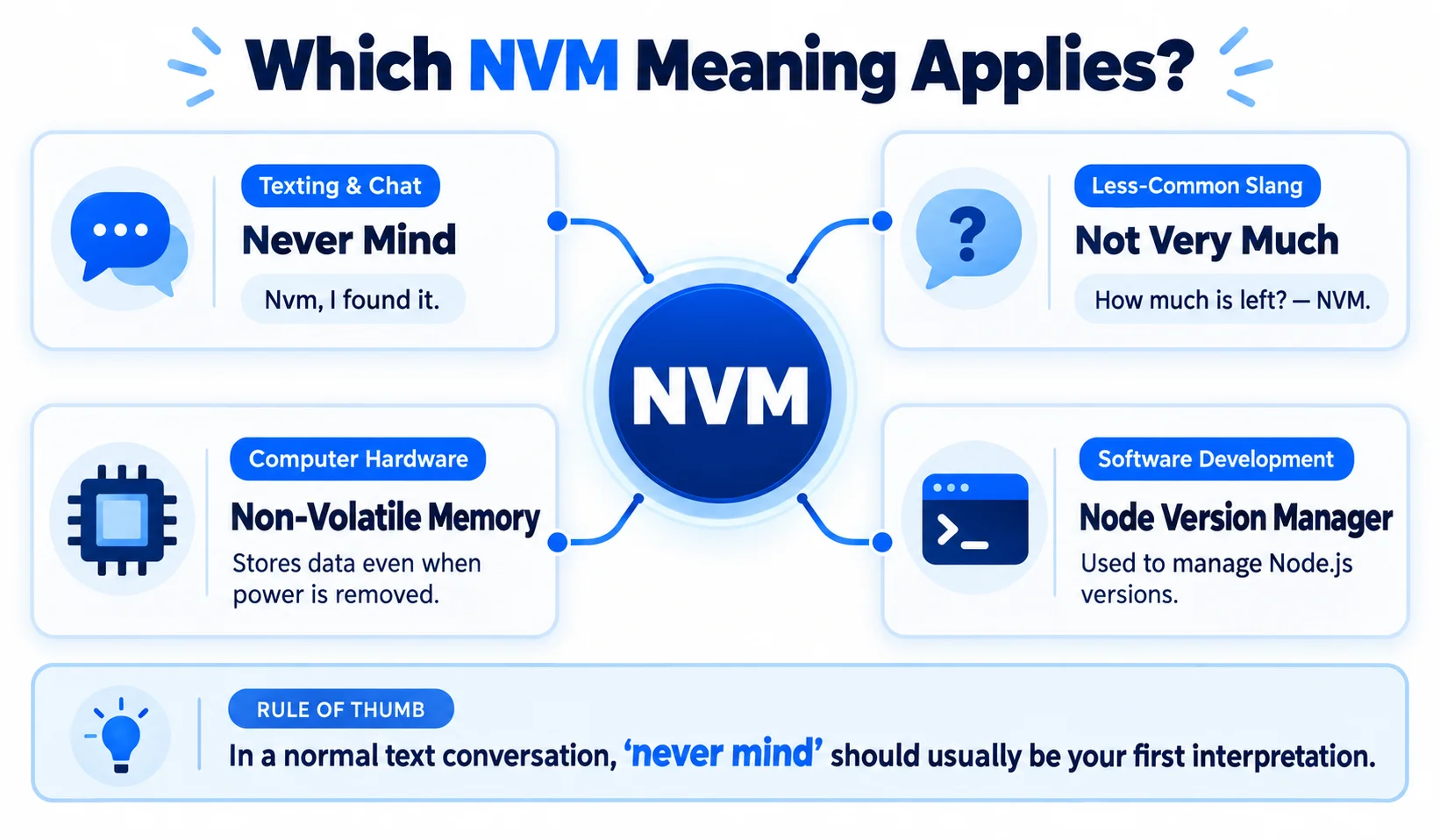
| Context | Meaning |
| Texting/chat | Never mind |
| Less-common slang use | Not very much |
| Computer hardware | Non-volatile memory |
| Software development | Node Version Manager |
Not Very Much
Some slang references also record NVM as “not very much.”
For example:
“How much money do you have left?”
“NVM.”
In that context, NVM could mean “not very much.”
However, this is not the default interpretation in most texting situations. “Never mind” is the more common texting meaning, so context should decide which one fits.
Non-Volatile Memory
In computing, NVM can mean non-volatile memory.
Non-volatile memory is computer storage that keeps data even when power is removed.
So if you see:
“The device stores settings in NVM.”
it probably has nothing to do with “never mind.”
Gaming
In normal gaming chat, NVM usually still means never mind.
However, games can have their own abbreviations, item names, or community-specific language. Always consider the game and sentence.
Business or Work Chats
In workplace messaging, NVM normally means “never mind.”
It does not usually represent a special business term unless the company or industry defines it differently.
Academic or Technical Documents
Technical documents may use NVM for non-volatile memory or another specialist abbreviation.
Software developers may also see lowercase nvm referring to Node Version Manager, a command-line tool used to install and switch between Node.js versions.
Origin & History of NVM
NVM is a shortened form of “never mind” used in digital communication. Its exact first use is difficult to establish, so a specific invention date should not be assumed without reliable historical evidence.
Dictionary.com documented NVM as internet shorthand for “never mind” in an entry dated May 3, 2018. That date shows the abbreviation was documented by then, but it should not be treated as the date NVM was invented.
Early Internet & SMS Era
Short abbreviations became useful in fast digital conversations because they reduced the amount of typing needed.
Expressions such as:
- BRB
- LOL
- IDK
- TBH
- NVM
fit naturally into chat and text communication because they are short.
Gaming Communities
Gaming also uses many short messages because players often need to communicate quickly.
A player may have only a few seconds to type:
“Need help—nvm got it.”
This makes NVM practical in gaming chats, but there is not enough reliable evidence to claim that gaming communities created or caused the abbreviation to become popular.
Social Media Growth
NVM also appears in modern social media messages, comments, and DMs.
The platform may change, but the basic texting meaning usually remains “never mind.”
Similar Slang Terms & Alternatives
NVM belongs to a larger group of short expressions used in digital conversation.
| Term | Common Meaning | How It Differs |
| NVM | Never mind | Withdraws or dismisses something |
| NM | Not much / never mind | More ambiguous |
| NVMD | Never mind | Less common variation |
| NVRM | Never mind | Less common variation |
| DW | Don’t worry | Reassures someone |
| NBD | No big deal | Says something is not important |
| IDK | I don’t know | Expresses uncertainty |
| JK | Just kidding | Shows something was a joke |
Common Alternatives
Instead of NVM, you can write:
- Never mind.
- Forget it.
- It’s okay.
- No worries.
- Ignore that.
- I figured it out.
- I don’t need it anymore.
Similar Phrases
The best alternative depends on what you actually mean.
If you solved the problem:
“I figured it out.”
If you no longer need help:
“No worries, I got it.”
If you made a mistake:
“Ignore my last message.”
If the conversation is formal:
“Please disregard my previous message.”
Related Slang Terms
Readers interested in NVM may also encounter:
- IDK — I don’t know
- BRB — be right back
- TBH — to be honest
- IMO — in my opinion
- JK — just kidding
- NBD — no big deal
These would make useful internal links to related slang-definition articles.
Is NVM Still Popular in 2026?
NVM remains documented in current online language references as shorthand for “never mind.” It also continues to appear across texts, chats, social media, and other forms of informal digital communication.
The important point is not whether it belongs to one generation. Its main meaning remains recognizable in modern online conversation.
Who Uses This Term?
NVM is not defined as belonging to one specific age group.
People who use informal digital communication may understand or use it, but texting habits vary from person to person.
Some people prefer abbreviations. Others simply write “never mind” in full.
Popular Among Different Age Groups
There is not enough reliable demographic evidence in the sources reviewed here to say that NVM belongs mainly to one generation or age group.
It is safer to treat NVM as a general texting abbreviation rather than label it as specifically Gen Z, Millennial, teenage, or adult slang.
Modern Usage Trends
The most useful thing to understand is not whether NVM belongs to one generation. It is that it remains a short way to withdraw a message or request in informal digital conversation.
Its meaning is still centered on “never mind.”
FAQs
What does NVM mean in a text message?
NVM usually means “never mind.” It tells the other person to ignore a previous message, question, or request because it no longer matters or no longer needs an answer.
Why did someone text me NVM?
They may have found the answer, changed their mind, decided not to continue the topic, or no longer needed your help. NVM alone does not tell you the sender’s exact emotion. Check the surrounding conversation for context.
Does NVM mean someone is mad at me?
Not necessarily. NVM can be neutral, friendly, embarrassed, playful, or frustrated depending on the conversation. A message such as “Nvm, found it!” is very different from “Fine. NVM.”
Is NVM rude?
Not usually. NVM can be completely neutral, especially in a message such as “Nvm, I found it.” A short message such as “NVM.” may sound more abrupt, but context matters.
What does NVM mean from a girl?
It normally means “never mind.” There is no special female meaning of NVM. Look at the surrounding conversation to understand whether the person changed their mind, found the answer, felt awkward, or wanted to end the topic.
What does NVM mean from a guy?
It usually means “never mind.” The definition does not change based on gender. Tone and intention depend on the conversation.
Is NVM the same as “nevermind”?
NVM is shorthand for the phrase “never mind.” In standard use, “never mind” is normally written as two words when used as the phrase.
How do you pronounce NVM?
NVM is usually pronounced by saying the three letters separately: “N-V-M.” In normal spoken conversation, people are more likely to say the full phrase “never mind.”
What does NVM mean on Snapchat?
On Snapchat, NVM normally means “never mind.” It can be used when someone changes their mind, answers their own question, or no longer wants to discuss something.
What should I reply to NVM?
A simple reply is usually enough:
- “Okay.”
- “No worries.”
- “All good.”
- “Let me know if you still need help.”
If the person sounds upset, you can gently ask if everything is okay.
Can you use NVM in school or work?
You can use NVM in casual school or workplace chats, but it may be too informal for teachers, formal assignments, clients, job applications, or professional emails. In formal communication, use “never mind” or “please disregard my previous message.”
Conclusion
The main takeaway is simple: NVM usually means “never mind,” but the full conversation tells you what the sender really intended. From the usage patterns discussed above, context is the deciding factor when the message feels rude, playful, awkward, or emotional. A quick look at the words before and after NVM can often prevent a misunderstanding and help you decide whether no reply is needed, a simple “No worries” is enough, or it makes sense to ask if everything is okay. If you use NVM yourself, keep it for casual settings and add a few extra words when you want your tone to be clear.

Welcome to Meaning Galaxy! I’m Muhammad Talha, a language enthusiast and meaning explorer dedicated to helping people discover the true meanings behind words, names, phrases, and concepts.
I help users understand words better, explore hidden meanings, and learn new information in a simple and easy way. My goal is to make learning meanings interesting, clear, and accessible for everyone.
Let’s explore the world of words together!