
Have you ever received a message that simply says “IK” and wondered what the other person was trying to say? If you see it in a text, Snapchat message, Instagram DM, or online conversation, the abbreviation might seem confusing at first.
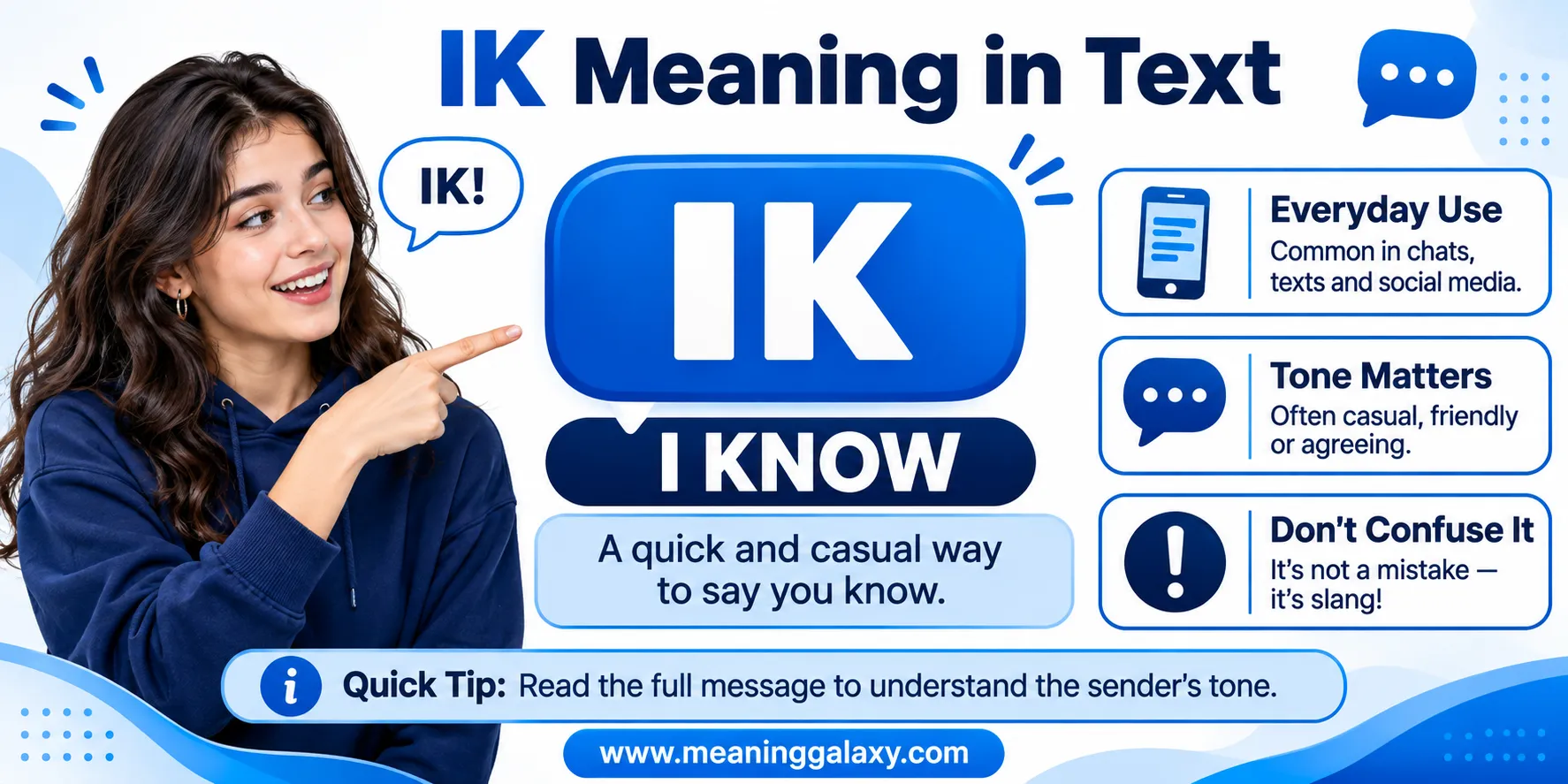
IK means “I Know.” People use it as a short way to say they already know something, understand what someone is talking about, or acknowledge information. It is a casual expression that makes everyday conversations quicker.
However, the tone can change depending on the situation. Sometimes IK sounds friendly and agreeable, while in other conversations, it may come across as impatient or sarcastic. Understanding the surrounding message helps you interpret it correctly.
Quick Answer: What Does IK Mean?
| Category | Meaning |
| Abbreviation | IK |
| Full form | I Know |
| Main meaning | Already knowing or understanding something |
| Tone | Neutral, friendly, playful, or occasionally annoyed |
| Common settings | Text messages and online chats |
| Appropriate use | Informal conversations |
| Opposite expression | IDK (I Don’t Know) |
| Quick tip | Read the complete message to understand the tone. |
What Does IK Mean in Text?
IK stands for “I Know.” It is an informal abbreviation people use when they already have information or understand what another person is saying.
Instead of typing the complete phrase, someone can simply write IK to make their response shorter.
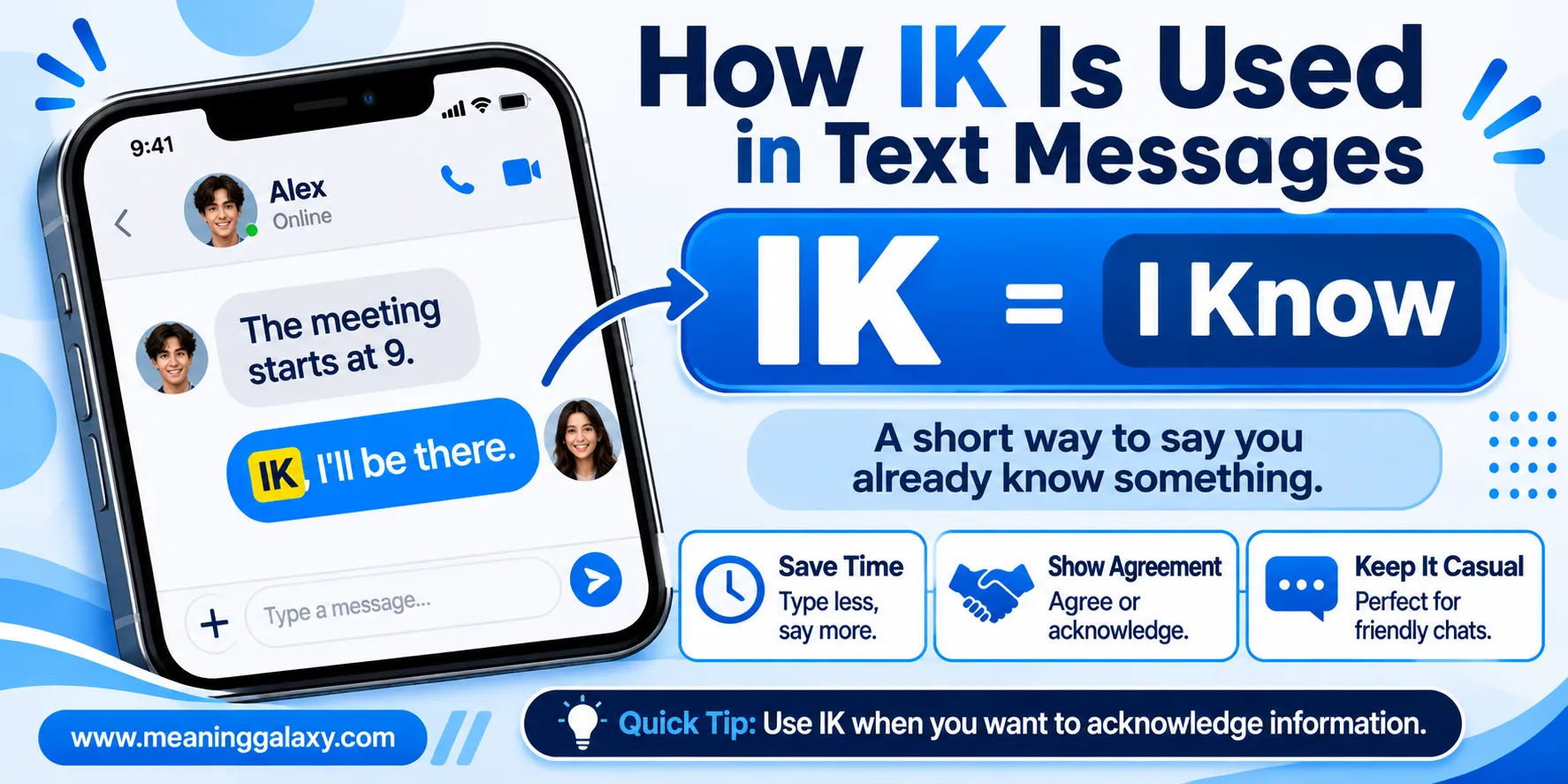
For example:
Person 1: “Tomorrow is your last day at school!”
Person 2: “IK, I’m so excited!”
In this conversation, the second person already knows about the upcoming event and is acknowledging the information.
IK is an initialism, which means its letters are pronounced individually rather than as one word. In ordinary texting, however, people generally use it as written shorthand.
The Most Common IK Meaning
The most common meaning of IK is simply “I Know.”
People use it in several everyday situations:
1. When someone tells you something you already know
- Friend: “Your favorite show has a new episode.”
- You: “IK! I’ve been waiting for it.”
The reply shows that you already knew about the episode.
2. When you understand someone’s feelings
- Friend: “This week has been really stressful.”
- You: “IK, you’ve had a lot going on.”
Here, IK acknowledges the other person’s situation.
3. When someone reminds you about something
- Friend: “Don’t forget your assignment.”
- You: “IK, I’ll finish it tonight.”
The sender confirms that the reminder is unnecessary because they already know.
Other Common Meanings of IK
In ordinary texting, “I Know” is the established meaning readers should recognize first.
However, the same letters can have different meanings in specialized subjects.
One example is Inverse Kinematics (IK), a technical term used in animation and computer graphics to describe a method of calculating how connected parts of a structure move.
For example, an animator might use inverse kinematics to position a character’s hand and calculate the movement of its arm.
This technical meaning is different from texting slang. The surrounding subject makes the intended meaning clear.
Origin and Evolution of IK
The exact origin of IK as an abbreviation for “I Know” is unclear.
It is associated with internet messaging and informal digital communication, where people use shorter expressions to make conversations faster.
An early Urban Dictionary entry dated October 20, 2004, describes IK as shorthand for “I Know” used in instant messaging. This provides evidence of its use by that time, but it does not establish the abbreviation’s original creation date.
Urban Dictionary+1
Today, IK remains a recognizable shorthand in casual digital conversations.
It is also related to other familiar expressions, including IDK (“I Don’t Know”) and IKR (“I Know, Right?”).
The Emotional or Social Meaning of IK
Although IK has a straightforward definition, it can communicate different feelings depending on the conversation.
The abbreviation itself does not determine someone’s emotional state. The complete message, punctuation, and relationship between the people involved all matter.
Here are some common interpretations.
1. Agreement or Understanding
Someone might use IK to show that they understand or agree with something.
Example:
- Friend: “We should start studying earlier next time.”
- You: “IK, we left everything until the last minute.”
The response acknowledges the point and shows agreement.
2. Friendly Acknowledgment
IK can also be a simple, friendly way to respond when someone shares familiar information.
Example:
- Friend: “You always order the same pizza.”
- You: “IK 😂 It’s my favorite!”
The reply sounds relaxed and playful.
3. Frustration or Annoyance
Sometimes, IK can sound impatient, particularly when someone repeats something you already know.
Example:
- Person 1: “You need to submit the form today.”
- Person 2: “IK. You already told me.”
Here, the complete response suggests frustration.
4. Sarcasm or Playfulness
IK may also be used sarcastically when someone responds to an obvious statement.
Example:
- Friend: “Water is wet.”
- You: “IK 😂”
The response playfully acknowledges something that does not need explaining.
How IK Works in Digital Communication
IK helps people acknowledge information without writing a complete sentence.
Its meaning becomes clearer when you consider how it fits into the conversation.
Consider these examples:
Example 1:
“IK what you mean.”
Meaning: The sender understands the other person’s point or situation.
Example 2:
“IK, that’s exactly what I was thinking.”
Meaning: The sender already shares the same thought or opinion.
Example 3:
“IK already!”
Meaning: The sender is emphasizing that they already know the information. Depending on the conversation, it may sound impatient.
In each example, IK performs the same basic function, but the additional words change how the message feels.
Cultural and Generational Context of IK
IK is informal internet shorthand rather than a formal English expression.
People who regularly communicate through texting, instant messaging, and online communities may recognize it more easily than readers who rarely use abbreviations.
However, it should not be considered exclusive to Gen Z or any particular age group.
Its meaning is straightforward once someone becomes familiar with common digital abbreviations.
The important distinction is between casual and formal communication. IK may fit naturally in a conversation with friends, but writing “I know” is generally clearer in professional or academic settings.
Why People Use IK
There are several practical reasons someone might use IK instead of writing the complete phrase.
- Saving time: Two letters are quicker to type than the full expression.
- Acknowledging information: It communicates that the sender already knows something.
- Keeping conversations casual: It fits naturally into informal messages.
- Responding quickly: It allows someone to acknowledge a statement without writing a long reply.
- Showing familiarity: Friends may use it naturally when discussing something they have already talked about.
For example:
Without abbreviation: “I know that you’re coming tomorrow.”
With abbreviation: “IK you’re coming tomorrow.”
Both communicate the same basic information, although the second sounds more informal.
The Core Meaning of IK
The central meaning of IK is simple: I Know.
Remember these four points:
- IK is short for “I Know.”
- It indicates that someone already knows or understands something.
- It is commonly used in informal digital communication.
- Its emotional tone depends on the surrounding conversation.
Do not automatically assume someone is annoyed or being sarcastic just because they reply with IK.
How to Use IK in Different Situations
You can use IK in everyday conversations when you want to acknowledge information or show that you already understand something.
Common Uses of IK
Here are five practical situations where the abbreviation fits naturally.
1. Friendly conversations
“IK you’re coming to the party!”
This shows that you already know your friend is attending.
2. Talking about plans
“IK we have to leave at 7.”
This acknowledges an existing plan.
3. Discussing something familiar
“IK, we’ve watched that movie three times.”
This indicates that the information is already familiar.
4. Expressing understanding
“IK how difficult that situation is.”
This communicates awareness of someone’s experience.
5. Responding to social media posts
“IK 😂 That happens every time!”
This is a casual acknowledgment of something familiar or relatable.
Examples of IK in Different Tones
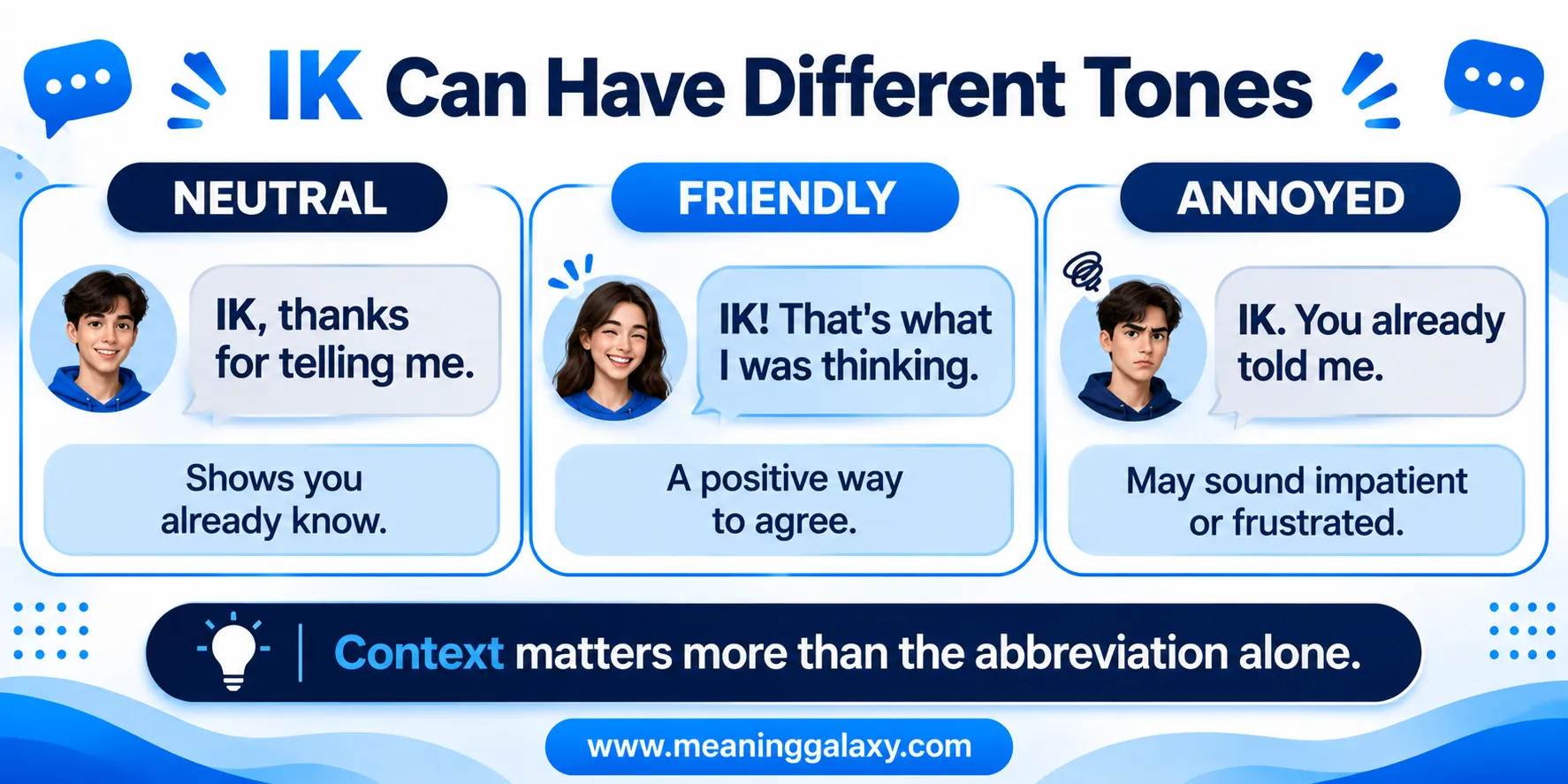
The following examples demonstrate how the surrounding words can influence the tone.
Tone: Friendly
Example: “IK! I’m happy for you.”
Meaning: The sender acknowledges something and responds positively.
Tone: Playful
Example: “IK 😂 You don’t have to remind me.”
Meaning: The sender responds casually, possibly joking about the reminder.
Tone: Serious
Example: “IK, and I’m working on fixing it.”
Meaning: The sender acknowledges the issue and explains what they are doing.
Tone: Supportive
Example: “IK it’s difficult, but you’ll get through it.”
Meaning: The sender recognizes the difficulty and offers encouragement.
Tone: Frustrated
Example: “IK! Stop telling me again.”
Meaning: The additional words suggest that the sender is becoming impatient.
Tone: Sarcastic
Example: “IK, obviously.”
Meaning: Depending on the situation, this may sound sarcastic or dismissive.
Remember that these tones come from the complete message, not from IK alone.
What Does IK Mean in Different Contexts?
The same abbreviation can fit different conversations without changing its basic definition.
Positive Context
In a positive conversation, IK can acknowledge good news or something exciting.
Example:
- Friend: “You finally got the tickets!”
- You: “IK! I’m so excited.”
The sender already knows about the tickets and expresses excitement.
Neutral Context
A neutral use simply acknowledges information.
Example:
- Friend: “The store closes at 9.”
- You: “IK.”
There is no obvious strong emotion in this response.
Negative or Critical Context
IK can appear in conversations involving frustration or disagreement.
Example:
- Person 1: “You should have checked the instructions.”
- Person 2: “IK, I made a mistake.”
The sender acknowledges the point. The full exchange gives the response a more serious feeling.
Ambiguous or Dry Context
A very short response can sometimes be difficult to interpret.
Example:
- Friend: “I told you this yesterday.”
- You: “IK.”
The sender might simply acknowledge the reminder, or the response might sound slightly impatient.
Without additional context, it is difficult to know the exact intention.
How IK Is Used in Real Conversations
Here are some original examples showing how IK fits into different everyday situations.
Asking for Clarification or Explaining a Point
Person A: “You know we have a test tomorrow, right?”
Person B: “IK, I’ve already started studying.”
Meaning: Person B already knows about the test and confirms that they are preparing.
Reacting to Something
Person A: “That restaurant is always crowded.”
Person B: “IK! We should go earlier next time.”
Meaning: Person B agrees that the restaurant is usually busy and suggests a different plan.
Friends or Dating Conversations
Person A: “You always make me laugh.”
Person B: “IK haha 😂”
Meaning: Person B responds playfully. The message alone does not establish romantic interest.
Group Chats and Online Communities
Friend 1: “Our team has another match this weekend.”
Friend 2: “IK, we need to practice.”
Friend 3: “Same, let’s plan something.”
Meaning: Friend 2 already knows about the match and acknowledges the need to prepare.
What Does IK Mean on Different Platforms?
IK generally keeps its basic meaning across messaging and social media platforms: “I Know.
The platform does not automatically give it a different definition. What changes is the conversation in which someone uses it.
IK Meaning on Snapchat
On Snapchat, IK can be used in private chats and casual conversations.
Example:
Friend: “You remember we’re meeting tomorrow?”
You: “IK!”
Meaning: You already know about the meeting.
IK Meaning on TikTok
On TikTok, someone may use IK in comments or discussions to acknowledge something in a video.
Example:
Comment: “Every student knows this struggle.”
Reply: “IK 😭”
Meaning: The person relates to the situation and already understands the experience being described.
IK Meaning on Instagram
On Instagram, IK can appear in direct messages and comments.
Example:
Friend: “Your favorite artist just posted!”
You: “IK! I already saw it.”
Meaning: You already know about the new post.
IK Meaning in Text Messages
In ordinary texting, IK is used as a short response to information, reminders, or familiar situations.
Example:
- Friend: “Don’t forget to bring your charger.”
- You: “IK, it’s already in my bag.”
The reply confirms that you remember.
IK Meaning on Discord or Other Communities
On Discord, IK can be used in casual text channels, private messages, and group conversations.
Example:
- Player 1: “The next game starts in five minutes.”
- Player 2: “IK, I’m ready.”
Meaning: Player 2 already knows when the game starts.
These are illustrative examples of how the abbreviation can fit into different settings, not claims that any platform has a unique IK definition.
When to Use and When to Avoid IK
Although IK is easy to understand, it is not suitable for every situation.
When to Use IK
Use IK when:
- Talking casually with friends.
- Replying to someone who shares familiar information.
- Acknowledging a reminder.
- Participating in informal group chats.
- Responding to everyday social media conversations.
Example:
“IK, I’ll be there in 10 minutes.”
This sounds natural in a casual conversation.
When to Avoid IK
Avoid using IK when:
- Writing formal emails.
- Communicating with clients or managers in professional situations.
- Responding to sensitive personal issues where a brief reply might sound dismissive.
- Speaking with someone who may not understand internet abbreviations.
In these situations, writing the complete phrase is usually more appropriate.
Professional Alternatives to IK
If you are communicating in a workplace or academic setting, consider these alternatives.
| Casual Expression | Professional Alternative |
| IK | I understand. |
| IK already | Yes, I am aware. |
| IK what you mean | I understand your point. |
| IK, thanks | Yes, thank you for letting me know. |
Example:
Casual: “IK, I’ll send it today.”
Professional: “I understand. I’ll send it today.”
The professional version communicates the same acknowledgment more clearly and politely.
Misunderstandings or Potentially Inappropriate Uses of IK
Even though IK has a simple meaning, people can sometimes misunderstand its tone.
Here are some common mistakes to avoid.
1. Assuming IK always means agreement
Someone can know something without agreeing with it.
For example, “IK, but I disagree” shows awareness without agreement.
2. Thinking IK always sounds rude
A short response may look blunt, but it is not automatically disrespectful.
3. Confusing IK with IKR
IK means “I Know,” while IKR means “I Know, Right?” They have related meanings but are not interchangeable in every sentence.
4. Assuming IK expresses anger
A person might simply be acknowledging information. Look at the rest of the message before interpreting their mood.
5. Using IK in every situation
Informal abbreviations are not always appropriate in professional or sensitive conversations.
Variations and Forms of IK
IK can appear in different written forms. These variations generally do not change its main definition.
Lowercase Form: ik
The lowercase form is common in casual digital writing.
Example: “ik what you mean.”
It still means “I know.”
Uppercase Form: IK
Uppercase letters are another common way to write the abbreviation.
Example: “IK, I already heard about it.”
Capitalization does not create a different definition.
Mixed Capitalization: Ik
Some people write the abbreviation as “Ik” rather than “IK” or “ik.”
Example: “Ik, that’s true.”
It still represents the same phrase.
Punctuation and Emojis
Punctuation and emojis can influence how the response feels.
| Written Form | Possible Interpretation |
| IK | Simple acknowledgment |
| IK! | More emphasis |
| IK 😂 | Playful or humorous |
| IK 😭 | Emotional or relatable reaction |
| IK… | Possibly hesitant or dry |
| IK. | May sound brief or neutral |
These interpretations are not fixed rules. The conversation determines the intended tone.
IK vs. Similar Slang Terms
IK is sometimes confused with other texting abbreviations because they share similar letters or conversational purposes.
Understanding the differences makes digital communication easier.
IK vs. IKR
- IK: I Know.
- IKR: I Know, Right?
IK acknowledges information, while IKR commonly expresses agreement or shared recognition.
Example:
Person A: “This movie is amazing.”
Person B: “IK!”
Person C: “IKR! I love it.”
IK vs. IDK
- IK: I Know.
- IDK: I Don’t Know.
These abbreviations communicate opposite ideas.
Example:
Person A: “Do you know where Sarah is?”
Person B: “IK, she’s at home.”
Another possible response:
Person C: “IDK, I haven’t seen her.”
IK vs. IMO
- IK: I Know.
- IMO: In My Opinion.
IK acknowledges existing knowledge, while IMO introduces a personal viewpoint.
Example:
“IK the game is popular, but IMO the older version was better.”
IK vs. TBH
- IK: I Know.
- TBH: To Be Honest.
TBH introduces an honest or direct statement.
Example:
“IK you’re busy, but TBH I wanted to talk to you.”
IK vs. OFC
- IK: I Know.
- OFC: Of Course.
IK communicates awareness, while OFC usually communicates agreement, certainty, or that something is expected.
Example:
Person A: “You know how to use this app?”
Person B: “OFC!”
Quick Comparison Table
| Term | Full Form | Main Purpose |
| IK | I Know | Acknowledge information |
| IKR | I Know, Right? | Express agreement |
| IDK | I Don’t Know | Show uncertainty |
| IMO | In My Opinion | Share an opinion |
| TBH | To Be Honest | Introduce an honest statement |
| OFC | Of Course | Express certainty or agreement |
How to Understand the Correct Meaning of IK
If someone sends you IK and you are unsure what they mean, use these simple steps.
- Start with the standard meaning: Assume IK means “I Know” in an ordinary text conversation.
- Read the entire message: Look at the words before and after the abbreviation.
- Consider the previous conversation: Think about what information the other person is responding to.
- Consider your relationship: A close friend might use short replies more casually than a professional contact.
- Check the emotional context: Is the conversation funny, serious, supportive, or frustrating?
- Look at additional signals: Emojis, punctuation, and capitalization may provide useful clues.
- Ask if necessary: If you genuinely cannot understand the reply, politely ask what the person means.
For example, if someone responds “IK 😂” after you share a funny experience, the emoji and previous message help explain the reaction.
How to Respond When Someone Uses IK
Your response depends on what the other person is acknowledging.
You do not always need to reply to IK, especially if it simply completes the conversation.
However, if you want to continue chatting, here are some natural responses.
Casual Replies
Sender: “IK, that place is expensive.”
Possible reply: “Haha, definitely!”
Why it works: It keeps the conversation relaxed.
Sender: “IK, we need to leave soon.”
Possible reply: “Let’s get ready then.”
Why it works: It moves the conversation forward.
Friendly Replies
Sender: “IK! That’s why I love this song.”
Possible reply: “Same! It’s so good.”
Why it works: It acknowledges their enthusiasm and shares a similar feeling.
Serious or Respectful Replies
Sender: “IK, I made a mistake.”
Possible reply: “It’s okay. We can figure it out.”
Why it works: It responds to the actual situation rather than focusing on the abbreviation.
When You Are Unsure What They Mean
Sender: “IK.”
Possible reply: “Got it. Just wanted to make sure.”
Why it works: It acknowledges their response without assuming a negative intention.
Common Misunderstandings About IK
Here are a few additional points worth remembering:
- IK does not mean “I Know, Right?” That is IKR.
- IK does not mean “I Don’t Know.” That is IDK.
- IK is not automatically rude or disrespectful.
- IK does not always indicate agreement.
- IK does not prove that someone is annoyed, interested, or flirting.
- IK generally keeps the same basic meaning across casual messaging platforms.
The best way to interpret it is to consider the complete conversation rather than focusing on two letters.
Regional and Cultural Usage of IK
IK is recognized as English-language internet shorthand for “I Know.” Its use is associated with informal digital communication rather than a particular geographic location.
There is not enough evidence here to establish a specific country or region as its place of origin.
People may recognize the abbreviation differently depending on their familiarity with English texting conventions and online communication.
In a formal or multilingual conversation, spelling out “I know” may be clearer than using IK.
Frequently Asked Questions About IK
1. What does IK mean in text?
IK means “I Know.” It is an informal abbreviation used in texting and online conversations when someone already knows or understands something.
2. What does IK mean in text messages?
In text messages, IK is a short way to acknowledge information or respond to something familiar. For example, “IK, I’ll be there” means “I know, I’ll be there.”
3. Does IK have another meaning?
Yes. In technical fields, IK can stand for Inverse Kinematics, particularly in animation and computer graphics. However, in ordinary texting, its main meaning is “I Know.”
4. Is IK the same as IKR?
No. IK means “I Know,” while IKR means “I Know, Right?” IK acknowledges information, whereas IKR commonly expresses agreement or shared recognition.
5. Is IK sarcastic or serious?
It can be either, depending on the surrounding conversation. A simple “IK” may be neutral, while “IK, obviously” could sound sarcastic.
6. What does IK mean on Snapchat?
On Snapchat, IK generally means “I Know.” Someone might use it in a private chat to acknowledge information or show that they already understand something.
7. Is IK appropriate to use at work?
IK is generally better suited to informal workplace chats with familiar colleagues. In professional emails and formal communication, use “I know,” “I understand,” or “I’m aware” instead.
8. How should I reply when someone says IK?
You can respond naturally based on the conversation. For example, if someone says “IK, that’s amazing,” you could reply, “Right? It’s exciting!” You may also leave the conversation there if no further response is needed.
Conclusion
IK means “I Know” in texting and everyday online communication. It is a simple abbreviation people use to acknowledge information, show understanding, or respond quickly in casual conversations.
Although its basic meaning stays the same, its tone can change depending on the message. It might sound friendly, playful, neutral, or occasionally impatient. The best way to understand it is to read the complete conversation instead of assuming what the sender feels.
Quick reminder: IK means “I Know,” IKR means “I Know, Right?” and IDK means “I Don’t Know.” Knowing the difference makes texting abbreviations much easier to understand.

Welcome to Meaning Galaxy! I’m Muhammad Talha, a language enthusiast and meaning explorer dedicated to helping people discover the true meanings behind words, names, phrases, and concepts.
I help users understand words better, explore hidden meanings, and learn new information in a simple and easy way. My goal is to make learning meanings interesting, clear, and accessible for everyone.
Let’s explore the world of words together!