
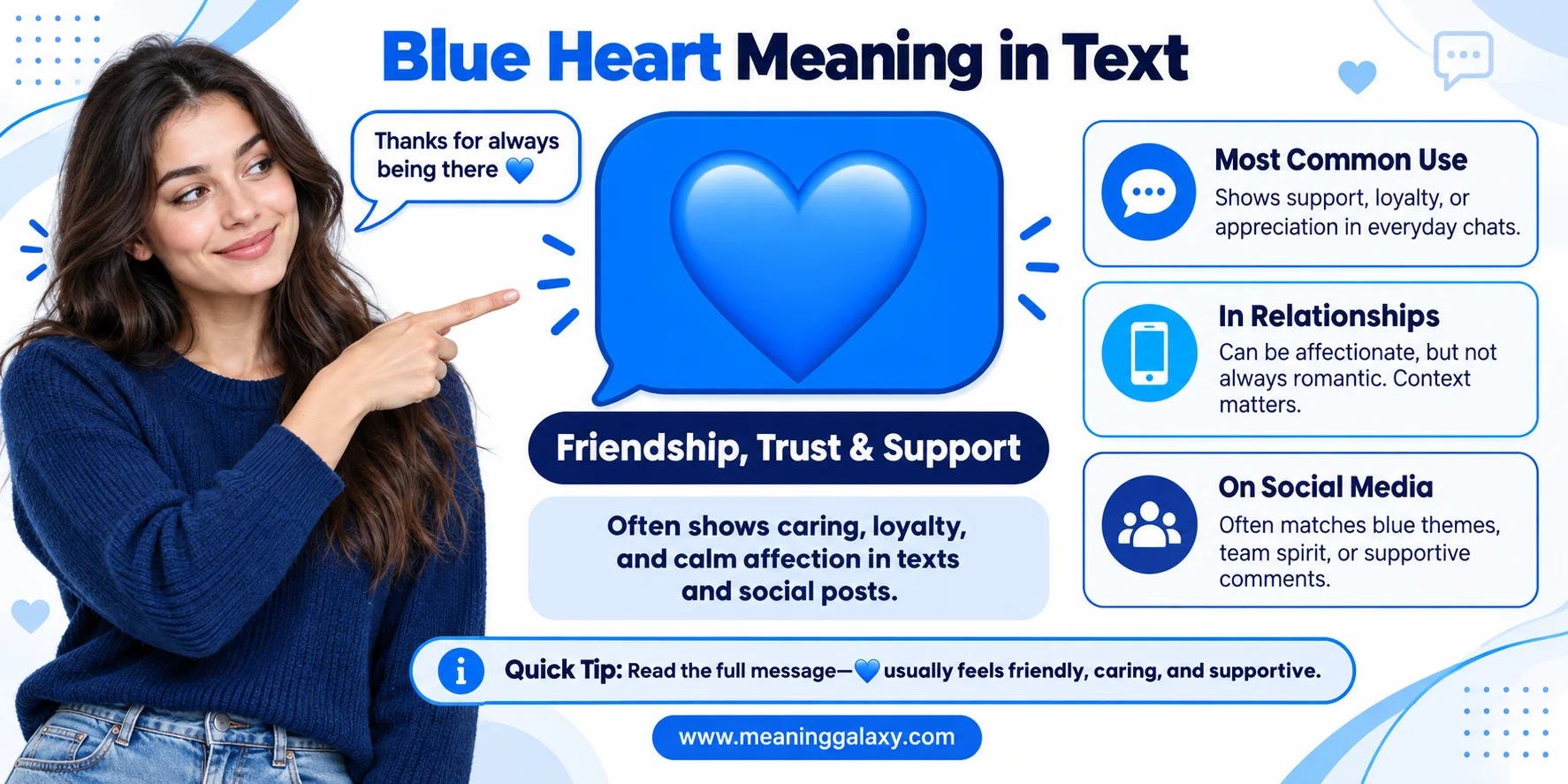
The blue heart emoji 💙 usually expresses trust, friendship, support, loyalty, or calm affection. Unlike the classic red heart ❤️, it often feels less intensely romantic. Someone may send a blue heart to show they care about you without necessarily saying “I love you” in a romantic way.
Still, 💙 does not have one fixed meaning. It can represent close friendship, emotional support, appreciation, a favorite color, a sports team, or simply match the look of a post.
Its meaning depends on the relationship, conversation, platform, and surrounding words. A 💙 from your best friend may feel completely different from the same emoji sent by someone you are dating.
Blue Heart Emoji – Quick Meaning
The blue heart emoji usually communicates:
- Friendship
- Trust
- Loyalty
- Support
- Caring and affection
- Calm or peaceful feelings
- Platonic love
- Appreciation
- Team or brand support
- Sympathy in some situations
The overall tone of 💙 is usually positive, supportive, and affectionate.
Compared with ❤️, the blue heart often feels calmer and more neutral. It can show genuine care without making the conversation strongly romantic.
However, people use emojis differently. A person who loves the color blue may use 💙 for almost everything. Someone else may reserve it for close friends or family members.
Quick Examples of the Blue Heart Emoji
Here are a few realistic ways people may use 💙 in messages.
Example 1
Person A: “Thanks for listening to me last night.”
Person B: “Anytime. I’m always here for you 💙”
Here, the blue heart communicates emotional support and friendship.
Example 2
Person A: “I passed my final exam!”
Person B: “I knew you could do it 💙”
The emoji adds encouragement and affection.
Example 3
Person A: “Hope you get home safely.”
Person B: “I will. Thank you 💙”
In this case, 💙 shows appreciation and warmth.
Example 4
Person A: “Game tonight! Let’s go!”
Person B: “Blue all the way 💙”
The blue heart may represent support for a team associated with the color blue.
Example 5
Person A: “Goodnight 💙”
Person B: “Sleep well 💙”
This could be friendly or romantic depending on the relationship between the two people.
Origin & Background of the Blue Heart Emoji
Where Did the Blue Heart Emoji Come From?
The official Unicode name of 💙 is Blue Heart. Its code point is U+1F499.
The blue heart was approved as part of Unicode 6.0 in 2010 and later included in Emoji 1.0 in 2015. Unicode records also show the blue heart among the colored heart symbols considered during the development of standardized emoji characters.
Unicode standardization defines the character so that phones, websites, and apps can recognize it. It does not assign every social or emotional interpretation people later develop around an emoji.
How Did 💙 Become Popular?
As emoji use expanded, colored hearts gave people more ways to express affection without relying only on the traditional red heart.
The blue heart became useful because blue is associated with many different people, organizations, interests, and visual themes. Emojipedia notes that 💙 is commonly used to express appreciation or affinity for people, places, groups, objects, and ideas connected with the color blue.
Over time, users also developed informal interpretations involving friendship, loyalty, support, and non-romantic affection.
Social Media Influence
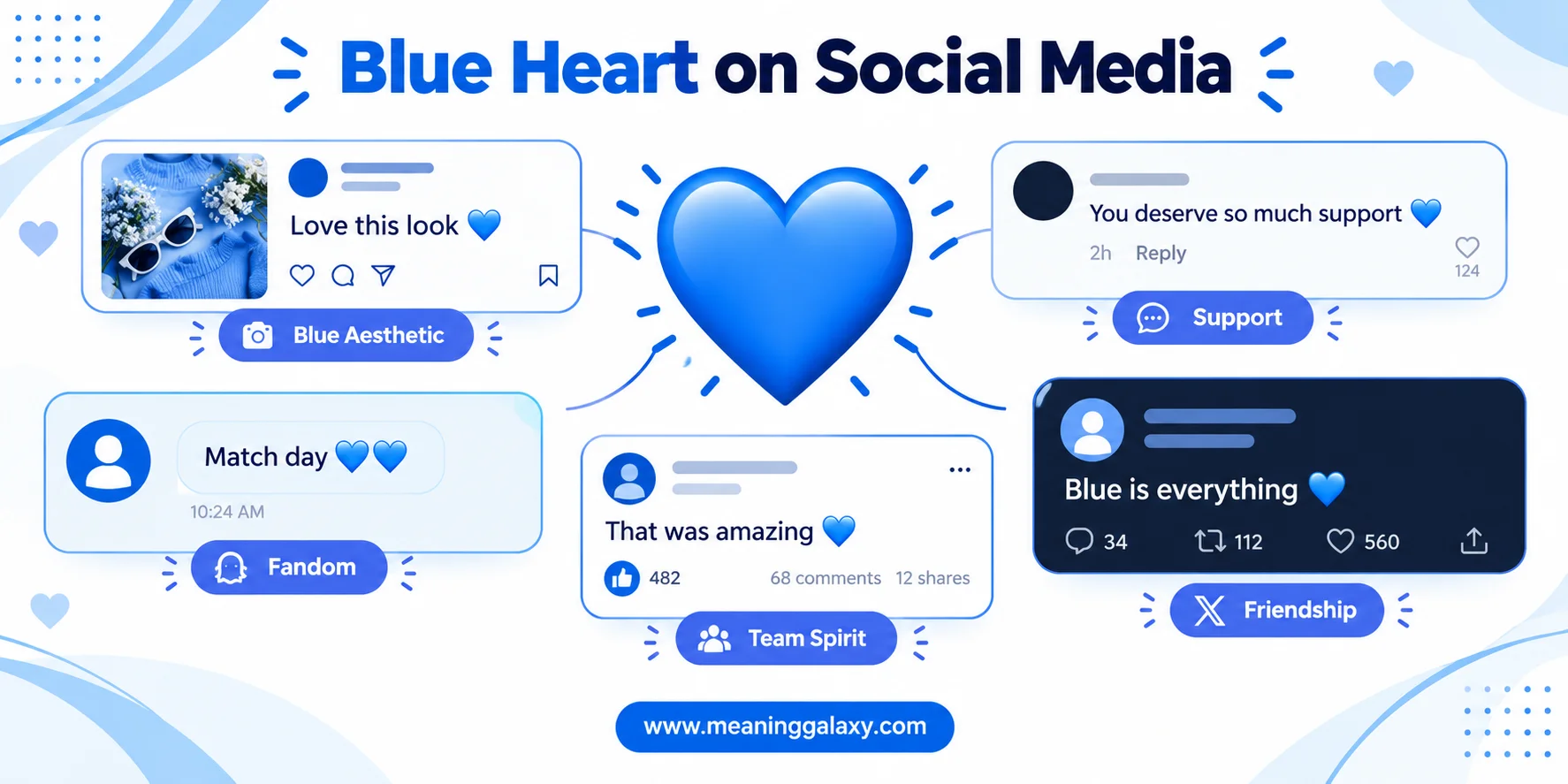
Instagram, TikTok, Snapchat, Facebook, and X have made colored hearts especially flexible.
A creator might use 💙 because it matches a photo. A fan might use it for a sports team. Friends may use it to show support. A brand with blue colors might use it throughout its posts.
This is why color alone cannot reveal the sender’s exact intention.
Blue Heart Emoji in Real-Life Conversations
In Text Messages
In normal texting, 💙 often makes a message feel warmer.
For example:
“Thanks for always having my back 💙”
The most likely interpretation is loyalty, friendship, or appreciation.
It could also come from a romantic partner, but nothing about the blue heart automatically makes the message romantic.
On WhatsApp
WhatsApp users may send 💙 to friends, relatives, partners, or group members.
For example:
“Hope you feel better soon 💙”
Here, the heart adds care and emotional support.
In a family group chat, it may simply mean love and concern without any romantic meaning.
On Instagram
The blue heart can appear in captions, comments, Stories, and direct messages.
For example:
“Love this outfit 💙”
The sender may be complimenting the person, matching the blue outfit, or simply using a favorite heart color.
On Instagram, visual appearance often matters as much as emotional meaning.
On TikTok
TikTok users frequently combine emojis for humor, trends, fandoms, aesthetics, and reactions.
A comment such as:
“You deserve so much support 💙”
usually communicates encouragement.
However, emoji meanings can shift inside specific communities or trends, so the video and surrounding comments matter.
On Snapchat
A blue heart sent in a Snapchat conversation can communicate warmth, closeness, or support.
For example:
“That was so funny yesterday 💙😂”
Here, the emoji feels playful and friendly rather than serious or romantic.
Related post : https://meaninggalaxy.com/nd-meaning-in-text/
Emotional Meaning of the Blue Heart Emoji
The blue heart emoji can carry several emotional tones.
Friendship and Platonic Love
One of its most common interpretations is close friendship.
A message like:
“You’re seriously the best 💙”
can show affection without the stronger romantic association commonly attached to ❤️.
Trust and Loyalty
Blue is often informally associated with trust and stability, so some users choose 💙 when expressing loyalty.
For example:
“I know I can always count on you 💙”
The emoji strengthens the supportive tone.
Emotional Support
Someone may send 💙 when comforting a friend.
“Don’t give up. You’ve got people who care about you 💙”
Here, the heart feels reassuring and compassionate.
Calm Affection
The blue heart can feel softer or calmer than a red heart.
It may communicate:
“I care about you.”
rather than:
“I’m passionately in love with you.”
That distinction is not universal, but it explains why people sometimes choose blue when they want warmth without intense romance.
Personal Scenario
Imagine telling your close friend that you finally got the job you wanted.
They reply:
“I’m so proud of you 💙”
In this situation, the blue heart likely shows genuine happiness, support, and affection. There is little reason to assume romance unless your relationship already includes romantic signals.
Blue Heart Emoji Meaning in Different Contexts
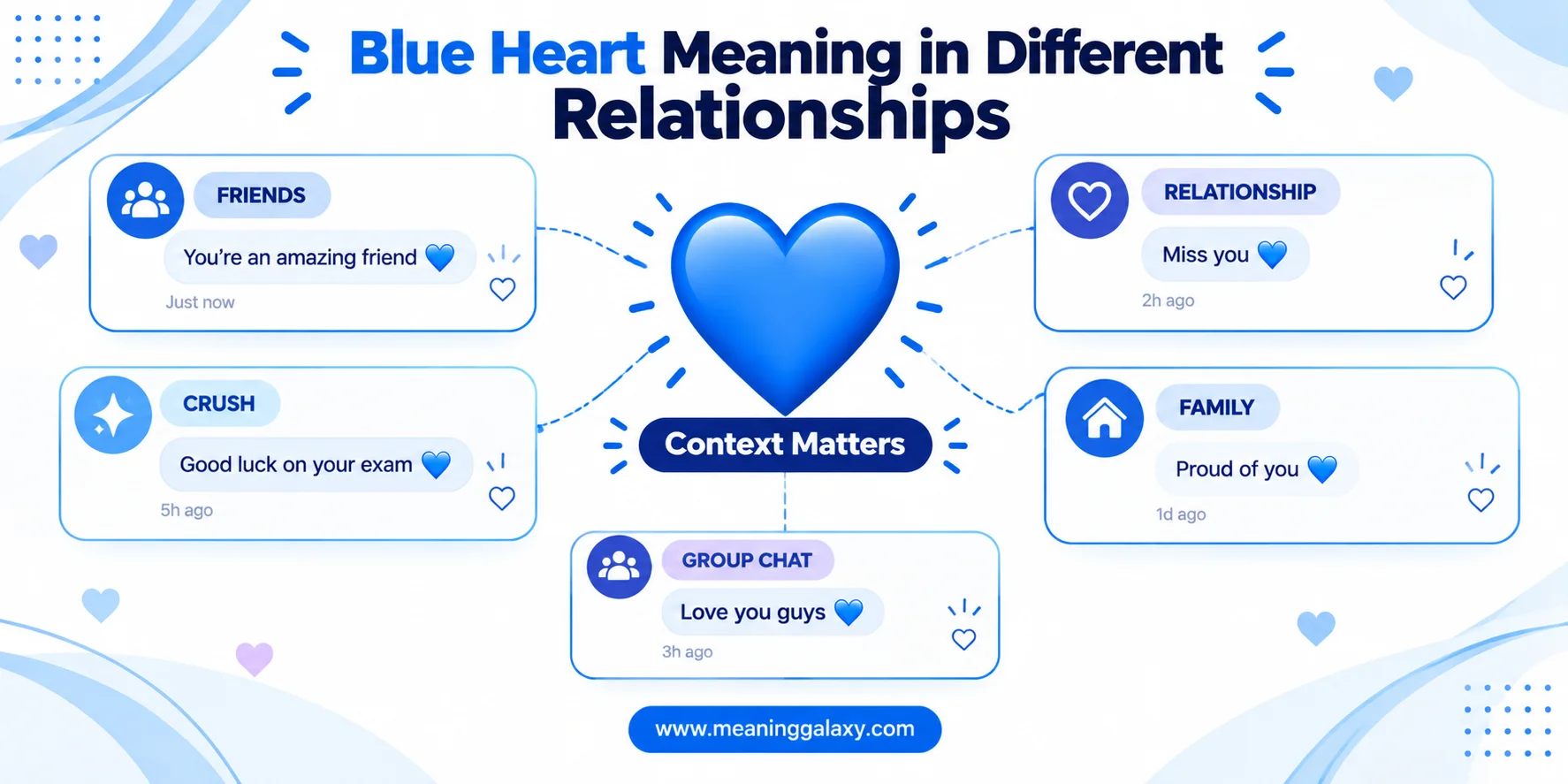
Between Friends
Among friends, 💙 commonly represents affection, loyalty, appreciation, and support.
“Love you bro 💙”
or
“You’re an amazing friend 💙”
usually feels platonic.
In a Relationship
Romantic partners can absolutely use blue hearts.
A partner sending:
“Miss you 💙”
may be showing romantic affection.
Some couples simply have favorite heart colors. Others use different colors for different moods.
The relationship matters more than the emoji color.
From a Crush
Receiving 💙 from a crush can feel meaningful, but it does not prove attraction.
For example:
“You looked great today 💙”
could be flirtatious.
But:
“Good luck with your exam 💙”
may simply be friendly encouragement.
Look at the whole conversation rather than treating one emoji as evidence.
From a Guy
A blue heart from a guy can mean friendship, affection, support, appreciation, or romantic interest.
Gender does not give the emoji a fixed definition.
A message like:
“Glad you made it home safely 💙”
shows care, but whether that care is romantic depends on the relationship and other signals.
From a Girl
The same principle applies when a girl sends 💙.
It may communicate friendship, closeness, affection, encouragement, or flirting.
For example:
“You’re actually really sweet 💙”
could feel flirty in an ongoing romantic conversation, while the same heart in a group chat may simply be friendly.
Family Conversations
Family members may use the blue heart to express love and support.
“Proud of you, son 💙”
has an affectionate family meaning rather than a romantic one.
Group Chats
In group chats, 💙 often functions as a quick positive reaction.
People may use it to say:
- Thank you
- I agree
- I appreciate this
- Sending support
- Love you guys
Casual vs Serious Use
A casual message might say:
“That blue jacket is perfect 💙”
Here, the emoji may simply match the color.
A more emotional message might say:
“Whatever happens, I’m here for you 💙”
In this context, it communicates stronger emotional support.
The same emoji can therefore move from decorative to deeply meaningful depending on the surrounding words.
When Not to Use the Blue Heart Emoji
The blue heart is usually harmless, but it may not fit every conversation.
Formal Business Messages
A 💙 may feel too personal in a formal email to a new client, manager, professor, or professional contact.
“Please review the attached contract 💙”
would usually be less appropriate than a neutral closing.
Serious Professional Communication
Avoid relying on emojis when discussing contracts, disputes, disciplinary issues, legal matters, or other serious topics where clarity matters.
Sensitive Relationships
If you are communicating with someone who may interpret hearts romantically, think about whether a heart emoji could create confusion.
A simple smile or straightforward sentence may sometimes be clearer.
Serious Emotional Situations
A blue heart can show sympathy and support, but words are usually more meaningful than sending an emoji alone.
Instead of only:
“💙”
you might write:
“I’m thinking about you and your family 💙”
Common Misunderstandings About 💙
It Doesn’t Always Mean the Friend Zone
Some people assume the blue heart means “friends only.”
That is too simplistic.
Friends commonly use it, but couples and people who are flirting can use it too.
It Doesn’t Automatically Mean Romantic Love
A blue heart is still a heart, but that does not make every use romantic.
Someone sending:
“Thanks for helping me 💙”
may simply be showing appreciation.
Color Can Be the Main Reason
Sometimes the meaning is not emotional at all.
A person might post:
“Match day 💙💙💙”
because their team’s colors are blue.
Someone might also use it because their clothes, artwork, profile theme, or favorite color is blue.
Tone Matters More Than a Single Emoji
Compare:
“You’re such a good friend 💙”
with:
“Can’t stop thinking about you tonight 💙”
The same emoji appears in both, but the surrounding words create very different interpretations.
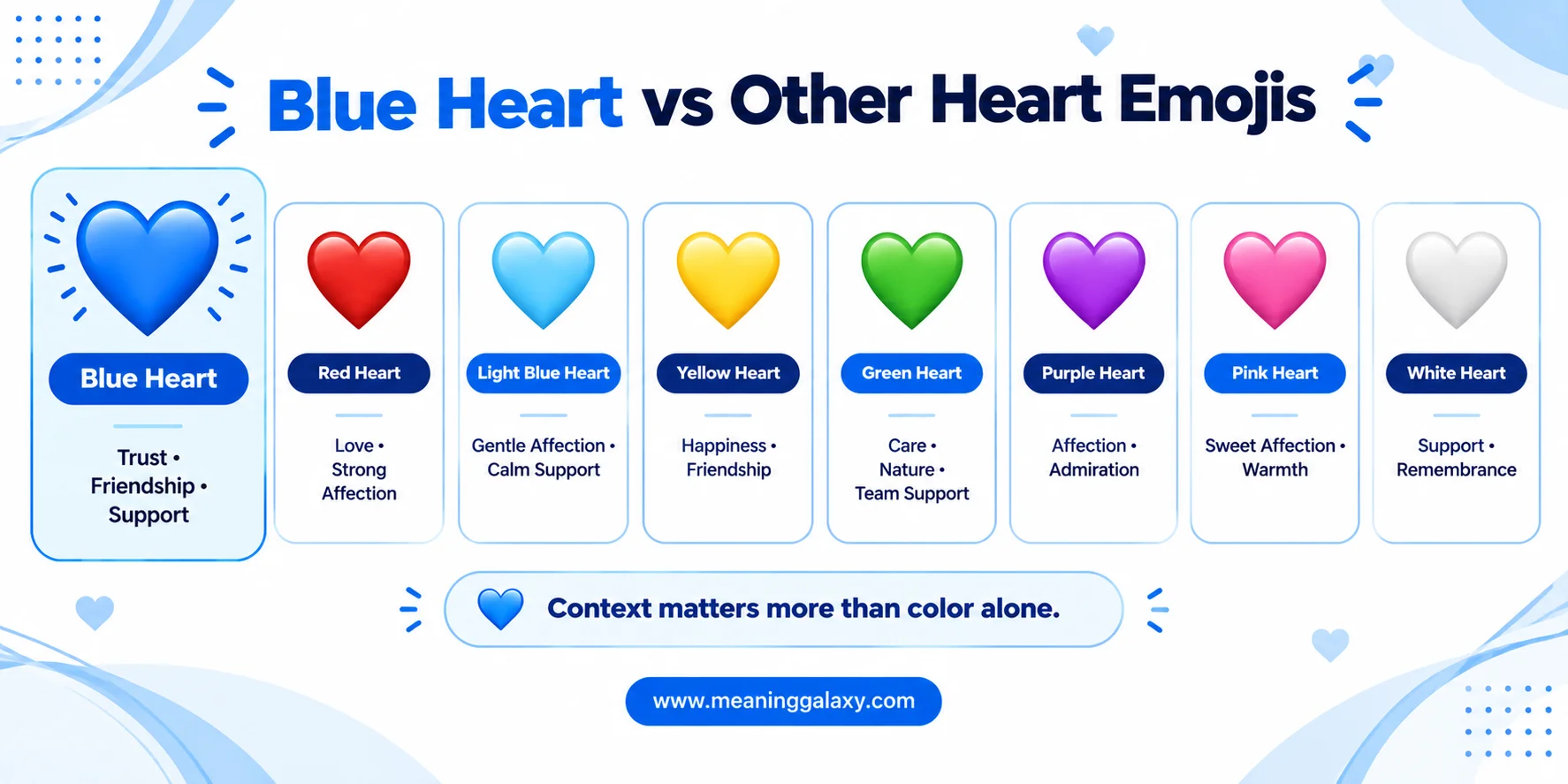
Blue Heart Emoji Comparison Table
| Emoji | Common Meaning | Typical Tone | Best Used For |
| 💙 Blue Heart | Trust, friendship, support, affection | Calm, supportive | Friends, encouragement, loyalty |
| ❤️ Red Heart | Love, strong affection | Warm, passionate | Romance, family, strong love |
| 🩵 Light Blue Heart | Gentle affection, calm support | Soft, peaceful | Friendship, caring messages |
| 💛 Yellow Heart | Happiness, friendship, positivity | Cheerful | Friends, appreciation |
| 💚 Green Heart | Care, nature, green-themed support | Friendly, varied | Nature, friendship, teams |
| 💜 Purple Heart | Affection, admiration, purple-themed interests | Warm, expressive | Friends, fandoms, aesthetics |
| 🩷 Pink Heart | Sweet affection, love, warmth | Cute, affectionate | Romance, friendship |
| 🤍 White Heart | Love, support, remembrance | Gentle, sincere | Sympathy, affection, support |
Key Insight: The blue heart usually feels calmer and more friendship-oriented than ❤️, but heart colors do not follow strict rules. Personal habits and context remain more important than the color itself.
Variations & Similar Terms
🩵 Light Blue Heart
The light blue heart has a softer appearance than 💙. People may use it for gentle affection, calmness, friendship, or a pastel aesthetic.
❤️ Red Heart
The red heart is more strongly associated with love and deep affection. It is often used romantically, though friends and family use it too.
💛 Yellow Heart
The yellow heart frequently feels cheerful and friendly. It works well for happiness, appreciation, and positive friendship.
💜 Purple Heart
The purple heart can express affection or admiration and is also frequently chosen for visual themes, fandoms, or anything associated with purple.
💙💙 Multiple Blue Hearts
Using several blue hearts generally adds emphasis.
“Thank you so much 💙💙💙”
may communicate stronger appreciation, excitement, or support. It does not automatically change the message from friendly to romantic.
How to Respond to a Blue Heart Emoji
Your response should match the relationship and tone of the conversation.
Casual Replies
- “Thanks 💙”
- “You too!”
- “Appreciate you 💙”
Friendly Replies
- “Always here for you 💙”
- “You’re the best.”
- “Much love 💙”
Funny Replies
- “Look at us getting emotional 😂💙”
- “Blue heart officially accepted.”
- “Right back at you 😂💙”
Flirty Replies
If the conversation is already romantic, you might respond with:
- “Sending one right back 💙”
- “You’re making me smile now.”
- “Only one heart? 😏💙”
Do not assume flirting is appropriate solely because someone sent the emoji.
Mature or Respectful Replies
- “Thank you. That means a lot.”
- “I really appreciate your support.”
- “That’s very kind of you 💙”
Regional and Cultural Usage
The blue heart emoji is used globally, but there is no single worldwide rule defining what it means in every culture or online community.
In U.S. online communication, 💙 commonly appears in friendly messages, supportive comments, sports-related posts, brand content, and affectionate conversations.
Other online communities may develop their own associations with blue because of local teams, organizations, fandoms, causes, or social trends.
The safest approach is to consider how the individual sender normally communicates rather than assuming their nationality or culture determines the meaning.
Blue Heart Emoji: Gen Z vs Millennials
Both Gen Z and Millennials use heart emojis, although individual habits vary widely.
Gen Z users may combine 💙 with other emojis, use it ironically, match it to an aesthetic, or include it in short reactions on TikTok, Instagram, Snapchat, and group chats.
Millennial users may be more likely to use it in direct supportive messages, comments, captions, or conversations with friends and family.
These are broad online patterns rather than fixed rules. Age alone cannot tell you what a person’s emoji means.
Is the Blue Heart Emoji Safe for Kids?
The blue heart emoji itself is generally harmless. Its standard character does not contain an explicit, sexual, or offensive meaning.
Children and teenagers may use 💙 to represent friendship, affection, support, favorite colors, teams, games, fandoms, or social-media aesthetics.
However, like almost any emoji, its meaning can depend on the conversation surrounding it.
Parents who are unsure about a particular message should look at the full conversation rather than judging one emoji in isolation.
FAQs
What does the blue heart emoji mean in a text?
The blue heart emoji usually expresses friendship, trust, loyalty, support, appreciation, or calm affection. Its exact meaning depends on who sent it and what the conversation is about.
What does 💙 mean from a guy?
A guy may use 💙 to show friendship, support, affection, appreciation, or romantic interest. The emoji alone does not prove that he likes someone romantically.
What does 💙 mean from a girl?
A girl may send 💙 as a friendly, affectionate, supportive, or potentially flirty gesture. Look at her words and the overall relationship for context.
Is the blue heart romantic?
It can be romantic, especially between partners or people who are already flirting. However, it is also commonly used between friends and family members.
Does a blue heart mean friendship?
Friendship is one common interpretation of 💙. It can represent loyalty, support, and platonic affection, but it is not exclusively a friendship emoji.
What does a blue heart mean on Instagram?
On Instagram, 💙 can express support, appreciation, friendship, or affection. It may also simply match a blue outfit, photo, brand, sports team, or visual theme.
What is the difference between 💙 and ❤️?
The red heart ❤️ tends to carry a stronger association with love and intense affection. The blue heart 💙 often feels calmer, more supportive, or more platonic. Neither meaning is absolute.
How should I respond when someone sends 💙?
Match the tone of the conversation. You can reply with another 💙, say “thank you,” send a different heart, or respond with words that reflect your relationship with the sender.
Conclusion
The blue heart emoji 💙 most commonly expresses friendship, trust, loyalty, support, appreciation, and caring affection. It often feels less intensely romantic than a red heart, which makes it popular between friends, family members, online communities, and people offering emotional support.
However, 💙 can also appear in romantic conversations, sports posts, social-media aesthetics, brand content, or messages connected to the color blue.
No single interpretation works in every situation. Look at the sender, your relationship, the surrounding words, and the conversation’s tone. A blue heart can carry emotion, but context is what gives that emotion its real meaning.

Welcome to Meaning Galaxy! I’m Muhammad Talha, a language enthusiast and meaning explorer dedicated to helping people discover the true meanings behind words, names, phrases, and concepts.
I help users understand words better, explore hidden meanings, and learn new information in a simple and easy way. My goal is to make learning meanings interesting, clear, and accessible for everyone.
Let’s explore the world of words together!
4 thoughts on “Blue Heart Emoji 💙 Meaning: What Does It Really Mean?”