
Imagine opening a TikTok comment that says, “Blud really thought he could win 😂” or receiving a message from a friend saying, “What’s up, blud?” You might wonder whether blud is a friendly nickname, a joke, or an insult.
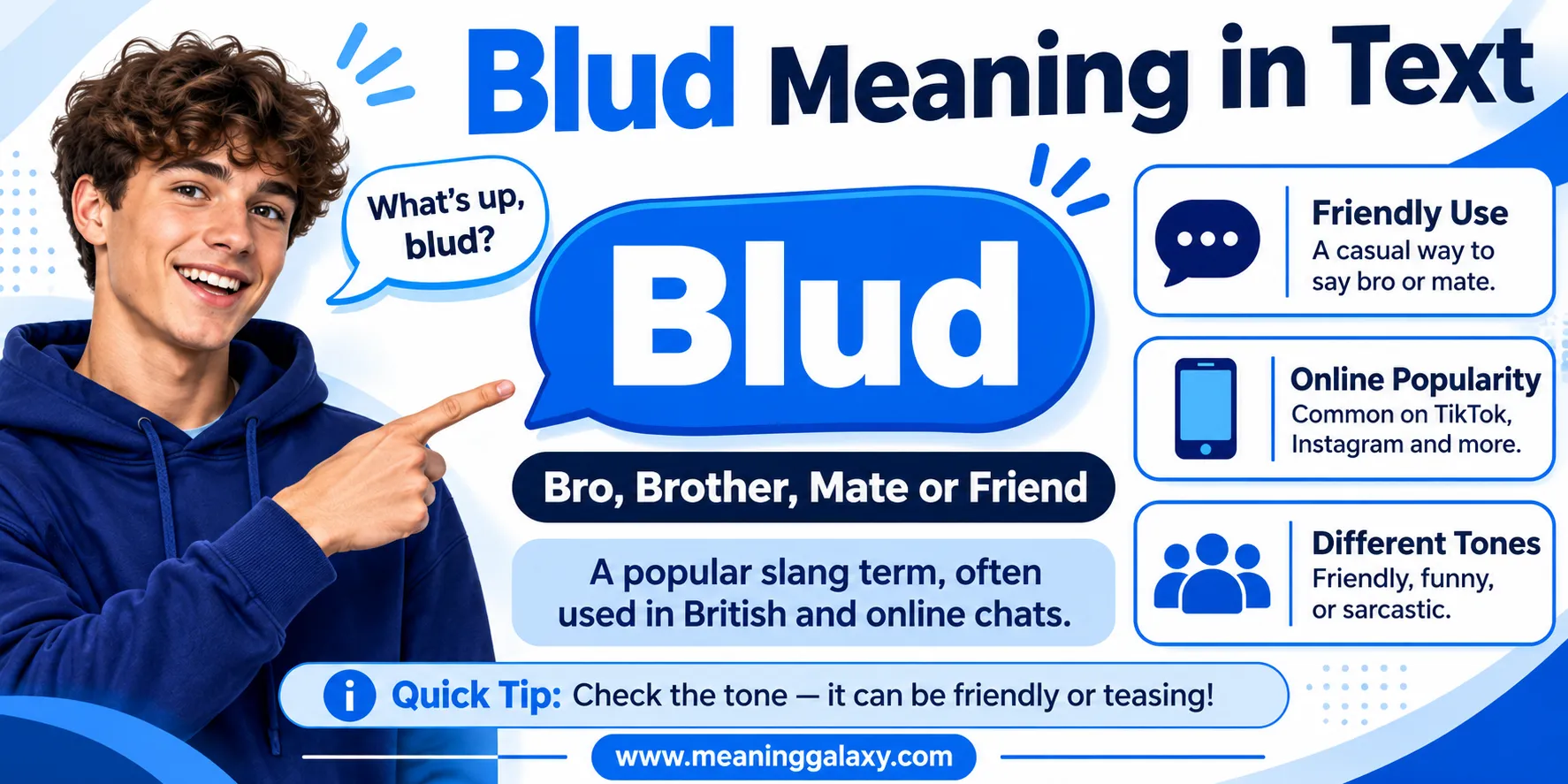
The word blud is popular British internet slang that generally means “bro,” “brother,” “mate,” or “close friend.” However, its meaning can change depending on the conversation, relationship, and tone. Sometimes it expresses friendship, while other times it adds sarcasm or playful criticism.
If you’ve encountered blud on TikTok, Instagram, Snapchat, WhatsApp, Discord, or in text messages, this guide explains its meaning, origins, different uses, and how to respond naturally.
Blud Meaning in Text – Quick Explanation
Blud means “bro,” “brother,” “mate,” or “friend.” It is an informal slang expression commonly associated with British youth language and Jamaican-influenced speech.
People use it to address someone directly or talk about another person in a casual, humorous, or sometimes sarcastic way.
Here is what blud can communicate:
- Friendship: Calling someone a close friend or buddy.
- Familiarity: Addressing someone casually, like saying bro.
- Humor: Making a conversation sound funny or exaggerated.
- Sarcasm: Teasing someone about something they said or did.
- Disbelief: Reacting to someone’s surprising or ridiculous behavior.
- Annoyance: Expressing frustration in certain situations.
Examples of Blud in Text Messages
Here are five examples showing how people use blud in everyday conversations.
| Text message | Meaning |
| What’s up, blud? | What’s up, bro? |
| Thanks for helping me, blud. | Thanks, my friend. |
| Blud is actually hilarious 😂 | That guy is really funny. |
| Blud, what are you doing? | Bro, what are you doing? |
| Who invited blud? 💀 | Who invited that guy? (Usually sarcastic or humorous.) |
The important thing to remember is that blud is not automatically an insult. Its tone depends on how someone uses it.
For example, saying “You good, blud?” to a friend sounds friendly. Saying “Blud doesn’t know what he’s talking about” may sound dismissive or mocking.
Origin and Background of Blud
The slang word blud has cultural roots connected to Jamaican language and British urban speech.
It is generally understood as a variant spelling and pronunciation of blood, a word associated with family relationships, brotherhood, and close friendships.
Jamaican Language and Brotherhood
In Jamaican-influenced speech, expressions connected with blood and brotherhood can communicate a close personal bond.
The term is commonly linked to the idea of blood brothers: people who share a strong connection even when they are not biologically related.
Over time, related forms became part of informal ways of addressing friends and other men.
How Blud Became Popular in the UK
The word became associated with Multicultural London English (MLE), a variety of English influenced by different languages and communities, including Caribbean, African, and British speech traditions.
It became familiar in London’s urban youth culture and spread through music, everyday conversations, and entertainment.
British grime and rap also helped bring expressions like blud into wider public awareness.
For example, the word appears in British music, including Stormzy’s 2015 track Shut Up.
How Social Media Made Blud a Global Slang Word
Social media introduced blud to people who might never have encountered British street slang in everyday life.
Platforms such as TikTok, Instagram, YouTube, and X helped spread the expression through:
- Funny reaction videos.
- British slang compilations.
- Gaming clips.
- Meme captions.
- Viral comment sections.
- Short comedy videos.
By the 2020s, blud had become especially recognizable in internet memes and Gen Z conversations.
Know Your Meme+2
Today, people often use it simply as another way of saying bro, even if they are not from the UK.
Real-Life Conversations Using Blud
Understanding blud becomes easier when you see how it works in actual digital conversations.
Below are some realistic examples inspired by everyday online communication.
WhatsApp Conversation
Alex: Blud, are you coming today?
Sam: Yeah bro, I’ll be there in 10 minutes.
Alex: Hurry up 😂
Sam: Relax, blud!
Meaning: Alex uses blud casually to address his friend. The expression communicates familiarity rather than disrespect.
Tone: Friendly and relaxed.
Instagram DMs
Mia: Blud really posted 20 selfies today 😭
Jake: Let him cook 😂
Mia: I’m just saying!
Meaning: Mia uses blud to refer humorously to another person. She is teasing someone about posting too many pictures.
Tone: Playful and sarcastic.
TikTok Comments
User 1: Blud thinks he’s the main character 💀
User 2: Bro has his own movie at this point.
User 3: Someone stop him 😂
Meaning: The commenters are joking about someone behaving as if they are the center of attention.
Tone: Humorous and teasing.
Text Message Conversation
Ryan: Blud, I forgot my homework again.
Chris: AGAIN? 😭
Ryan: Don’t judge me bro.
Chris: You’re unbelievable, blud.
Meaning: Friends use blud while joking about a repeated mistake.
Tone: Friendly teasing.
Gaming Chat
Player 1: Blud, why did you run into the enemy team?
Player 2: I thought you were covering me!
Player 1: I was healing 😂
Meaning: The players use blud to express surprise and frustration during a game.
Tone: Funny, slightly annoyed, but casual.
Emotional and Psychological Meaning
Blud is more than a casual replacement for the word bro. Depending on the situation, it can communicate different emotions and social signals.
Here are some common interpretations.
1. Friendship and Belonging
When someone calls you blud in a friendly conversation, they may be showing that they feel comfortable around you.
Example: “You’re my blud, always got my back.”
This communicates friendship and loyalty.
2. Affection and Familiarity
Friends sometimes use blud as an informal nickname to make conversations feel relaxed.
Example: “Good morning, blud! Hope you have a great day.”
It creates a familiar and friendly atmosphere.
3. Humor and Playful Teasing
Blud is frequently used in jokes, memes, and funny reactions.
Example: “Blud really thought he could jump over that fence 😂”
The speaker is making fun of someone’s unsuccessful attempt without necessarily intending to hurt them.
4. Sarcasm and Criticism
The expression can also introduce a sarcastic comment.
Example: “Blud has never opened a textbook in his life.”
Here, the speaker is teasing someone about their study habits.
5. Annoyance and Frustration
When someone is irritated, blud can make their reaction sound more direct.
Example: “Blud, can you stop doing that?”
The speaker is frustrated, although the expression itself is not necessarily offensive.
6. Confidence and Group Identity
Using slang can help people feel connected to a particular friendship group or online community.
People who regularly use British internet slang may naturally include blud in their conversations.
However, remember that the sender’s intention and the receiver’s interpretation are not always the same. A joke between close friends may sound disrespectful when used with someone unfamiliar.
Using Blud in Different Contexts
The meaning of blud can change depending on where and why someone uses it. Let’s look at some common situations.
Blud on Social Media
On TikTok, Instagram, and X, blud often appears in comments, captions, and memes.
People use it to react to funny videos, unusual behavior, or unexpected situations.
Example: “Blud really said that with confidence 💀”
Meaning: The person is joking about someone who said something surprising or ridiculous.
Tone: Usually humorous or sarcastic.
Appropriate? Yes, in casual social media interactions.
Blud Between Friends and in Group Chats
Friends may use blud as a casual nickname when chatting, making plans, or joking around.
Example: “Blud, don’t forget we’re meeting at 7.”
Meaning: Bro, remember that we’re meeting at 7.
Tone: Friendly and informal.
Appropriate? Yes, especially among friends who understand the expression.
Blud in Gaming Conversations
Gamers sometimes use blud when reacting to teammates, opponents, or unexpected gameplay.
Example: “Blud just eliminated the entire team!”
Meaning: That player just defeated everyone.
Tone: Excited, humorous, or surprised.
Appropriate? Yes, in informal gaming chats.
Blud in Dating and Relationships
Some couples may use blud jokingly, especially when they already have a playful communication style.
Example:
“Blud forgot our anniversary 😭”
Here, the word adds humor to a complaint.
However, it is not necessarily a romantic nickname. It generally carries a casual, friendly meaning rather than expressing love.
Tone: Playful or teasing.
Appropriate? Depends on the relationship and personal communication style.
Blud at Work and in Professional Settings
Blud is generally too informal for professional communication.
For example:
“Blud, send me that report.”
This might sound disrespectful or overly casual when addressing a manager, client, or colleague.
Instead, use more appropriate expressions such as:
- Could you please send me the report?
- Hey, can you share the document?
- Thanks for your help.
Tone: Informal.
Appropriate? Usually not in formal workplace communication.
Blud in Casual Versus Serious Conversations
The expression works best in relaxed conversations.
Compare these examples:
- Casual: “Blud, that movie was amazing!”
- Serious: “Blud, we need to discuss this important issue.”
The second example may sound insensitive if the conversation requires seriousness.
Tip: Pay attention to the situation before using slang. Not every conversation needs informal language.
When Not to Use Blud and Common Misunderstandings
Although blud is widely used online, it is not appropriate in every situation.
Understanding its limitations can help prevent awkward conversations.
1. Avoid Using It With Strangers Without Understanding Their Tone
Some people enjoy slang, while others may find unfamiliar expressions strange or disrespectful.
If you are meeting someone for the first time, a simple greeting is usually safer.
2. Don’t Assume It Is Always Friendly
Blud can be used sarcastically or mockingly.
For example:
“Blud really thinks he’s better than everyone.”
This is not necessarily a compliment. The speaker may be criticizing someone’s attitude.
3. Avoid It in Formal Communication
Professional emails, academic writing, interviews, and official messages generally require standard language.
Using blud in these situations can make your communication seem unprofessional.
4. Don’t Confuse Blud With a Literal Blood Reference
Although blud is connected to the spelling and pronunciation of blood, its modern slang meaning is generally about addressing someone, not discussing the substance in the body.
5. Is Blud Only for Boys?
Traditionally, the expression has been associated with addressing men or boys, particularly in British slang.
However, internet users sometimes apply it more broadly and humorously, including when referring to women, fictional characters, animals, or other subjects.
Its use is not strictly limited to one gender online.
6. Does Blud Always Mean a Close Friend?
No. Someone can call a stranger blud without actually knowing them.
For example:
“Blud, what is this video?”
Here, blud is simply an informal way of addressing someone.
The word does not automatically indicate a close relationship.
Blud Compared With Similar Slang
Blud is similar to several other internet slang expressions, but each has slightly different associations and usage.
Here is a comparison of eight related terms.
| Expression | Basic Meaning | Typical Tone | Example |
| Blud | Bro or mate | Casual, humorous | What’s up, blud? |
| Bro | Brother or friend | Friendly | Thanks, bro! |
| Bruh | Bro or reaction to something | Funny, surprised | Bruh, seriously? |
| Fam | Close friend or group | Familiar | What’s good, fam? |
| Mate | Friend or companion | Casual, British | You alright, mate? |
| Dude | Person or friend | Relaxed | What’s happening, dude? |
| Homie | Close friend | Friendly | That’s my homie. |
| G | Friend or respected person | Casual, confident | What’s up, G? |
Important Differences Between These Expressions
- Blud vs. Bro: Both can mean brother or friend, but blud has stronger associations with British and Jamaican-influenced slang.
- Blud vs. Bruh: Bruh is often used as a reaction to something ridiculous, while blud is commonly used as a form of address.
- Blud vs. Fam: Fam emphasizes friendship or belonging, while blud is often directed toward an individual.
- Blud vs. Mate: Mate is a familiar British expression with broader everyday use. Blud has a more distinct urban slang identity.
- Blud vs. Dude: Dude is widely used in American English, whereas blud is particularly associated with British slang.
These expressions can overlap, so the best choice depends on the speaker’s personality, location, and audience.
Variations and Types of Blud
People use blud in different sentence patterns across social media and everyday conversations.
Here are eight common examples.
1. What’s Up, Blud?
Meaning: A casual way to ask someone how they are doing.
Tone: Friendly.
Example: “What’s up, blud? Haven’t seen you in ages!”
2. Yo, Blud!
Meaning: An informal greeting used to get someone’s attention.
Tone: Casual and energetic.
Example: “Yo, blud! Check out this new game.”
3. Blud, What Are You Doing?
Meaning: A reaction to someone’s surprising, confusing, or unusual behavior.
Tone: Playful or annoyed.
Example: “Blud, what are you doing with that outfit? 😂”
4. Who Invited Blud?
Meaning: A humorous expression used when someone appears unexpectedly or seems out of place.
Tone: Sarcastic or teasing.
Example: “Who invited blud to the party? 💀”
5. Blud Thinks He’s…
Meaning: A meme-style expression used to mock someone who appears overly confident or acts like someone important.
Tone: Humorous and sarcastic.
Example: “Blud thinks he’s the next football superstar.”
6. Blud Is Finished
Meaning: A humorous way of saying someone is in trouble, has failed, or is having a difficult moment.
Tone: Dramatic and funny.
Example: “Blud missed the final shot. He’s finished 😭”
7. My Blud
Meaning: My friend, buddy, or close companion.
Tone: Friendly.
Example: “That’s my blud! Always helping everyone.”
8. Blud Really…
Meaning: An expression used to introduce a surprising or ridiculous action.
Tone: Often sarcastic or humorous.
Example: “Blud really woke up and chose chaos today.”
These patterns are particularly recognizable in internet memes, although their exact tone depends on the situation.
How to Respond When Someone Says Blud
If someone calls you blud, you don’t need to use the same slang in your reply. You can respond naturally depending on the situation.
Here are some possible responses.
Casual Replies
Use these when a friend addresses you informally.
- “What’s up, bro?”
- “I’m good, you?”
- “Yo, what’s happening?”
- “Hey, mate!”
- “All good, blud!”
Funny Replies
These work when someone is joking around.
- “Who are you calling blud? 😂”
- “Not you again 💀”
- “Relax, my guy!”
- “Bro is speaking facts.”
- “What’s the mission today?”
Mature Replies
Use these when you want to keep the conversation straightforward.
- “Hey, how are you?”
- “What’s going on?”
- “I’m doing well, thanks.”
- “How can I help?”
- “Good to hear from you!”
Respectful Replies
If someone uses blud in a situation where you prefer more formal communication, you can respond politely.
- “Hello, how can I help you?”
- “Could you explain what you mean?”
- “Hey, nice to hear from you.”
- “Let’s talk about it.”
- “Thanks for reaching out.”
Remember: You don’t have to copy someone else’s slang to fit into a conversation. A natural response is always better than forcing unfamiliar expressions.
Regional and Cultural Usage
Blud is not equally common everywhere. Its cultural background is particularly connected to Jamaican-influenced language and British urban speech, although social media has expanded its reach.
Blud in the United Kingdom
The UK is strongly associated with the modern use of blud.
It is particularly recognizable in London slang and Multicultural London English.
People may use it in conversations with friends, music, social media posts, and everyday informal speech.
Example: “You good, blud?”
This means “Are you okay, mate?”
Blud in Jamaica and Caribbean Communities
The term is associated with Jamaican language influences and expressions of brotherhood and familiarity.
However, Jamaican language varieties are diverse, and blud should not be treated as a universal expression used identically by every Caribbean speaker.
Its modern British internet usage is closely connected to these linguistic influences.
Blud in the United States and Canada
Blud is not traditionally as common in everyday American and Canadian English as bro, dude, or buddy.
However, younger internet users increasingly recognize and use it because of viral British slang videos and memes.
Example: “Blud thinks he’s famous 💀”
In this context, the word is often used humorously.
Blud in South Asian Internet Culture
People in countries such as Pakistan, India, and Bangladesh may encounter blud through TikTok, Instagram Reels, gaming communities, and international meme pages.
It is generally understood as a casual alternative to bro or buddy.
Example: “Blud, that was an amazing match!”
This is an informal way to address a friend.
However, its popularity does not mean it is a traditional expression in every South Asian language or community.
Blud in Global Online Communities
The internet has made blud recognizable beyond its original cultural settings.
People use it in:
- TikTok comments.
- YouTube videos.
- Instagram memes.
- Discord servers.
- Online gaming communities.
- Group chats.
Sometimes users employ it seriously as a nickname. Other times, they use it ironically because it sounds funny or fits a meme.
Blud Among Gen Z and Gen Alpha
Younger internet users have helped make blud a recognizable part of online slang.
Gen Z and Gen Alpha users frequently encounter expressions such as:
- Blud thinks he’s him.
- Who invited blud?
- Blud is cooked.
- Blud really said that.
- What is blud doing?
These expressions often appear in short videos, reaction memes, and gaming content.
It is worth remembering that viral meme usage can differ from the original everyday meaning of a word.
Is Blud Safe for Kids?
Generally, blud is not a swear word or inherently offensive expression. It is an informal slang term that usually means bro, brother, or friend.
Children may encounter it while watching TikTok videos, YouTube Shorts, playing online games, or communicating with friends.
However, its meaning depends on how it is used.
Can Children Use Blud?
Yes. Children and teenagers may use it casually when speaking with friends.
For example:
“Hey, blud! Want to play Minecraft?”
This is a harmless example of friendly slang.
Can Blud Be Used for Bullying?
Yes, like many other informal expressions, it can appear in teasing or insulting comments.
For example:
“Blud is so bad at this game.”
Depending on the relationship and delivery, this might be friendly teasing or an attempt to embarrass someone.
How Parents and Teachers Can Explain It
Parents and teachers can explain that:
- Blud usually means bro or friend.
- It is informal rather than professional language.
- It can sometimes be used sarcastically.
- The surrounding words help determine whether someone is joking or being unkind.
- Calling someone a name does not make it harmless if the person feels hurt.
The most important lesson is to understand the intention behind online communication rather than judging a word in isolation.
Frequently Asked Questions
1. What does blud mean in text?
Blud means bro, brother, mate, or friend. It is informal slang commonly associated with British English and Jamaican-influenced speech. People use it in text messages, social media comments, and online conversations to address someone casually or refer to another person.
2. Is blud a friendly word or an insult?
Blud is generally friendly or neutral when used between friends. However, it can become sarcastic or insulting depending on the sentence. For example, “What’s up, blud?” sounds friendly, while “Blud doesn’t know anything” may sound mocking.
3. What does blud mean on TikTok?
On TikTok, blud usually means bro, dude, or that person. It frequently appears in funny comments and memes, such as “Blud thinks he’s the main character.” In these situations, it often adds humor, exaggeration, or sarcasm to the comment.
4. Where did the word blud originate?
Blud is associated with Jamaican linguistic influences and Multicultural London English. It is generally understood as a variant of blood, connected with brotherhood and close relationships. It became recognizable in British urban speech before spreading through music, entertainment, and internet culture.
5. Is blud British slang?
Yes. Blud is particularly associated with British slang, especially London urban speech and Multicultural London English. It has also become popular internationally through social media, where people use it as an informal alternative to bro or mate.
6. Can girls use or be called blud?
Yes. Although blud has traditionally been associated with addressing men, online usage is more flexible. Girls can use the expression, and people sometimes apply it humorously to anyone regardless of gender.
7. Is blud the same as bro?
They have similar meanings because both can refer to a friend, brother, or companion. However, blud has stronger associations with British and Jamaican-influenced slang, while bro is widely used in many English-speaking communities.
8. What does “who invited blud” mean?
“Who invited blud?” is a sarcastic or humorous internet expression used when someone appears unexpected or out of place. It is often used in memes and comment sections to tease someone, although the intention can vary.
9. What does “blud thinks he’s him” mean?
It means someone is acting overly confident or behaving as if they are exceptionally important or talented. The expression is usually sarcastic and appears in internet memes when someone is exaggerating their abilities or achievements.
10. Is blud appropriate for kids?
Blud is generally a harmless slang expression rather than a swear word. Children may use it with friends, but parents should explain that context matters. The expression can be used for teasing or bullying if someone intends to embarrass another person.
Conclusion
The word blud is an informal slang expression that generally means bro, brother, mate, or friend. Its roots are connected to Jamaican language influences and British urban speech, and social media has helped introduce it to younger audiences around the world.
Although blud is usually friendly, its meaning can change depending on the conversation. It may express friendship, humor, surprise, sarcasm, or playful criticism.
The easiest way to understand it is to look at the surrounding words and the relationship between the people communicating.
So, the next time someone messages you “What’s up, blud?” you’ll know they’re probably just saying, “What’s up, bro?”

Welcome to Meaning Galaxy! I’m Muhammad Talha, a language enthusiast and meaning explorer dedicated to helping people discover the true meanings behind words, names, phrases, and concepts.
I help users understand words better, explore hidden meanings, and learn new information in a simple and easy way. My goal is to make learning meanings interesting, clear, and accessible for everyone.
Let’s explore the world of words together!