
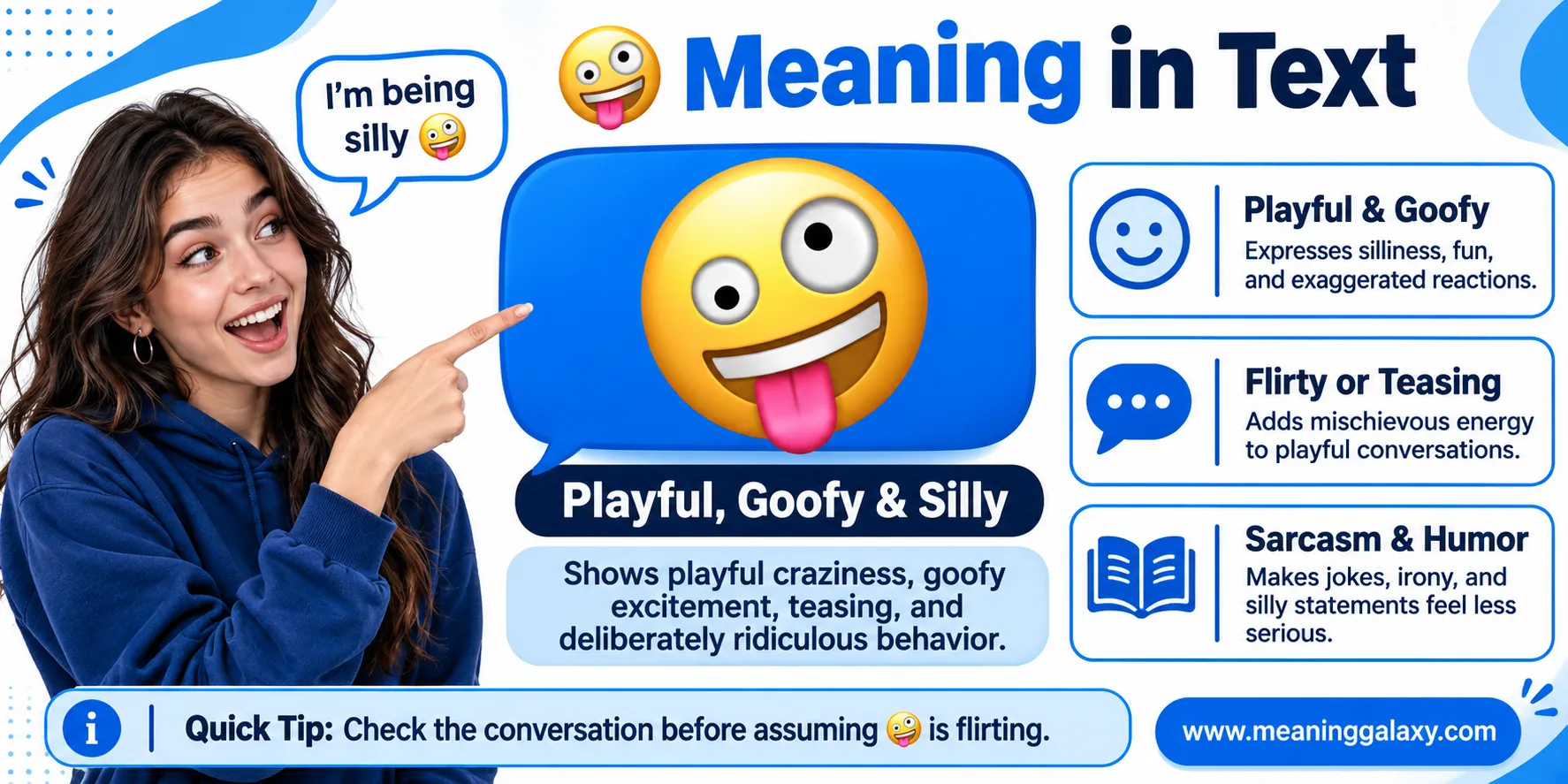
The 🤪 meaning in text is usually playful silliness, goofy excitement, mischievous behavior, or acting deliberately ridiculous. Officially called the Zany Face emoji, it features uneven, wide-open eyes, a tilted expression, and a tongue sticking out. These unusual facial features give it a wild, unserious personality. For example, “I might spend my entire weekend watching movies 🤪” suggests someone is joking about their plans rather than making a serious statement.
However, the meaning can change depending on the conversation and the person sending it. A simple “Sure 🤪” might sound teasing, while the same word without an emoji could feel cold or serious. Between friends, it often signals shared silliness; from a crush, it may add mischievous or flirty energy; and on TikTok, it can express irony or exaggeration. Below, you’ll discover its meanings, emotional signals, flirting potential, common misunderstandings, similar emojis, and the best ways to respond.
🤪 Meaning in Text – Quick Meaning
🤪 means “I’m being silly, goofy, playful, wild, or deliberately ridiculous.”
Depending on the conversation, this emoji can communicate several related feelings:
- Playful craziness
- Goofy excitement
- Mischievous behavior
- “I’m kidding”
- Light sarcasm
- Chaotic fun
- Flirty teasing
- Embarrassing but funny behavior
- Exaggerated enthusiasm
- Not taking yourself seriously
Here are three examples:
Example 1: “I bought another pair of shoes even though I have ten 🤪”
Meaning: The sender knows they’re being excessive and makes fun of their own shopping habits.
Example 2: “Let’s drive somewhere random tonight 🤪”
Meaning: They’re suggesting a spontaneous adventure and making the idea sound exciting.
Example 3: “Maybe I was waiting for your message 🤪”
Meaning: The sender is hinting at affection while using humor to make the confession less serious.
The important thing is that 🤪 communicates an attitude rather than one fixed emotion. The surrounding words help reveal which interpretation makes the most sense.
🤪 in One Sentence
🤪 usually means “I know I’m being silly, ridiculous, or a little chaotic, and I’m having fun with it.”
Origin and Background of the 🤪 Emoji
What the emoji officially is
The 🤪 emoji is officially known as Zany Face in Unicode’s current emoji list. Its codepoint is U+1F92A. It was introduced in Emoji 5.0 in 2017, following its approval in Unicode 10.0.
Its appearance is designed to look intentionally unusual. One eye appears larger than the other, the head is tilted, and the tongue sticks out from a wide grin. Together, these features create an exaggerated expression associated with silliness and goofy behavior.
Why the face looks so chaotic
The unusual facial expression separates 🤪 from more ordinary smiling emojis.
For example:
- 🙂 looks calm, friendly, and controlled.
- 😂 communicates clear amusement or laughter.
- 🤪 adds an exaggerated, deliberately ridiculous expression.
It feels less like a simple smile and more like someone making a silly face to entertain a friend.
How its meaning evolved online
As emoji use spread through texting, comments, and memes, 🤪 became useful for more than showing straightforward silliness.
People also use it to communicate irony and exaggerated reactions. For example, someone might write, “Another weekend spent cleaning my entire apartment 🤪” to make an ordinary or frustrating activity sound ridiculous.
In meme-heavy conversations, it can also accompany jokes about questionable decisions, unexpected situations, and intentionally dramatic behavior.
Its meaning depends on how people use it, rather than a single universal internet definition.
4. Real-Life Conversations Using 🤪
WhatsApp: Friends Making Silly Plans
Alex: We should go to the beach tomorrow.
Jamie: It’s a three-hour drive.
Alex: Exactly why we should leave at sunrise 🤪
Jamie: You’re actually serious?
Alex: Unfortunately, yes.
What it means: Here, 🤪 makes an impractical plan feel entertaining rather than overly serious. Alex knows the suggestion is spontaneous and slightly ridiculous but enjoys the idea. It also invites Jamie to join the joke instead of immediately rejecting the plan.
Instagram DMs: Flirting
Ryan: You looked really good in that picture.
Mia: Are you always this smooth?
Ryan: Only when someone deserves it 🤪
Mia: Okay, I see what you’re doing.
What it means: The emoji adds a mischievous tone to Ryan’s compliment. It suggests that he’s enjoying the playful exchange and isn’t embarrassed by the teasing. The conversation may be flirtatious, but the relationship and previous messages provide the stronger clues.
TikTok Comments: Chaotic Humor
Creator: Tried making homemade pizza for the first time.
User 1: That looks like a science experiment.
User 2: Michelin stars are definitely coming 🤪
User 3: The confidence is unmatched.
What it means: In this public comment, 🤪 supports obvious exaggeration. The commenter isn’t seriously predicting a restaurant award. They’re making fun of the contrast between the pizza’s appearance and the creator’s imagined success.
Text Message: Playful Confession
Taylor: So you actually saved my picture?
Jordan: Maybe 🤪
Taylor: That’s suspicious.
Jordan: I have no explanation.
What it means: The emoji makes Jordan’s short answer sound mischievous and slightly revealing. Instead of giving a direct admission, Jordan leaves room for playful teasing. It can suggest interest, but the conversation alone doesn’t establish how serious that interest is.
Emotional and Psychological Meaning of 🤪
The 🤪 emoji can do more than express silliness. It can change how a message feels by making an emotional statement easier to receive.
It can say “Don’t take this too seriously”
Sometimes people make dramatic statements simply to entertain others. 🤪 works like a silly facial expression that tells the reader not to interpret every word literally.
- Without emoji: “I’m going to become the most famous person in the world.”
- With emoji: “I’m going to become the most famous person in the world 🤪”
The second message makes the exaggeration feel intentional and humorous.
It can hide mild embarrassment
People sometimes use humor when they feel awkward about admitting something. The emoji helps turn an embarrassing confession into a joke.
- Without emoji: “I checked your profile five times today.”
- With emoji: “I checked your profile five times today 🤪”
The second version sounds more self-aware and less uncomfortable.
It can soften flirting
A direct romantic message can feel vulnerable, especially when two people are still getting to know each other. 🤪 can make that message feel lighter.
- Without emoji: “I think you’re really cute.”
- With emoji: “I think you’re really cute 🤪”
The second version adds playful energy. It may help the sender express attraction without making the conversation feel too intense.
Imagine you’re messaging your crush
You’ve written a message, deleted it, and rewritten it several times. Eventually, you decide to admit that you enjoy talking to them. Just before sending, you add 🤪 because the confession suddenly feels a little too honest. Now the message sounds playful rather than overly serious. Their response may tell you whether the feeling is mutual, but the emoji gives you a softer way to start the conversation.
🤪 Meaning in Different Contexts
🤪 Meaning on Social Media
On TikTok, Instagram, and Snapchat, 🤪 often appears in captions, comments, and reactions to exaggerated situations. It can make an ordinary experience sound intentionally dramatic or ridiculous. It also works well with self-deprecating humor.
Example: “Said I was going to sleep early and started a new series at midnight 🤪”
The emoji highlights the contrast between the person’s intention and actual behavior.
🤪 Meaning From a Friend
When a friend sends 🤪, it often suggests comfort and familiarity. Friends may use it when sharing embarrassing moments, making unexpected plans, or joking about something they both understand.
Example: “I accidentally wore my shirt inside out all morning 🤪”
The sender is laughing at their own mistake and sharing the moment without feeling overly embarrassed.
🤪 Meaning From a Guy
When a guy sends 🤪, possible meanings include:
- He’s making a joke.
- He’s teasing you playfully.
- He’s expressing goofy excitement.
- He’s being mischievous.
- He’s adding a little flirtation.
- He’s making a dramatic statement less serious.
Example: “You make it difficult to concentrate sometimes 🤪”
This could be playful flirting, especially if the conversation already contains mutual compliments. However, it could also be friendly teasing. The emoji alone does not prove romantic interest.
🤪 Meaning From a Girl
When a girl sends 🤪, the basic meanings are the same. She may be joking, teasing, expressing excitement, or making a slightly embarrassing statement feel funny.
Example: “I told everyone I was staying home, and now I’m going out again 🤪”
It communicates playful self-awareness rather than a special meaning based on gender. Always consider the actual conversation and relationship instead of assuming romantic interest.
🤪 in Professional Messages
🤪 is usually too casual for formal communication. It may be acceptable in relaxed conversations between coworkers who already share a friendly relationship.
Wrong context: “We missed the quarterly sales target again 🤪”
Acceptable informal context: “This is the third time the spreadsheet has crashed today 🤪”
The difference is the seriousness of the subject and the relationship between the people communicating.
When NOT to Use 🤪
Serious Emotional Conversations
Avoid adding 🤪 after an apology when someone is genuinely hurt. For example, “I’m sorry I ignored your message 🤪” may make the apology appear careless or dismissive.
Condolences
This emoji is not suitable for messages about death, grief, or serious personal loss. Its exaggerated playful expression can clash with the emotional weight of the situation.
Formal Workplace Communication
Avoid using 🤪 in:
- Job applications and cover letters
- Formal client emails
- Official complaints
- Business reports
- Academic communication
- Sensitive workplace discussions
A clear, respectful tone is usually better in these situations.
When Your Joke Could Be Misunderstood
Text messages don’t include facial expressions or vocal tone. If your sentence could already sound offensive or sarcastic, adding 🤪 may make the intended meaning even harder to understand.
Common Misunderstandings About 🤪
Does 🤪 Mean Someone Is Crazy?
No, 🤪 does not literally mean someone has lost their mind or has a mental-health problem. It is generally a playful expression used for goofy, exaggerated, or deliberately ridiculous behavior. When someone sends it after a joke, they’re usually communicating silliness rather than making a serious statement about themselves or another person.
Is 🤪 Always Flirty?
No, 🤪 is not always a flirting emoji. It can appear in completely ordinary conversations between friends, family members, or coworkers. For example, “I just ate six tacos by myself 🤪” is more likely to communicate humorous self-awareness than romantic interest. Flirting depends on the words, relationship, and surrounding behavior.
Is 🤪 Sarcastic?
Sometimes, yes. 🤪 can support sarcasm when the sender uses positive words to describe something frustrating or unpleasant. For example, “Love getting stuck in traffic for two hours 🤪” probably means the opposite of what the sentence literally says. The emoji helps reveal the exaggerated, ironic tone.
Does 🤪 Mean Drunk?
No, 🤪 does not automatically mean someone is drunk. It may appear in conversations about parties, celebrations, or drinking, but its basic meaning is playful silliness. Someone can use it while talking about a normal day, a funny mistake, or an unusual idea without suggesting alcohol is involved.
🤪 Compared With Similar Emojis
Some emojis have similar playful expressions, but their emotional signals are slightly different.
| Emoji | Common Meaning | Typical Tone | Key Difference |
| 🤪 | Goofy, wild, playful | Chaotic | Deliberately ridiculous expression |
| 😜 | Teasing, joking | Playful / flirty | More controlled wink and tongue gesture |
| 😝 | Silly reaction | Childlike / playful | Eyes squeezed shut with tongue out |
| 😂 | Very funny | Amused | Focuses on laughter rather than silliness |
| 🤭 | Shy amusement | Cute / secretive | Covers the mouth instead of making a wild face |
| 😏 | Suggestive confidence | Flirty | Has a knowing smirk rather than goofy energy |
| 🙃 | Irony, awkwardness | Dry / sarcastic | Uses an upside-down face for awkward or ironic tone |
| 🥴 | Dazed, overwhelmed | Messy | Suggests disorientation more than intentional silliness |
| 😈 | Mischief | Naughty | Has a devilish, intentionally provocative feel |
| 😵💫 | Confusion / overload | Overwhelmed | Communicates dizziness or confusion instead of playful fun |
Key Insight
🤪 sits between the teasing personality of 😜 and the more exaggerated expressions of 😝. However, it has its own chaotic energy. It basically says, “I know this looks ridiculous, and I’m completely fine with that.”
10 Common Variations of 🤪 Meaning in Text
The exact meaning of 🤪 can shift depending on what the sender wants to communicate. Here are ten common ways it appears in everyday messages.
1. I’m Being Silly
The sender is acting goofy or making a funny face to show they’re not being serious.
Example: “I just danced around the kitchen for no reason 🤪”
2. I’m Joking
It helps make an exaggerated statement sound humorous rather than believable.
Example: “I’m quitting everything and opening a penguin farm 🤪”
3. Playful Flirting
It can make a compliment or romantic hint feel less direct and more relaxed.
Example: “You might be becoming my favorite notification 🤪”
4. Mischievous
The emoji can suggest that someone has done something cheeky and knows it.
Example: “I took the last slice and blamed the dog 🤪”
5. Chaotic Energy
It can describe unpredictable behavior or a situation that has become unexpectedly entertaining.
Example: “We started with coffee and somehow ended up at a karaoke bar 🤪”
6. I Know This Is a Bad Idea
Sometimes the sender recognizes that their decision isn’t sensible but finds it funny anyway.
Example: “I’m buying concert tickets before checking my bank balance 🤪”
7. Playful Sarcasm
It can make a sentence sound ironic when the literal words don’t match the actual situation.
Example: “My phone battery died right before the important call, perfect timing 🤪”
8. Embarrassed but Laughing
It can help someone admit an awkward moment without making it feel too uncomfortable.
Example: “I waved back at someone who wasn’t waving at me 🤪”
9. Excited and Hyper
It can add extra energy when someone is too excited to express themselves calmly.
Example: “The concert tickets just arrived and I cannot sit still 🤪”
10. Not Taking Myself Seriously
It can show exaggerated confidence while making it clear that the sender is having fun.
Example: “Obviously, I’m the main character of this grocery store trip 🤪”
How to Respond When Someone Sends 🤪
The best approach is to match the message, not just the emoji. Think about whether the sender is joking, teasing, flirting, or sharing something funny.
Casual Replies
Use these when a friend or someone you know sends a playful message.
- “You’re something else 😂”
- “That sounds exactly like you.”
- “I can’t even argue with that.”
- “You always find a way.”
- “This is why I never get bored with you.”
Funny Replies
If the sender is making an outrageous joke, you can respond with something equally entertaining.
- “Please explain your thought process.”
- “I need to see how this ends.”
- “Somebody take your phone away 😂”
- “That’s a choice, for sure.”
- “The plot gets stranger every time.”
Flirty Replies
Use these only when the conversation is clearly mutual and playful. A little teasing can keep the exchange interesting without making things uncomfortable.
- “You always know how to get my attention 😏”
- “Should I be worried about you?”
- “You’re making this conversation interesting.”
- “I might be enjoying this a little too much 🤭”
- “Are you always this charming?”
Mature or Respectful Replies
If you’re unsure whether the sender is joking, respond to the actual message instead of guessing what the emoji means. You can ask something light like, “Wait, are you actually serious about that? 😂” This gives the person an easy chance to explain. If the subject is important, keep your response clear and don’t let a playful emoji distract you from the real conversation.
Regional and Cultural Usage of 🤪
Emoji habits can differ between communities, age groups, and online spaces. These are broad observations, not fixed cultural rules.
Western Online Culture
In many English-speaking online spaces, 🤪 can accompany self-deprecating humor, impulsive decisions, exaggerated excitement, and playful chaos. It is also useful when someone wants to make an ordinary experience sound ridiculous.
Asian Digital Culture
Emoji use varies widely across Asian countries, languages, and platforms. Younger users may combine 🤪 with local slang, repeated punctuation, stickers, and other emojis. Its interpretation depends on the particular conversation rather than one shared Asian meaning.
Middle Eastern Digital Culture
In multilingual conversations involving Arabic, English, Urdu, Persian, and other languages, 🤪 can add a playful tone to a message. However, whether a message sounds friendly or flirtatious depends on the relationship and the words surrounding it.
Global Internet Usage
Online conversations have helped 🤪 develop a recognizable association with exaggerated behavior and goofy humor. It can appear in memes, captions, reactions, and messages about unexpected decisions.
Gen Z vs. Millennials
Gen Z users may lean toward ironic uses, especially when describing obviously questionable situations. Millennials may use it more straightforwardly to express silliness or excitement. These are tendencies rather than rules, and individual texting habits matter more than region or generation.
Is 🤪 Safe for Kids?
Yes, 🤪 is generally kid-friendly. Its basic meaning is silly, goofy, playful, or zany, making it suitable for ordinary conversations, jokes, and friendly messages.
However, like almost any emoji, its meaning can change when combined with inappropriate words or adult conversations. Parents should consider the entire message and the surrounding discussion rather than worrying about this emoji by itself.
FAQs About 🤪 Meaning in Text
1. What does 🤪 mean in texting?
🤪 usually means someone is being silly, goofy, playful, or deliberately ridiculous. People use it to make jokes, express exaggerated excitement, tease friends, or make awkward situations feel lighter. Its exact meaning depends on the message and the relationship between the sender and receiver.
2. What does 🤪 mean from a guy?
When a guy sends 🤪, he may be joking, teasing, acting mischievously, or expressing goofy excitement. It can also add a playful or flirty tone to a conversation. However, it doesn’t automatically mean he likes you romantically. His words and overall behavior provide better clues.
3. What does 🤪 mean from a girl?
When a girl sends 🤪, she may be expressing silliness, excitement, playful teasing, or humorous embarrassment. She might also use it while flirting, depending on the conversation. The basic meaning is the same regardless of gender, so consider her message and your relationship rather than assuming romantic interest.
4. Is 🤪 a flirting emoji?
🤪 can be a flirting emoji, but it isn’t exclusively romantic. Someone might use it after a compliment, a playful confession, or a teasing comment to make the conversation feel less serious. Between friends, it can simply express humor. Mutual interest and the surrounding conversation matter more than the emoji alone.
5. What does 🤪 mean after a sentence?
When 🤪 appears after a sentence, it usually changes the tone by adding silliness, exaggeration, or humor. For example, “I’m definitely becoming a professional napper 🤪” makes the statement sound intentionally ridiculous. It can also soften teasing or make a slightly embarrassing confession feel less serious.
6. What is the difference between 🤪 and 😜?
🤪 generally communicates exaggerated silliness, goofy excitement, and chaotic behavior. 😜 usually feels more like direct teasing or playful joking because it includes a wink and a tongue-out expression. Both can be flirty, but 🤪 tends to look more exaggerated and deliberately ridiculous.
7. Does 🤪 mean someone is being sarcastic?
🤪 can communicate sarcasm when it follows a statement whose literal meaning is different from the sender’s real opinion. For example, “Wonderful, another Monday morning meeting 🤪” suggests the person isn’t actually excited. In other situations, it simply expresses silliness or excitement rather than sarcasm.
Conclusion
The 🤪 emoji is all about playful chaos. It can communicate silliness, joking, exaggerated excitement, mischievous behavior, or the feeling of knowing you’re doing something ridiculous. In a flirty conversation, it may soften a compliment or romantic hint. Between friends, it often adds goofy energy, while on social media, it can make an embarrassing story or questionable decision sound funny.
The biggest lesson is that context decides its meaning. Don’t assume someone has romantic feelings just because your crush sends 🤪. Likewise, don’t interpret its playful expression as a serious statement about someone’s mental state. Look at the words before the emoji, your relationship with the sender, and the tone of the surrounding conversation. Sometimes there’s a subtle message behind it. Other times, your friend simply ordered another dessert after saying they were full 🤪.

Welcome to Meaning Galaxy! I’m Muhammad Talha, a language enthusiast and meaning explorer dedicated to helping people discover the true meanings behind words, names, phrases, and concepts.
I help users understand words better, explore hidden meanings, and learn new information in a simple and easy way. My goal is to make learning meanings interesting, clear, and accessible for everyone.
Let’s explore the world of words together!