
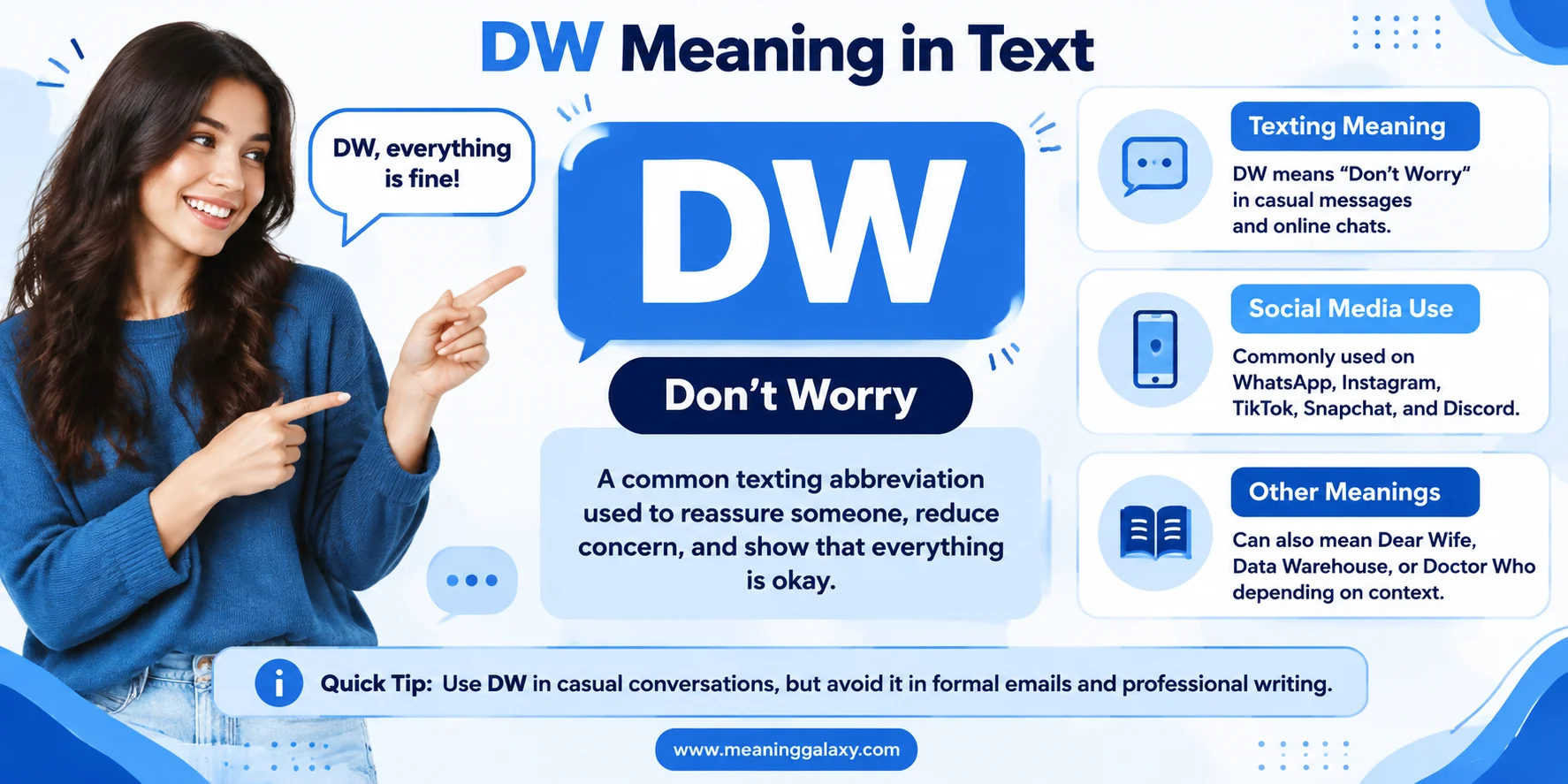
The DW meaning in text is usually “Don’t Worry.” People use this short abbreviation to reassure someone, respond to an apology, or show that a small problem is under control. You may see DW in texting, WhatsApp messages, Instagram DMs, Snapchat chats, TikTok comments, Discord messages, and other forms of online messaging.
For example, if someone says, “Sorry I’m late,” a friend might reply, “DW, it’s fine.” In that message, DW means “Don’t Worry.” The abbreviation can have other meanings in certain contexts, including dear wife, darling wife, or technical terms such as Data Warehouse, so the surrounding conversation matters.
What does DW mean in text?
DW in text usually means “Don’t Worry.” People use it to reassure someone, respond casually to a concern, or say that everything is okay. It commonly appears in text messages, social media chats, direct messages, and group chats. Other meanings are possible, so context helps identify the correct interpretation.
Quick Meaning of DW
| Term | Meaning | Context |
| DW | Don’t Worry | Texting, chats, social media |
| DW | Dear Wife / Darling Wife | Relationship or social-media context |
| DW | Data Warehouse | Technology and computing |
| DW | Doctor Who | Entertainment discussions |
In everyday casual texting, “Don’t Worry” is the meaning you should usually consider first. Oxford also recognizes dear wife/darling wife and don’t worry as informal meanings used particularly in text messages and social media.
DW Meaning & Definition
DW means “Don’t Worry” when it appears in most casual text conversations. It is a short way of telling someone that they do not need to feel concerned, stressed, embarrassed, or sorry about something.
People often type DW when they want to reassure someone without writing a longer message such as:
- “Don’t worry about it.”
- “Everything is okay.”
- “No problem.”
- “It’s fine.”
- “I’ll take care of it.”
The DW abbreviation works well in casual communication because it is short, easy to type, and direct. A person may use it after someone apologizes, asks for help, expresses concern, or worries about a small problem.
DW is generally an informal abbreviation rather than something used in formal writing. It fits naturally in personal chats, social media comments, messaging apps, direct messages, and group conversations.
Definition
DW: An informal initialism commonly used in texting and online communication to mean “Don’t Worry.” It is used to tell another person not to be concerned about a situation.
The letters come from:
D = Don’t
W = Worry
DW may also represent other phrases in special contexts. Oxford, for example, lists both “don’t worry” and “dear wife/darling wife” as informal uses.
Full Form
The most relevant DW full form for someone asking about texting is:
DW = Don’t Worry
It is often used instead of writing the complete phrase.
Example:
“Sorry, I forgot to call you.”
“DW, we can talk later.”
Here, DW means Don’t Worry. The second person is telling the first person that the missed call is not a serious problem.
Common Interpretation
Consider this conversation:
Person A:
“Sorry I couldn’t reply earlier.”
Person B:
“DW, I knew you were busy.”
The plain-English interpretation is:
“Don’t worry about replying late. I understand.”
In this situation, DW provides reassurance and creates a friendly tone. It tells the other person that there is no need to keep apologizing or stressing about what happened.
Another example is:
Person A:
“I think I sent you the wrong file.”
Person B:
“DW, just send the new one.”
Here, DW means:
“Don’t worry. It is easy to fix.”
This is why the DW abbreviation meaning often depends not only on the letters but also on what happened earlier in the conversation.
Background
The exact origin of DW as a texting abbreviation is not tied to a clearly documented person, website, or specific date. It belongs to the broader style of short abbreviations used in online chats and text messaging.
People often shorten common phrases during digital communication because typing two letters is faster than writing an entire sentence. Similar texting abbreviations include BRB for “Be Right Back,” IDK for “I Don’t Know,” and TTYL for “Talk To You Later.”
DW follows the same pattern:
Don’t Worry → DW
The abbreviation is now recognized in dictionary references as an informal expression used particularly in text messages and social media.
There is no need to attach DW to one generation or one particular social platform. You may encounter it anywhere people use short, informal messages.
That can include:
- Personal text messages
- WhatsApp chats
- Instagram direct messages
- Snapchat conversations
- TikTok comments
- Discord chats
- Online communities
- Social media comments
- Group chats
The wording is useful because it allows someone to communicate quickly while keeping the message simple.
What Does DW Mean in Text?
In texting, DW usually means “Don’t Worry.”
A person sends DW when they want another person to stop worrying about a problem, mistake, delay, apology, or situation.
It can communicate ideas such as:
- Everything is fine.
- You do not need to apologize.
- It is not a big problem.
- I can handle it.
- There is no need to stress.
- The situation is under control.
The exact tone depends on the conversation.
For example, a warm message such as:
“DW 😊 everything is fine.”
clearly sounds friendly and reassuring.
A very short reply such as:
“dw”
may still mean “Don’t Worry,” but its emotional tone can be harder to judge without seeing the rest of the conversation.
Example 1: Responding to an Apology
Text:
“Sorry I forgot to message you yesterday.”
“DW, no problem.”
Meaning:
The sender means, “Don’t worry about it. I’m not upset.”
DW is being used as a friendly response to an apology.
Example 2: Reassuring Someone
Text:
“I’m worried we’ll miss the movie.”
“DW, we still have 20 minutes.”
Meaning:
DW means “Don’t Worry.” The sender is trying to reduce concern by explaining that there is still enough time.
Example 3: Offering to Handle Something
Text:
“Who’s going to fix the booking?”
“DW, I got this.”
Meaning:
The message means:
“Don’t worry. I’ll take care of it.”
Here, DW communicates confidence as well as reassurance.
Example 4: A Small Mistake
Text:
“I accidentally sent that photo twice.”
“DW 😂”
Meaning:
The response means:
“Don’t worry about it. It isn’t a big deal.”
The emoji also makes the response feel more relaxed and playful.

Is the Meaning of DW Always the Same?
No. Although DW in text commonly means “Don’t Worry,” the letters can represent other words in certain situations.
For example:
“My DW made dinner tonight.”
“Don’t Worry” would make no sense here.
In this type of sentence, DW can mean “dear wife” or “darling wife.” Both uses are recognized in major dictionary references.
Now consider:
“We need to move the customer data into the new DW.”
This is clearly a technology context. DW may mean Data Warehouse, an established computing abbreviation.
This is why you should understand the conversation context rather than assuming that every use of DW has exactly the same meaning.
What Does DW Communicate in a Message?
When DW means “Don’t Worry,” it normally communicates reassurance.
Depending on the situation, it can be used to:
Reassure Someone
“DW, everything is okay.”
The sender wants the other person to feel calmer.
Respond to an Apology
“Sorry I’m running late.”
“DW!”
The reply means that the delay is not a serious issue.
Show Confidence
“Are you sure you can finish it?”
“DW, I got this.”
Here, the sender is confident that they can handle the situation.
Reduce Stress
“I think I made a mistake.”
“DW, we can fix it.”
The message is meant to reduce stress or reduce tension.
Take Responsibility
“Who will handle the tickets?”
“DW, I’ll manage it.”
The speaker is saying both “Don’t Worry” and “I’ll take care of it.”
These DW examples show why the abbreviation is useful in everyday conversations. A very short message can still communicate comfort, confidence, or understanding.
When Is DW Usually Used?
DW is especially useful when someone has expressed concern.
For example, someone might say:
“I’m sorry.”
“I might be late.”
“I forgot to bring it.”
“I’m worried about tomorrow.”
“Are you sure everything is okay?”
A person can respond with DW when they want to calm someone down or show that the problem is manageable.
Common Situations
DW may appear when:
- Someone apologizes for a small mistake
- A friend feels nervous
- Someone is worried about being late
- A person asks whether something went wrong
- Someone offers an unnecessary apology
- A friend is concerned about a plan
- Someone wants reassurance
- The sender plans to solve the problem
For example:
“Sorry, I’ll be about 10 minutes late.”
“DW, I’m still getting ready.”
This response is short but clear. It tells the other person that being late is not a problem.
DW Full Form in Chat
The most common DW full form in chat is “Don’t Worry.”
However, the letters DW are not limited to one expansion. Their meaning depends on where and how they appear.
| Full Form | Meaning | Common Usage |
| Don’t Worry | Tells someone not to be concerned | Texting, chats, DMs, social media |
| Dear Wife / Darling Wife | An affectionate reference to a wife | Relationship discussions, forums, social media |
| Data Warehouse | A system or repository used for organized data | Technology, computing, business data |
| Doctor Who | Short reference to the TV series | Entertainment and fan discussions |
For someone asking “what does DW stand for” after seeing it in an ordinary text message, Don’t Worry is normally the most relevant interpretation.
However, words around the abbreviation can quickly change that interpretation.
Example
“DW, you didn’t do anything wrong.”
Here:
DW = Don’t Worry
But:
“My DW and I went out for dinner.”
Here:
DW = Dear Wife/Darling Wife
And:
“The reporting system pulls information from the DW.”
Here:
DW = Data Warehouse
The surrounding words reveal the correct meaning based on context.
Common Meanings of DW
The following table separates the normal DW texting meaning from meanings that belong to other contexts.
| DW Meaning | Explanation | Example |
| Don’t Worry | Reassures someone or tells them not to be concerned | “DW, I’ll fix it.” |
| Dear Wife / Darling Wife | Refers affectionately to someone’s wife | “My DW planned our trip.” |
| Data Warehouse | A computing and data-management term | “The records are stored in the DW.” |
| Doctor Who | A shortened reference used in entertainment discussions | “Have you watched the latest DW episode?” |
The first two meanings have documented use in messaging or social-media language, while Data Warehouse belongs mainly to the technology context.
1. Don’t Worry
This is the meaning most relevant to everyday texting.
“DW, I’ll handle it.”
The sender is telling someone not to worry about the situation.
2. Dear Wife or Darling Wife
DW can sometimes refer to a person’s wife, especially in relationship discussions or social-media writing.
“My DW surprised me with dinner.”
Here, the sentence means:
“My dear/darling wife surprised me with dinner.”
It does not mean “Don’t Worry.”
3. Data Warehouse
In a technical discussion, DW may stand for Data Warehouse.
For example:
“The analytics team uses the DW for reporting.”
This meaning has little connection with DW slang or casual texting. It becomes relevant when the conversation is about computing, databases, analytics, or business technology.
4. Doctor Who
In conversations about television and entertainment, people may use DW as shorthand for Doctor Who.
For example:
“I’ve been watching old DW episodes.”
The subject of television makes the intended meaning much easier to recognize.
How Context Changes the DW Meaning
Context is the easiest way to decide what DW means.
Look at the words surrounding it.
Texting Context
“Sorry about earlier.”
“DW, we’re good.”
Meaning: Don’t Worry
Relationship Context
“My DW bought me this for my birthday.”
Meaning: Dear Wife or Darling Wife
Technology Context
“The company is upgrading its DW.”
Meaning: Data Warehouse
Entertainment Context
“Which DW season should I watch first?”
Meaning: Doctor Who
This is an important part of understanding multiple meanings of DW. The abbreviation itself may be identical, but the surrounding conversation usually tells you which meaning makes sense.
For normal DW in messages, DW in chats, and everyday online interactions, “Don’t Worry” should usually be considered first. Other meanings become more likely when the conversation clearly involves marriage, technology, or entertainment.
How People Use DW in Text Messages
People use DW in text messages as a quick way to provide reassurance or make someone feel less worried. Instead of typing a complete sentence like “Don’t worry about it” or “Everything is fine,” users often choose this short texting abbreviation to save time.
The abbreviation works best in casual communication between friends, family members, classmates, coworkers who have an informal relationship, and online communities.
DW can be used to:
- Respond to an apology
- Calm someone down
- Show that a problem is not serious
- Confirm that everything is okay
- Tell someone you can handle a situation
- Keep a conversation short and friendly
DW Examples in Real Text Conversations
Example 1: Responding to an Apology
Person A:
“Sorry, I forgot to send the document.”
Person B:
“DW, you can send it later.”
Meaning:
The person means, “Don’t worry. It is not a problem.”
Example 2: Reassuring a Friend
Person A:
“I think I made a mistake.”
Person B:
“DW, we can fix it.”
Meaning:
The sender is telling the other person not to panic because the problem can be solved.
Example 3: Offering Help
Person A:
“Who will arrange everything?”
Person B:
“DW, I’ll take care of it.”
Meaning:
The message means, “Don’t worry, I will handle this.”
Example 4: Casual Conversation
Person A:
“I might be a little late.”
Person B:
“DW, take your time.”
Meaning:
The response shows patience and reassurance.
DW in Different Contexts
The DW meaning usually stays the same in casual online communication, but the way people use it can change depending on the situation.
DW in Text Messages
In normal texting, DW means “Don’t Worry.”
Friends commonly use it when they want to sound supportive and relaxed.
Examples:
“DW, everything is okay.”
“DW about the meeting.”
“DW, I got this.”
In these examples, DW communicates reassurance and a friendly tone.
DW in Social Media
The DW social media meaning is usually the same as texting: Don’t Worry.
People use it in:
- Comments
- Captions
- Replies
- Direct messages
- Group conversations
For example:
Comment:
“I thought the video was deleted.”
Reply:
“DW, it’s still available.”
The user is reassuring another person that there is no problem.
DW in Gaming
DW is sometimes seen in gaming chats because players often use short messages while playing.
Examples:
“DW, I’ll revive you.”
“DW, we still have time.”
In gaming conversations, DW usually keeps its normal meaning: Don’t Worry.
It helps players communicate quickly without stopping gameplay.
DW in Online Communities
In forums, Discord servers, and online groups, DW can appear when members want to reassure others.
Example:
“DW, someone already answered the question.”
Meaning:
“Don’t worry, someone has already helped.”
The abbreviation fits online communities because users often prefer fast communication.
DW in Professional Communication
DW is generally considered an informal abbreviation.
It is suitable for:
- Friendly workplace chats
- Casual team conversations
- Internal messages with familiar coworkers
However, it is usually not recommended for:
- Formal emails
- Client communication
- Business proposals
- Official documents
- Academic writing
Instead of writing:
“DW, we fixed the issue.”
A professional message may say:
“No need to worry. The issue has been resolved.”
The difference is mainly about tone. DW creates a casual and friendly feeling, while professional communication usually requires clearer and more formal language.
DW Meaning on WhatsApp, Instagram, TikTok, Snapchat, and Discord
DW does not have a different definition on every platform. On most social platforms, it keeps the same meaning: Don’t Worry.
The difference is how people use it.
| Platform | Meaning | Example |
| Don’t Worry | “DW, I’ll send it soon.” | |
| Don’t Worry | “DW, your comment is fine.” | |
| TikTok | Don’t Worry | “DW, it’s just a trend.” |
| Snapchat | Don’t Worry | “DW, I’m not upset.” |
| Discord | Don’t Worry | “DW, we can play later.” |
DW Meaning on WhatsApp
The DW meaning on WhatsApp is usually Don’t Worry.
Because WhatsApp is mainly used for personal conversations, DW often appears between friends, family members, and groups.
Examples:
“Sorry I missed your call.”
“DW, call me when you’re free.”
It creates a relaxed and friendly response.
DW Meaning on Instagram
On Instagram, people commonly use DW in:
- Direct messages
- Comments
- Story replies
Example:
“I accidentally tagged you.”
“DW 😂”
Meaning:
“Don’t worry, it’s okay.”
Instagram conversations are usually informal, so short abbreviations are common.
DW Meaning on TikTok
The DW meaning on TikTok is also usually Don’t Worry.
It may appear in:
- Comments
- Creator replies
- Captions
Example:
Comment:
“I thought this was a serious video.”
Reply:
“DW, it’s just a joke.”
The abbreviation helps creators and users respond quickly.
DW Meaning on Snapchat
On Snapchat, DW is commonly used in quick chats between friends.
Example:
“Sorry I opened your snap late.”
“DW.”
Meaning:
“Don’t worry.”
Because Snapchat conversations are often fast and casual, short abbreviations are common.
DW Meaning on Discord
The DW meaning on Discord is generally “Don’t Worry.”
It can appear in:
- Gaming servers
- Community chats
- Friend groups
Example:
“I’m new here, sorry.”
“DW, welcome!”
The abbreviation helps create a friendly environment.
Common Misconceptions About DW
Because abbreviations can have multiple meanings, some people misunderstand DW. The correct meaning depends on the conversation.
| Misconception | Actual Meaning |
| DW always means something technical | In normal chats, DW usually means “Don’t Worry” |
| DW is only used by gamers | DW appears in general texting and social media |
| DW has a different meaning on every app | Most platforms use the same meaning |
| DW is always slang | DW is an abbreviation/initialism commonly used informally |
| DW always means “Dear Wife” | This meaning only applies in relationship contexts |
DW Is Not Always a Slang Word
Many people call DW a slang term, but technically it is better described as an informal abbreviation or texting initialism.
Slang usually refers to informal words or expressions that develop within certain groups.
DW is different because it is simply a shortened form of a phrase:
Don’t Worry → DW
It is part of modern digital communication where people shorten common expressions for faster messaging.
Similar Terms & Alternatives
Several other texting abbreviations are related to DW because they help people communicate quickly.
| Term | Full Form | Difference |
| NVM | Never Mind | Used when something is no longer important |
| IDC | I Don’t Care | Shows lack of concern or interest |
| IDK | I Don’t Know | Shows uncertainty |
| BRB | Be Right Back | Tells someone you will return soon |
| TTYL | Talk To You Later | Ends a conversation temporarily |
DW vs NVM
| Term | Meaning | Main Difference |
| DW | Don’t Worry | Reassures someone |
| NVM | Never Mind | Tells someone to ignore something |
Example:
DW:
“DW, I fixed the issue.”
Meaning:
“Don’t worry, everything is okay.”
NVM:
“NVM, I found the answer.”
Meaning:
“Never mind, I solved it.”
DW vs IDC
| Term | Meaning | Main Difference |
| DW | Don’t Worry | Shows reassurance |
| IDC | I Don’t Care | Shows lack of interest |
DW is usually positive and supportive, while IDC can sometimes sound dismissive.
What Does DW Mean in a Conversation?
The meaning of DW becomes clearer when you look at the full conversation.
Conversation Example 1
Person A:
“I forgot your birthday gift.”
Person B:
“DW, you can give it tomorrow.”
Meaning:
DW means “Don’t Worry.” The person is saying the mistake is acceptable.
Conversation Example 2
Person A:
“I’m nervous about my presentation.”
Person B:
“DW, you’ll do great.”
Meaning:
DW is used to encourage and reassure someone.
Conversation Example 3
Person A:
“Sorry for bothering you.”
Person B:
“DW, it’s completely fine.”
Meaning:
The person is telling them they do not need to apologize.
Conversation Example 4
Person A:
“I think we are late.”
Person B:
“DW, the event hasn’t started.”
Meaning:
The sender is reducing stress by explaining that there is still enough time.
Difference Between DW and Related Terms
DW vs “No Problem”
| Term | Meaning | Main Difference |
| DW | Don’t Worry | Focuses on reducing concern |
| No Problem | It is okay | Focuses on accepting something |
Example:
“Sorry I made a mistake.”
Response 1:
“DW.”
Meaning:
“Don’t worry about it.”
Response 2:
“No problem.”
Meaning:
“It is acceptable.”
Both can be friendly, but DW directly focuses on reassurance.
DW vs “It’s Fine”
| Term | Meaning | Main Difference |
| DW | Don’t Worry | More directly tells someone not to stress |
| It’s Fine | The situation is acceptable | Can sometimes sound neutral |
Example:
“Sorry I’m late.”
“DW” sounds reassuring.
“It’s fine” may sound more neutral depending on tone.
Is DW Appropriate Everywhere?
DW works best in casual situations.
Good Places to Use DW:
- Friends’ chats
- Family messages
- Social media
- Gaming conversations
- Informal group chats
Avoid Using DW In:
- Formal emails
- Official reports
- Academic assignments
- Professional documents
The abbreviation is easy to understand, but formal writing usually requires complete words and sentences.
Other Meanings of DW
Although DW in texting usually means “Don’t Worry,” the same letters can have other meanings in different fields. The surrounding words, topic, and platform help you understand the intended meaning.
| Field | Meaning of DW |
| Internet/Texting | Don’t Worry |
| Relationship context | Dear Wife / Darling Wife |
| Technology | Data Warehouse |
| Entertainment | Doctor Who |
DW as “Dear Wife” or “Darling Wife”
In some relationship discussions, forums, or social posts, DW can mean Dear Wife or Darling Wife.
Example:
“My DW surprised me with tickets.”
Here, DW refers to the person’s wife.
This meaning is very different from Don’t Worry, so sentence structure is important.
Compare:
“DW, I’ll call you later.”
Here, DW means Don’t Worry.
“My DW will be there too.”
Here, DW refers to a wife.
DW as Data Warehouse
In a technology context, DW can mean Data Warehouse.
A data warehouse is used to store and organize large amounts of data for reporting and analysis.
Example:
“The company moved its reports to the new DW.”
This is a technical use rather than DW slang meaning.
If the conversation includes terms such as databases, analytics, reports, business intelligence, or data systems, Data Warehouse may be the correct interpretation.
DW as Doctor Who
DW can also be used as a shortened reference to Doctor Who, especially in entertainment or fan discussions.
Example:
“Which DW episode should I watch next?”
The topic makes the meaning clear.
This use should not be confused with the normal DW message meaning in casual texting.
How to Respond to DW
Your response to DW depends on why the other person used it.
If someone says DW to reassure you, you usually do not need a long reply. A simple acknowledgment often works well.
| Situation | Suggested Response |
| Friend | “Thanks!” |
| Casual chat | “Okay, got it.” |
| Someone reassuring you | “That makes me feel better.” |
| Gaming | “Cool, thanks.” |
| Professional conversation | “Thanks for confirming.” |
Casual Responses
If a friend says:
“DW, I’ll handle it.”
You could reply:
- “Thanks!”
- “Okay, cool.”
- “Got it.”
- “Perfect.”
- “Appreciate it.”
- “Sounds good.”
These replies keep the conversation relaxed.
Responding After an Apology
Example:
You:
“Sorry I’m late.”
Friend:
“DW.”
You could respond:
“Thanks for understanding.”
or:
“Appreciate it.”
You may not need to reply at all if the conversation naturally moves on.
Responding When Someone Offers Help
Example:
Friend:
“DW, I’ll fix it.”
Possible responses:
“Thanks, I appreciate it.”
“Great, thank you.”
“Perfect.”
The goal is simply to acknowledge the reassurance or help.
Formal Responses
In a professional setting, it is usually better to use complete wording instead of replying with another piece of informal texting.
Useful responses include:
“Thank you for confirming.”
“I appreciate the clarification.”
“Thanks for taking care of that.”
“Understood, thank you.”
These phrases fit professional communication better than casual slang.
DW vs. Similar Terms
DW is related to several phrases used in online messaging, but each one communicates something slightly different.
| Term | Meaning | Tone | Typical Use |
| DW | Don’t Worry | Reassuring | Calming someone |
| NVM | Never Mind | Neutral/casual | Dropping a topic |
| NP | No Problem | Friendly | Accepting thanks or apologies |
| IDC | I Don’t Care | Direct | Showing lack of concern |
| IDK | I Don’t Know | Neutral | Showing uncertainty |
DW vs NP
DW focuses on reducing worry.
NP, meaning No Problem, usually tells someone that something is acceptable.
Example:
“Sorry I’m late.”
“DW.”
This means:
“Don’t worry about being late.”
Another response could be:
“NP.”
That means:
“No problem.”
The messages are similar, but DW puts more emphasis on reassuring someone.
DW vs NVM
NVM means Never Mind.
It is used when something no longer needs attention.
Example:
“Can you send me the address?”
“NVM, I found it.”
This is different from:
“DW, I’ll send it.”
DW gives reassurance, while NVM tells the other person they can ignore the earlier request.
DW vs IDC
IDC means I Don’t Care.
It can sound much stronger than DW.
Example:
“Which restaurant should we choose?”
“IDC.”
The person has no strong preference.
Compare that with:
“DW, you can choose.”
This sounds more supportive and relaxed.
Similar Texting Abbreviations
People who use DW may also use other short abbreviations in casual messages.
| Abbreviation | Full Form | Meaning |
| NVM | Never Mind | Ignore the previous message or request |
| NP | No Problem | Something is okay |
| IDK | I Don’t Know | The person does not know |
| IDC | I Don’t Care | The person has no concern or preference |
| BRB | Be Right Back | The person will return soon |
| TTYL | Talk To You Later | The conversation will continue later |
| IMO | In My Opinion | Introduces a personal opinion |
| FYI | For Your Information | Shares useful information |
These abbreviations are common examples of short and simple communication.
They help users save time while texting and keep messages brief.
DW in Dating Apps and Social Conversations
DW can also appear in dating apps, DMs, or relationship conversations.
When used as Don’t Worry, it often helps reduce awkwardness or reassure another person.
Example:
Person A:
“Sorry I took so long to reply.”
Person B:
“DW, I’ve been busy too.”
Here, DW keeps the conversation friendly and relaxed.
Another example:
Person A:
“I hope I didn’t say anything weird.”
Person B:
“DW, you’re good.”
The second person is offering reassurance.
DW in Relationship Conversations
In some relationship discussions, DW can also mean Dear Wife or Darling Wife.
Example:
“My DW and I are planning a trip.”
This meaning is usually clear because DW acts like a noun rather than a response.
Compare:
“DW, the reservation is already done.”
Here, it means Don’t Worry.
How Tone Changes the Meaning of DW
Even when DW means the same thing, tone can change how it feels.
Friendly Tone
“DW 😊 everything is fine.”
This sounds warm and supportive.
Very Casual Tone
“dw lol”
This may sound playful or relaxed.
Short Tone
“dw”
This still means “Don’t Worry,” but it may feel more neutral because there is no extra context.
Reassuring Tone
“DW, seriously, you didn’t do anything wrong.”
This gives stronger reassurance.
Emojis, punctuation, and surrounding words can all affect how a message feels.
Is DW a Slang Word?
DW is often called internet slang, but it is more accurately described as an abbreviation or initialism.
It comes from the first letters of:
Don’t Worry
Because it is commonly used in casual texting, social media, and chat conversations, people often group it with slang words and texting expressions.
However, DW is not a complete slang word with a separate pronunciation or meaning. It is simply a shortened way to write a common phrase.
Is DW Formal?
No. DW is generally informal.
It is suitable for:
- Text messages
- Social media chats
- DMs
- Friend conversations
- Gaming chats
- Casual group chats
It is less suitable for:
- Business emails
- Academic writing
- Formal reports
- Client messages
- Official communication
In formal writing, write the full phrase instead.
Instead of:
“DW, the issue has been resolved.”
Use:
“There is no need to worry. The issue has been resolved.”
Why DW Is Used in Online Communication
DW fits naturally into modern digital communication because it is short and easy to type.
People often use it for several practical reasons.
It Saves Typing Time
Writing:
“DW”
is faster than:
“Don’t worry about it.”
This makes it useful in fast communication.
It Gives Quick Reassurance
Sometimes a person only needs a short response.
Example:
“Sorry!”
“DW!”
Two letters can communicate that the situation is fine.
It Fits Casual Conversations
People often write shorter and more relaxed messages when talking with friends.
DW works naturally in:
- Personal chats
- Social media comments
- Direct messages
- Gaming conversations
- Group conversations
It Helps Keep Messages Short
Many people prefer short messages when using phones or messaging platforms.
DW lets someone express reassurance without typing a long explanation.
It Can Make a Reply Feel Relaxed
Example:
“DW, we still have plenty of time.”
The phrase can help make the conversation feel less stressful.
Common Ways DW Appears in Messages
DW can appear at the beginning, middle, or end of a sentence.
At the Beginning
“DW, I’ll fix it.”
This is the most natural pattern.
In a Short Reply
“DW!”
The whole message may consist of only two letters.
With Another Reassuring Phrase
“DW, everything is fine.”
This makes the meaning even clearer.
With Emojis
“DW 😄”
“DW ❤️”
“DW 😂”
The emoji may add warmth, humor, or emotion.
Uppercase DW vs Lowercase dw
There is usually no difference in meaning between:
DW
and
dw
Both can mean Don’t Worry.
Uppercase is common because the letters form an abbreviation.
Lowercase may look more relaxed in casual chats.
Example:
“DW, I’ll call you later.”
and
“dw, I’ll call you later.”
Both communicate the same basic message.
Is DW Polite?
Yes, DW can be polite when used in the right situation.
It often shows that the sender wants to comfort someone or make them feel less stressed.
For example:
“Sorry I made you wait.”
“DW, it’s all good.”
This is a friendly and polite response.
However, tone still matters. A very short “dw” may seem less warm than:
“DW, seriously, it’s completely fine 😊”
Adding a few extra words can make the reassurance clearer.
Can DW Be Misunderstood?
Yes. Like many abbreviations, DW can be misunderstood if there is not enough context.
For example:
“My DW is coming.”
Someone unfamiliar with the relationship meaning might incorrectly read DW as “Don’t Worry.”
Likewise:
“The new DW stores all our reporting data.”
This clearly uses the technology meaning.
To understand the DW full meaning in text, look at:
- The topic
- The words before and after DW
- Who is speaking
- Where the message appears
- Whether DW is being used as a reply or as a noun
These clues usually make the intended meaning easy to identify.
Quick Guide: How to Understand DW
If you are unsure what DW means, use this simple process:
- Check whether DW is responding to worry or an apology.
- If yes, it probably means Don’t Worry.
- Check whether the sentence discusses a spouse.
- If yes, it may mean Dear Wife or Darling Wife.
- Check whether the conversation is about data or computing.
- If yes, it may mean Data Warehouse.
- Check whether the topic is the TV series Doctor Who.
- Use the surrounding conversation to confirm the meaning.
For normal DW in texting, “Don’t Worry” remains the most relevant interpretation.
Frequently Asked Questions
What does DW mean in texting?
DW means “Don’t Worry” in texting. People use it to reassure someone, show that a problem is not serious, or tell another person that everything is okay. It is commonly used in casual conversations, messages, social media chats, and direct messages.
What does DW stand for in chat?
In chat conversations, DW usually stands for “Don’t Worry.” It is a short abbreviation that replaces the longer phrase “Don’t Worry about it.” The meaning is normally clear when someone uses it as a reply to an apology, concern, or problem.
What is the full form of DW?
The most common DW full form is Don’t Worry. However, DW can have other meanings depending on the context, such as Dear Wife/Darling Wife in relationship discussions and Data Warehouse in technology conversations.
What does DW mean on WhatsApp?
The DW meaning on WhatsApp is usually Don’t Worry. Users often send it in personal chats or group conversations when they want to reassure someone. For example, “DW, I’ll send it later” means “Don’t worry, I’ll send it later.”
What does DW mean on Instagram?
On Instagram, DW usually means Don’t Worry. It can appear in comments, story replies, and direct messages. Users often write DW when responding to concerns, apologies, or misunderstandings in a casual way.
What does DW mean on TikTok?
The DW meaning on TikTok is generally Don’t Worry. It is commonly used in comments and replies to reassure viewers or explain that something is not serious. The abbreviation keeps the conversation short and casual.
What does DW mean on Snapchat?
On Snapchat, DW usually means Don’t Worry. Since Snapchat conversations are often quick and informal, users frequently use short abbreviations like DW to respond faster while keeping a friendly tone.
Is DW slang?
DW is often grouped with internet slang, but technically it is an informal abbreviation or initialism. It comes from the first letters of “Don’t Worry.” It is common in casual texting but is not recommended for formal writing.
Does DW have multiple meanings?
Yes, DW can have multiple meanings depending on the situation. In everyday messages, it usually means Don’t Worry. Other meanings include Dear Wife/Darling Wife, Data Warehouse, and Doctor Who. Context helps identify the correct meaning.
What is the difference between DW and NVM?
DW means Don’t Worry, while NVM means Never Mind. DW is used to reassure someone, while NVM is used when something no longer needs attention or should be ignored.
Example:
DW:
“DW, I’ll handle it.”
Meaning: Don’t worry, I will take care of it.
NVM:
“NVM, I found the answer.”
Meaning: Never mind, I solved it.
How should I respond when someone says DW?
You can respond to DW with a simple acknowledgment such as:
- “Thanks!”
- “Appreciate it.”
- “Okay, sounds good.”
- “Thanks for understanding.”
The best response depends on the conversation and relationship with the person.
Can I use DW in professional communication?
DW is usually not recommended for formal professional communication. While it may be acceptable in casual workplace chats with familiar coworkers, formal emails and business messages should use complete phrases like “No need to worry” or “The issue has been resolved.”
Conclusion
The DW meaning in text is most commonly “Don’t Worry.” It is a popular abbreviation used in casual conversations, text messages, social media chats, and online interactions to reassure someone or show that a situation is under control.
People use DW because it is short, simple, and easy to understand. It can help reduce concern, respond to apologies, and keep conversations friendly. However, DW can have other meanings, including Dear Wife, Data Warehouse, and Doctor Who, depending on the context.
Understanding the surrounding conversation is the best way to identify the correct meaning. In everyday texting and social media, DW almost always refers to “Don’t Worry.”

Welcome to Meaning Galaxy! I’m Muhammad Talha, a language enthusiast and meaning explorer dedicated to helping people discover the true meanings behind words, names, phrases, and concepts.
I help users understand words better, explore hidden meanings, and learn new information in a simple and easy way. My goal is to make learning meanings interesting, clear, and accessible for everyone.
Let’s explore the world of words together!
10 thoughts on “DW Meaning in Text: What Does DW Mean in Messages?”