

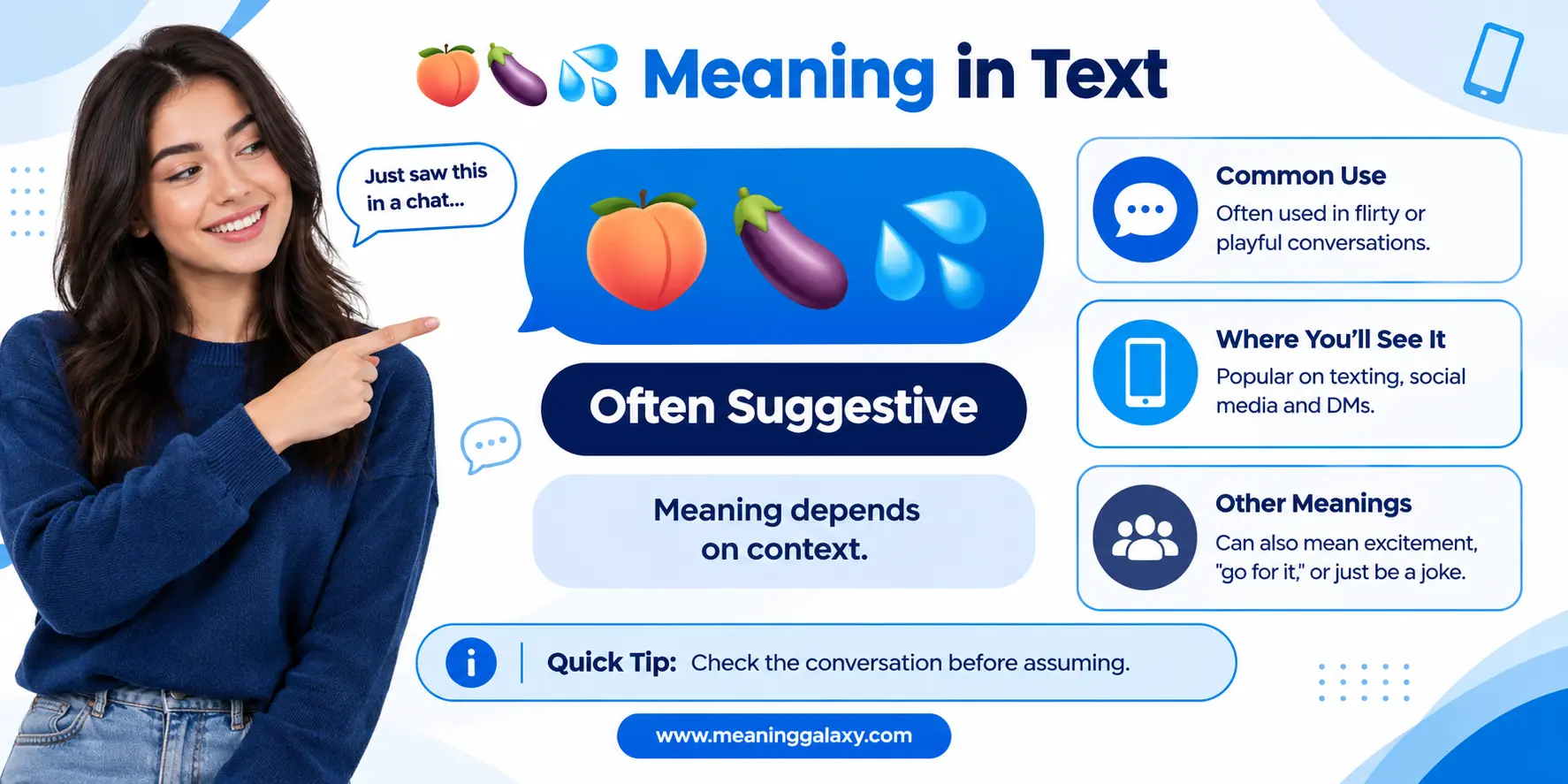
The 🍑🍆💦 meaning in text is often suggestive when these three emojis appear together. In internet slang, the peach emoji 🍑 can represent buttocks, the eggplant emoji 🍆 can represent a penis, and the water droplets emoji 💦 can suggest sweating, splashing, or sexual excitement. Together, they may communicate a sexual joke or innuendo.
However, emojis do not have a single meaning in every conversation. A peach can refer to fruit, an eggplant can appear in a recipe, and water droplets can describe rain, sweat, or a refreshing drink. The surrounding words, relationship between the people messaging, and overall tone help determine the intended meaning.
This guide explains the literal meanings, common slang interpretations, real-life examples, and ways to respond without jumping to conclusions.
🍑🍆💦 Meaning in Text: Quick Answer
The combination 🍑🍆💦 commonly carries a suggestive or sexual meaning in informal online conversations, especially when the emojis appear together in a flirtatious message.
Here is what each emoji can mean:
- 🍑 Peach: Literally a peach; commonly used as a reference to buttocks in internet slang.
- 🍆 Eggplant: Literally an eggplant; commonly used as a phallic symbol in suggestive messages.
- 💦 Sweat droplets: Literally droplets or splashing; sometimes used to suggest sweating, excitement, or sexual innuendo.
When combined, the three emojis may communicate a suggestive message without spelling it out in words.
Important: This is a common interpretation, not a guaranteed translation. A food-related post, gardening discussion, or cooking conversation may use these emojis literally.
Where Did These Emoji Meanings Come From?
Emoji slang develops as people reuse familiar images in creative ways. A symbol can acquire an additional meaning because of its shape, an internet joke, a popular meme, or a convention that spreads through online communities.
The peach emoji became associated with buttocks because of its rounded shape. The eggplant emoji gained a phallic association through visual resemblance, while water droplets have been used in several contexts involving sweat, splashes, and suggestive expressions.
These meanings spread through texting, memes, social media captions, and private messages. Repeated use makes an interpretation recognizable to some people, although not everyone knows or uses the same conventions.
How Internet Culture Changed Emoji Language
Emojis allow people to communicate ideas without writing complete sentences. Online communities often turn ordinary images into shorthand for jokes, emotions, reactions, and references that make sense within a particular group.
For example, someone might use 🍑 as a playful reference in a meme, while another person might use the same emoji to discuss a peach smoothie. The symbol stays the same, but the meaning changes with the situation.
Suggestive emoji combinations work similarly. Their meaning may be understood through shared internet conventions rather than an explicit explanation.
Official Meaning vs. Internet Meaning
An emoji’s standard description identifies the image it represents. Its slang interpretation is an additional meaning created through social usage.
| Emoji | Literal representation | Common slang interpretation |
|---|---|---|
| 🍑 | Peach | Buttocks |
| 🍆 | Eggplant | Penis or phallic reference |
| 💦 | Sweat droplets or splashing water | Sweating, excitement, or suggestive innuendo |
| 🍑🍆💦 | A combination of the three images | Often a sexual or suggestive message |
The informal interpretations do not replace the emojis’ standard identities. They simply illustrate how visual symbols can develop additional meanings online.
Real-Life Texting Conversations
The same emoji can be understood differently depending on the words around it. The following fictional conversations illustrate common possibilities without assuming that every sender has the same intention.
WhatsApp Conversation
Example: A literal food reference
- Alex: “I’m making roasted vegetables tonight.”
- Sam: “Save some eggplant for me 🍆”
Here, the eggplant emoji most likely refers to food because the conversation is about cooking. The surrounding words make the literal interpretation more likely than a slang interpretation.
Instagram DM
Example: An ambiguous compliment
- Alex: “That peach dessert looks amazing 🍑”
- Sam: “It really does!”
The fruit-related conversation makes an ordinary meaning likely. In a different conversation focused on someone’s appearance, 🍑 could carry a flirtatious or suggestive implication.
Flirty Text Message
Example: A suggestive combination
- Alex: “You know what those emojis usually suggest? 🍑🍆💦”
- Sam: “I get the joke, but let’s keep things friendly.”
The combination can signal adult-style innuendo. The reply also shows that recognizing a suggestive meaning does not require reciprocating it.
TikTok Comment
Example: A food video
- Creator: “My homemade eggplant recipe is finally ready!”
- Viewer: “That looks delicious 🍆👏”
The food-related caption and the applause emoji support a cooking interpretation. Although 🍆 has a recognizable slang meaning, its appearance in a recipe comment does not automatically make the comment suggestive.
The Emotional and Social Meaning of Emojis
The 🍑🍆💦 combination can communicate more than the literal images, but its exact implication depends on context.
- Humor: Someone may use the combination to make a cheeky joke or refer to a familiar internet meme.
- Flirting: In a personal conversation, the emojis may suggest attraction or an attempt to flirt.
- Indirect communication: Emojis can imply something without spelling it out.
- Shared cultural references: Friends may recognize the combination from memes or online jokes.
- Ambiguity: Different people may interpret the same message differently, creating confusion.
These possibilities describe common communication patterns, not proof of what a particular sender is thinking.
Why People Use Emojis Instead of Words
Emojis can make messages shorter, more expressive, and more playful. They can also soften a joke or allow someone to hint at an idea without stating it directly.
That indirectness has a downside: an emoji may be easier to misinterpret than a clear sentence. If a message matters or makes someone uncomfortable, asking for clarification is often more useful than guessing.
🍑🍆💦 Meaning in Different Contexts
Social Media
On social platforms, captions, videos, hashtags, and comment threads help determine what an emoji means. A food tutorial featuring 🍑 and 🍆 may use them literally, while the same symbols under a flirtatious post may be interpreted as innuendo.
The 💦 emoji can also represent sweat, splashing water, or excitement. Consider the entire post rather than interpreting the emoji combination in isolation.
Dating and Relationships
In a personal conversation, 🍑🍆💦 may be intended as a suggestive joke or an attempt to flirt. However, receiving the combination does not automatically mean the sender has a particular intention or expects a particular response.
If you are unsure, you can ask what the person means. You are also free to change the subject or state your boundaries if the message feels uncomfortable.
Friend Groups
Friends sometimes use suggestive emojis as part of shared humor, memes, or inside jokes. Their meaning may be obvious to one group but confusing to someone outside it.
Familiarity can provide useful context, but it does not mean everyone in a group will interpret the emojis identically.
Professional Settings
The combination is generally unsuitable for workplace messages, school-related communication, or formal conversations because of its widely recognized suggestive interpretation.
For professional discussions about recipes, produce, or exercise, clearer wording and relevant individual emojis are less likely to cause confusion.
Casual vs. Serious Conversations
A joke-filled chat may make a suggestive interpretation more likely. A conversation about groceries, gardening, or a recipe may support a literal meaning instead.
Repetition, accompanying words, previous messages, and the relationship between participants can all provide clues. None guarantees the sender’s intended meaning.
When Should You Avoid Using 🍑🍆💦?
These emojis can be misunderstood, especially when the recipient is unfamiliar with the sender’s humor or online communication style.
Professional Communication
Avoid the combination in work emails, school assignments, formal group chats, and conversations with teachers or colleagues. Its common slang associations can distract from the actual message.
With People You Barely Know
A suggestive emoji combination can be interpreted as flirtation even if you intend it as a joke. With people you do not know well, plain language is usually a safer choice.
Public Comments
Public comments reach people with different backgrounds, ages, and levels of familiarity with internet slang. A joke that makes sense among friends may look inappropriate or confusing to a wider audience.
When the Meaning Is Ambiguous
If your message needs to be understood accurately, explain it in words. For example, write “I’m making eggplant parmesan” rather than relying on 🍆 alone.
Likewise, if you receive the combination and cannot tell what it means, a simple clarification is reasonable.
Common Misunderstandings About 🍑🍆💦
Does 🍑🍆💦 Always Have a Sexual Meaning?
No. The combination is widely associated with suggestive slang, but individual emojis can have literal meanings, and people sometimes use combinations for food jokes or other playful references. The surrounding conversation is important when deciding which interpretation fits.
Can These Emojis Have Completely Innocent Meanings?
Yes. 🍑 can refer to peaches, 🍆 can refer to eggplant dishes, and 💦 can represent water or sweat. A grocery list, cooking conversation, or discussion of a workout may explain the symbols without any innuendo.
Does the Emoji Combination Always Mean the Same Thing?
No. Although the combination commonly suggests sexual innuendo, the precise interpretation varies by context and by the people communicating. A meme may use it for humor, while another message may be intended as flirtation.
Is This an Official Emoji Meaning?
No. The standard emoji descriptions identify a peach, an eggplant, and sweat droplets. Their suggestive associations developed through informal online use rather than being part of the emojis’ official names. Unicode’s emoji list documents the standard identities.
Unicode
+2
🍑🍆💦 Meaning Comparison Table
| Emoji or combination | Literal meaning | Common internet interpretation | Context clue |
|---|---|---|---|
| 🍑 | Peach | Buttocks or a suggestive reference | Compliments, memes, or body-related jokes |
| 🍆 | Eggplant | Phallic reference | Flirtatious conversation versus recipes |
| 💦 | Sweat droplets or splashing | Sweating, excitement, or suggestive innuendo | Exercise, water, or suggestive messages |
| 🍑🍆 | Peach and eggplant | Often a suggestive combination | Flirtatious comments or adult-style jokes |
| 🍆💦 | Eggplant and droplets | Often suggestive innuendo | Personal messages versus food or water references |
| 🍑💦 | Peach and droplets | May suggest innuendo or simply fruit and water | Surrounding text and image |
| 🍑🍆💦 | All three emojis | Commonly a sexual or suggestive message | Private jokes or flirtatious conversation |
These interpretations are common conventions, not universal definitions. The combined meaning is especially dependent on context.
Common Variations and Emoji Combinations
Peach Emoji 🍑
Literal meaning: A peach fruit.
Common slang meaning: Buttocks, particularly in jokes, comments about appearance, and suggestive messages.
When it applies: The slang meaning is more likely in a conversation about physical attraction. In a recipe or fruit-related post, the literal meaning may be more appropriate.
Meaning, Copy And Paste
+1
Eggplant Emoji 🍆
Literal meaning: An eggplant, also known as an aubergine.
Common slang meaning: A phallic reference.
When it applies: The slang interpretation is widely recognized in informal online communication. However, the emoji remains a normal food symbol in cooking, shopping, and gardening discussions.
Meaning, Copy And Paste
+1
Sweat Droplets Emoji 💦
Literal meaning: Sweat droplets or splashing water.
Common slang meaning: Sweating, excitement, or suggestive innuendo.
When it applies: A fitness post might use the emoji to represent sweat, while a suggestive message may use it with a different implication.
Unicode
+1
Peach and Eggplant Together 🍑🍆
Literal meaning: A peach and an eggplant.
Common online interpretation: The pair is often suggestive because both emojis have established slang associations.
When it applies: The interpretation is more likely in a flirtatious exchange than in a conversation about produce.
Peach and Sweat Droplets Together 🍑💦
Literal meaning: A peach and droplets.
Common online interpretation: It may be used as innuendo, but the pairing has no single universal meaning.
When it applies: Look at whether the conversation involves suggestive jokes, fruit, water, or another subject.
Eggplant and Sweat Droplets Together 🍆💦
Literal meaning: An eggplant and droplets.
Common online interpretation: Often a suggestive pairing in informal messages.
When it applies: A personal message may support an innuendo interpretation, whereas a cooking or gardening discussion may not.
The Full Combination 🍑🍆💦
Literal meaning: A peach, an eggplant, and sweat droplets.
Common online interpretation: A strongly suggestive combination that may communicate sexual innuendo without words.
When it applies: The interpretation is particularly plausible when the surrounding conversation is already flirtatious. It should not automatically be applied to every appearance of the emojis.
How to Respond When Someone Uses 🍑🍆💦
Your response depends on your comfort level and the relationship you have with the sender. You do not need to interpret the message immediately or respond in the same style.
Casual Response
If you are unsure whether the person is joking, keep your response simple.
- “What do you mean by those emojis?”
- “That’s an interesting combination 😂”
These replies acknowledge the message without assuming its meaning.
Funny Response
If the conversation is friendly and you are comfortable joking, you could say:
- “The emoji translator is working overtime 😂”
- “That’s quite a combination of symbols!”
A lighthearted response lets you acknowledge the joke without making the conversation more suggestive.
Clarifying Response
When you want a straightforward answer, try:
- “Are you joking, or do you mean something else?”
- “Can you explain what you’re trying to say?”
Asking directly can prevent unnecessary confusion and help you understand the intended message.
Respectful Boundary-Setting Response
If the message feels uncomfortable, you can respond clearly and politely.
- “I’d rather keep our conversation friendly.”
- “I’m not comfortable with suggestive messages.”
- “Please don’t send me messages like that.”
You do not have to reciprocate a suggestive message, explain your discomfort at length, or continue a conversation that makes you uneasy.
Regional and Cultural Differences
Emoji interpretations can vary across languages, communities, and individual experiences. A symbol that is widely understood as slang in one online community may be unfamiliar to someone in another.
English-Language Internet Culture
In English-language online spaces, 🍑 and 🍆 have recognizable slang associations, and 💦 can contribute to a suggestive interpretation. These conventions appear in memes, social media posts, and informal conversations.
However, there is no guarantee that every English-speaking person knows or uses these meanings.
International Online Communities
Emojis travel across borders, and their slang meanings can spread through globally shared memes and social media trends. At the same time, local languages, food traditions, and community-specific jokes can influence how a message is interpreted.
A literal food reference may be obvious to one reader, while another may notice the slang association first.
Generational Differences
Familiarity with emoji slang depends on individual experience, online communities, and personal communication habits. It is better to consider the conversation itself than to assume someone understands a particular emoji because of their age.
Is 🍑🍆💦 Appropriate for Younger Users?
These emojis have ordinary meanings related to fruit, vegetables, and droplets. Their additional slang interpretations are part of informal online communication, so understanding the difference can help younger users interpret messages more confidently.
The full combination is widely associated with suggestive content. That does not mean every individual emoji is inappropriate, but it is useful to recognize when a combination may carry an adult-style implication.
A few practical principles can help:
- Consider the context: Look at the words and conversation before interpreting a message.
- Respect personal boundaries: You never need to reply to a message that makes you uncomfortable.
- Ask for clarification: It is reasonable to ask what someone means instead of guessing.
- Communicate clearly: Use words when an emoji could create confusion.
Understanding emoji slang is primarily about interpreting communication thoughtfully, not treating every unusual emoji as a problem.
Frequently Asked Questions
What does 🍑🍆💦 mean in texting?
The combination usually suggests sexual innuendo in informal online conversations. 🍑 commonly represents buttocks, 🍆 can represent a penis, and 💦 may add a suggestive implication. However, the context matters, and the emojis can also appear in jokes or literal discussions.
What does 🍑🍆💦 mean on social media?
On social media, the combination often appears in suggestive comments, memes, or flirtatious exchanges. A post’s caption, subject, and surrounding comments can help clarify its meaning. The combination does not automatically reveal the poster’s intentions.
What does 🍑🍆💦 mean when someone sends it privately?
In a private message, the combination may be intended as a suggestive joke or an attempt to flirt. However, the sender’s intention cannot be established from emojis alone. If you are unsure, ask for clarification or respond according to your comfort level.
Does 🍑🍆💦 always have a slang meaning?
No. Although the combination has a recognizable suggestive interpretation, context can change how it is understood. Individual emojis may refer to fruit, vegetables, sweat, or water, particularly when the conversation is about cooking, groceries, or exercise.
What does 🍑 mean by itself?
The peach emoji literally represents a peach, but it is also widely used to refer to buttocks. Its intended meaning depends on the surrounding words and situation. Food-related messages generally provide stronger evidence for a literal interpretation.
What does 🍆💦 mean together?
This combination is commonly interpreted as suggestive innuendo in informal messaging. However, the eggplant and droplets can also appear in literal contexts involving food and water. The surrounding conversation is the best clue to the intended meaning.
How should I respond when someone sends 🍑🍆💦?
If you understand the joke and feel comfortable, you can respond casually. If the meaning is unclear, ask what the sender means. If the message makes you uncomfortable, you can change the subject or politely ask the person to stop.
Is 🍑🍆💦 appropriate for professional messages?
Generally, no. The combination has widely recognized suggestive associations and could create confusion in workplace, school, or formal communication. Clear wording and relevant literal emojis are better choices when communicating in professional settings.
Final Thoughts on 🍑🍆💦 Meaning in Text
The 🍑🍆💦 meaning in text is usually suggestive when the emojis appear together in informal online conversations. Individually, they represent a peach, an eggplant, and sweat droplets, but their common slang associations can create an entirely different interpretation.
The most important thing is to consider the surrounding words, platform, relationship, and tone before deciding what someone intended. If a message is ambiguous, ask for clarification rather than jumping to conclusions. And if a message makes you uncomfortable, you can set a boundary without feeling obligated to play along.

Welcome to Meaning Galaxy! I’m Muhammad Talha, a language enthusiast and meaning explorer dedicated to helping people discover the true meanings behind words, names, phrases, and concepts.
I help users understand words better, explore hidden meanings, and learn new information in a simple and easy way. My goal is to make learning meanings interesting, clear, and accessible for everyone.
Let’s explore the world of words together!