
Have you received a message containing “ONG” and wondered whether it means something different from “OMG”? These two abbreviations look similar, but they usually communicate different things.
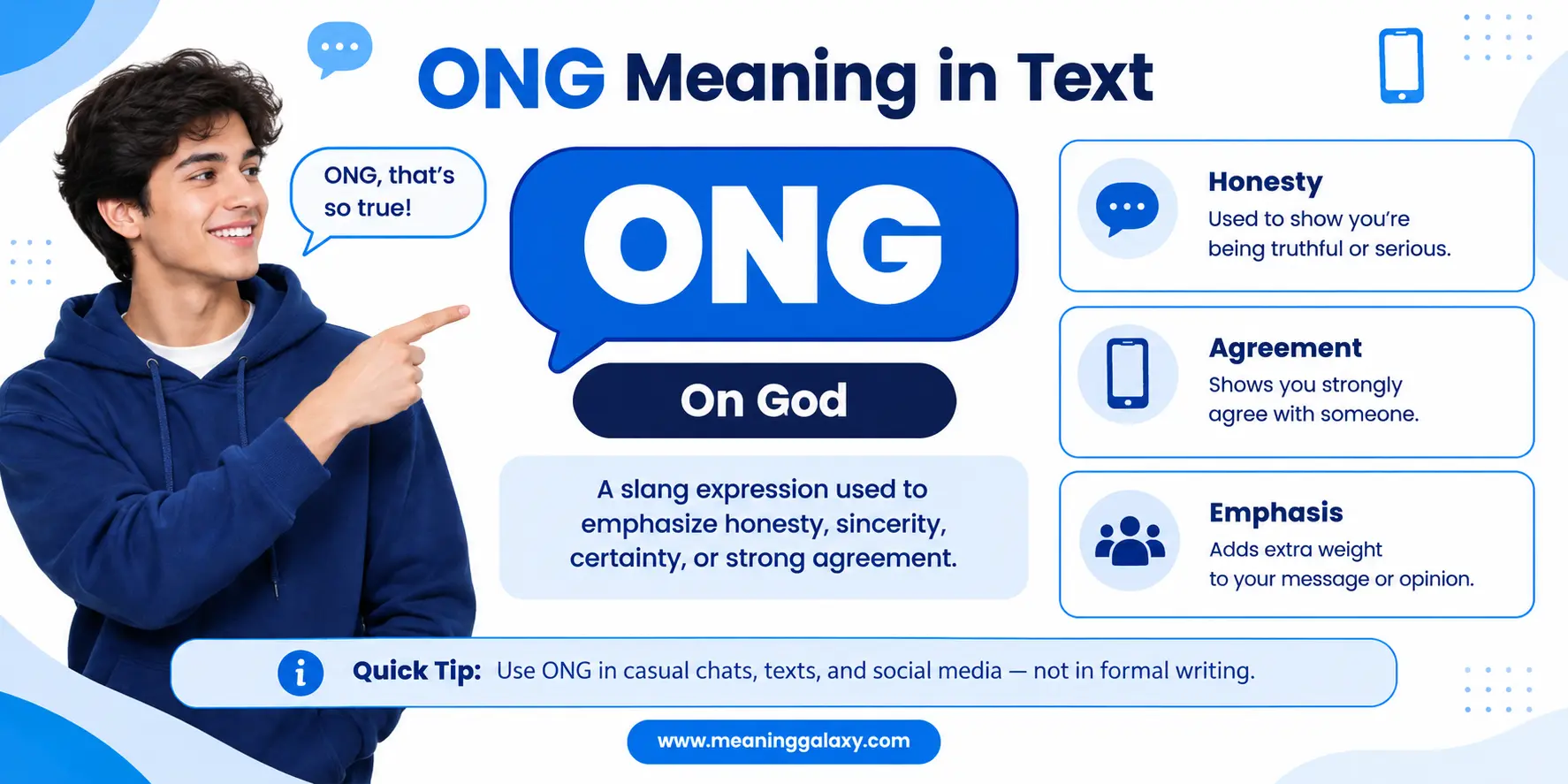
In texting and internet slang, ONG stands for “on God.” People use it to emphasize that they are being honest, strongly believe something, or genuinely agree with another person. It can be similar to saying “I swear,” “I mean it,” or “for real.”
For example:
Friend 1: “That was the funniest movie ever.”
Friend 2: “ONG, I couldn’t stop laughing.”
Here, the second person is emphasizing how much they agree.
ONG is informal, so you will generally see it in casual conversations, text messages, online comments, and social media posts rather than formal writing.
Quick Answer: What Does ONG Mean?
ONG means “on God.” It is a slang expression used to stress honesty, sincerity, certainty, or strong agreement.
| Context | Likely meaning |
| Texting | “I swear” or “I’m telling the truth” |
| Snapchat | Emphasis or agreement in a casual chat |
| TikTok | Emphasis in comments, captions, or replies |
| Agreement, sincerity, or a strong opinion | |
| Emphasis in personal and group chats | |
| Discord | Emphasis in casual community or gaming conversations |
| Gaming | Strong agreement or an emphatic reaction |
| Professional or technical contexts | May have a different meaning if the surrounding subject defines an acronym |
The social media examples above describe the general slang meaning, not separate definitions established by each platform. Context remains important.
What Does ONG Mean in Text?
When someone writes ONG in a text message, they are usually trying to make their statement sound more convincing, sincere, or emphatic.
The phrase comes from “on God,” which is used as an expression of swearing or affirming that something is true. In everyday online conversations, however, people also use it casually to agree with a statement or emphasize an opinion.
Depending on the message, ONG can communicate several related ideas:
- Honesty: “I am telling you the truth.”
- Sincerity: “I genuinely mean what I am saying.”
- Agreement: “Exactly! I feel the same way.”
- Emphasis: “I really mean it.”
- Frustration or excitement: “This is seriously getting to me” or “That was amazing.”
Consider these examples.
Example 1: Proving that something is true
Person A: “Did you really finish the assignment last night?”
Person B: “ONG, I stayed up until 3 a.m.”
Meaning: Person B is emphasizing that they genuinely completed the assignment.
Example 2: Agreeing with a friend
Person A: “Mondays should be three days shorter.”
Person B: “ONG 😂”
Meaning: Person B strongly agrees with the complaint, probably in a humorous way.
Example 3: Expressing an opinion
Person A: “This is the best burger I’ve ever had.”
Person B: “That place is amazing, ONG.”
Meaning: Person B is emphasizing how strongly they feel about the restaurant.
The abbreviation does not automatically prove that a statement is true. It simply shows how strongly the sender wants to express it.
Why Do People Use ONG?
People use ONG because it adds emphasis without requiring a long explanation. Like other forms of internet slang, it helps communicate tone in short digital messages.
There are four common reasons to use it.
1. To emphasize honesty
Someone may add ONG when they think the other person doubts their story.
Example: “I didn’t tell anyone your secret, ONG.”
The sender is insisting that the statement is true.
2. To agree with someone
ONG can work as a short response when a person strongly agrees with another person’s opinion.
Example:
Person A: “That exam was unnecessarily difficult.”
Person B: “ONG.”
Here, it means something like “Exactly” or “I completely agree.”
3. To make a reaction stronger
A plain sentence can sound more emphatic when ONG is added.
Example: “That concert was incredible, ONG.”
The sender wants to emphasize their enthusiasm.
4. To keep messages casual and short
Typing ONG takes less time than writing “I swear to God” or “I completely agree.” It also signals an informal, conversational tone.
However, ONG is not appropriate for every audience. Some readers may not know the expression, and others may prefer not to use slang involving religious language.
What Does ONG Mean on Different Social Media Platforms?
ONG generally retains its meaning across social media platforms. What changes is the setting in which someone uses it, rather than the basic definition.
ONG meaning on Snapchat
On Snapchat, ONG may appear in private chats, group conversations, or replies to a friend’s Snap. It can emphasize that a statement is true or show strong agreement.
Example:
Friend: “You actually remembered my birthday?”
You: “ONG, of course I did!”
Meaning: The sender is emphasizing that they remembered.
The abbreviation does not have a special Snapchat-only definition. The surrounding conversation determines the intended tone.
ONG meaning on TikTok
On TikTok, you may encounter ONG in comments, captions, or conversations about videos. It can emphasize a reaction or show agreement with another person’s opinion.
Example:
Comment: “This is the funniest video I’ve seen today, ONG.”
Meaning: The commenter is strongly emphasizing how funny they found the video.
It can also appear in replies to relatable videos, jokes, personal stories, or opinions. The phrase does not have to be a literal promise or serious declaration.
ONG meaning on Instagram
On Instagram, ONG can appear in direct messages, Reels comments, Stories replies, and casual conversations.
Example:
Friend: “Your new photos look amazing!”
You: “Thank you! ONG, I spent forever editing them 😂”
Here, ONG adds emphasis to the sender’s comment about the effort involved.
In a comment such as “ONG, this outfit is perfect,” the expression intensifies the compliment.
ONG meaning on WhatsApp
On WhatsApp, ONG usually works the same way it does in other messaging apps. Friends, relatives, and group members may use it to emphasize a statement or agree with someone.
Example:
Person A: “The traffic was terrible today.”
Person B: “ONG, it took me an hour to get home.”
Meaning: Person B strongly agrees and emphasizes their experience.
WhatsApp does not give the abbreviation a separate standard meaning. It remains informal slang.
ONG meaning on Discord
On Discord, ONG may appear in gaming servers, hobby communities, and general chat channels.
Example:
Player A: “That final round was impossible.”
Player B: “ONG, we almost lost.”
Meaning: Player B agrees that the round was extremely difficult.
The abbreviation can also be used in conversations about music, entertainment, online communities, or other interests. If a server uses ONG as a custom acronym, its local meaning may differ, so check the surrounding discussion.
What Does ONG Mean in Different Contexts?
The meaning of ONG depends partly on the topic being discussed. Its familiar meaning in casual texting is “on God,” but not every appearance of these three letters is internet slang.
ONG in gaming
In gaming conversations, ONG usually retains its everyday slang meaning rather than referring to a particular game mechanic or official gaming term.
Example:
“That boss fight was so hard, ONG.”
The player is emphasizing how difficult the fight was.
If you see ONG in a game’s settings, an official guide, or a technical discussion, do not automatically interpret it as “on God.” Check whether the game or community defines it as an acronym.
ONG in business or technology
In professional and technical environments, three-letter abbreviations can have specialized meanings. ONG does not have one universally applicable business or technology expansion.
For example, if someone writes “ONG” in a company report, software specification, or project document, the intended definition may depend on the organization or subject.
In an ordinary message between colleagues, however, it may still be informal slang.
Practical tip: Check the document’s glossary, the first occurrence of the acronym, or the surrounding sentence before interpreting it.
ONG in education
Students may use ONG in messages about exams, homework, teachers, or university life.
Example:
Student A: “That assignment took me the whole weekend.”
Student B: “ONG, I barely finished mine.”
Here, the second student is emphasizing agreement.
In formal educational materials, research papers, and official academic documents, do not assume ONG means “on God.” Look for a definition specific to the subject.
ONG in relationships or dating
In a personal or dating conversation, ONG can emphasize sincerity, agreement, or a strong opinion. It does not automatically express romantic interest.
Example:
Person A: “I really enjoy spending time with you.”
Person B: “ONG, I feel the same way.”
Here, the phrase emphasizes sincerity. The affectionate meaning comes from the rest of the conversation, not from ONG alone.
ONG in professional and everyday communication
The difference between slang and specialized language matters most when the same abbreviation appears in unrelated settings.
| Example | Likely interpretation | Why |
| “That food was incredible, ONG.” | “On God” | Casual emphasis |
| “I didn’t take your book, ONG.” | “On God” | Insisting on honesty |
| “Please define ONG in this technical report.” | Unclear without context | It may be a domain-specific acronym |
| “ONG, you’re absolutely right.” | “On God” | Strong agreement |
The first two examples are ordinary slang. The third requires clarification rather than a guessed expansion.
Does ONG Always Mean On God?
No. Although “on God” is the established meaning in texting slang, ONG can occasionally be a typo for OMG or an acronym used in a specialized context. Dictionary.com also notes that ONG can be confused with OMG because the letters are close together on a keyboard.
Here is how to distinguish the possibilities.
- ONG as slang: “I’m telling the truth, ONG.”
- ONG as agreement: “ONG, that was the best episode.”
- ONG as a possible typo: “ONG! Look at that puppy!” If the sender is reacting to something surprising, they may have intended OMG.
- ONG as a specialized acronym: In a technical document, its meaning must be established from the subject or a reliable definition.
A useful rule is to consider the entire message, not just the three letters. If the sender is emphasizing a claim or agreeing with someone, “on God” is a reasonable interpretation. If the message expresses surprise and the letters appear out of place, a typo is possible.
How to Identify the Correct Meaning of ONG
If you are unsure what someone means, use these six clues.
1. Read the surrounding messages. If someone is defending a statement, ONG probably emphasizes honesty. If they are responding to an opinion, it may indicate agreement.
2. Consider the topic. A casual discussion about food, school, or entertainment is more likely to involve slang than a technical report.
3. Look at the sentence structure. ONG at the end of a statement often reinforces the claim. At the beginning, it can emphasize the whole sentence.
4. Notice the relationship. Friends who frequently use internet slang may use ONG casually. A colleague who rarely uses slang may have a different intention.
5. Pay attention to punctuation and emojis. “ONG 😂” may express humorous agreement, while “ONG, I’m serious” emphasizes sincerity. Emojis help indicate tone but do not establish a fixed definition.
6. Check whether the message makes sense. If “on God” does not fit the sentence, consider a typo or an acronym specific to the conversation.
If the meaning remains unclear, asking the sender is perfectly reasonable. A quick “Do you mean on God?” is better than making an assumption.
Real Conversation Examples of ONG
The following examples show how ONG can be used naturally in different everyday situations.
1. Making plans with friends
Person A: “Are we still meeting at 6?”
Person B: “ONG, I’ll be there.”
Meaning: Person B is emphasizing their commitment to the plan. It is not a guarantee that they will actually arrive on time.
2. Talking about food
Person A: “You need to try that pizza place.”
Person B: “ONG, their pizza is incredible.”
Meaning: Person B strongly agrees or emphasizes their positive opinion.
3. Discussing an exam
Person A: “I studied all night for that test.”
Person B: “ONG, same. I’m exhausted.”
Meaning: Person B emphasizes that they share the experience.
4. Sharing exciting news
Person A: “I finally got the job!”
Person B: “ONG, congratulations! You deserve it!”
Meaning: ONG adds emphasis to an enthusiastic reaction. The congratulations communicate the excitement.
5. Chatting while gaming
Player A: “We won with one second left.”
Player B: “ONG, that was so close.”
Meaning: Player B strongly emphasizes how close the match was.
6. Talking about a relationship
Person A: “I really appreciate everything you did for me.”
Person B: “ONG, you don’t have to thank me.”
Meaning: Person B is emphasizing their response. Whether the exchange is romantic, friendly, or familial depends on the broader relationship.
These examples are illustrative, not quotations from real private conversations. They demonstrate the usual conversational function of the abbreviation.
How to Use ONG Correctly in a Text Message
ONG is best suited to informal conversations where both people understand internet slang.
When should you use ONG?
Use it when you want to emphasize a statement, agree strongly, or communicate casually with friends.
Examples:
- “ONG, I didn’t see your message.”
- “That was the best match, ONG.”
- “ONG, you’re absolutely right.”
- “I’m so tired today, ONG.”
You can write it as “ONG” or “ong.” Capitalization usually does not change its meaning.
It may appear at the beginning or end of a sentence, or on its own as a brief response. There is no single mandatory punctuation style.
When should you avoid using ONG?
Avoid it in formal or unfamiliar settings where the abbreviation may be confusing or too casual.
For example:
| Informal message | Clearer professional alternative |
| “ONG, I finished the report.” | “I confirm that I have finished the report.” |
| “ONG, this is urgent.” | “This matter is urgent and requires attention.” |
| “ONG, you’re right.” | “I agree with your assessment.” |
These alternatives communicate the same general intent more clearly in a professional setting.
Also consider your audience. Because “on God” contains a religious reference, some people may prefer not to use it. You can use “honestly,” “seriously,” or “I promise” instead, depending on what you mean.
Does ONG Have a Romantic or Hidden Meaning?
ONG does not have an established romantic meaning on its own. Its usual function is to emphasize honesty, sincerity, or agreement.
For example:
Person A: “I miss talking to you.”
Person B: “ONG, I’ve missed our conversations too ❤️”
The message sounds affectionate because of the words and the heart emoji, not because ONG secretly means “I love you.”
Compare that with:
Person A: “That movie was amazing.”
Person B: “ONG, it really was.”
Here, the expression simply emphasizes agreement.
The same principle applies when interpreting messages from a girl or a guy. ONG does not have a different standard definition based on the sender’s gender. Look at the actual message, the relationship, and the tone rather than trying to infer romantic interest from the abbreviation alone.
How Should You Reply to ONG?
Your response depends on what the sender is trying to communicate. You do not need to use slang yourself to reply naturally.
| If someone sends… | Possible reply |
| “ONG, that was hilarious.” | “I know 😂” |
| “I didn’t tell anyone, ONG.” | “Okay, I understand.” |
| “ONG, you’re right.” | “Exactly!” |
| “That was the best concert ever, ONG.” | “Glad you enjoyed it!” |
| “ONG, I’m so tired.” | “Same here.” |
| “ONG?” when questioning something | “Yes, seriously!” or clarify what you mean |
Example conversation
Person A: “This week has been exhausting.”
Person B: “ONG, I need a weekend already.”
Person A: “Same 😂”
In this exchange, both people are using casual language to express agreement and shared frustration.
If someone sends only “ONG” and you cannot tell whether they agree, are surprised, or have made a typo, ask a simple follow-up:
- “Do you mean on God?”
- “Are you agreeing with me?”
- “Wait, did you mean OMG?”
A short clarification is often all that is needed.
ONG vs. Similar Texting Abbreviations
ONG belongs to a broader group of internet expressions that communicate sincerity, agreement, or strong emotion. These expressions overlap, but they are not interchangeable in every situation.
| Abbreviation or phrase | Meaning | Main difference |
| ONG | On God | Emphasizes sincerity, certainty, or agreement |
| OMG | Oh my God | Usually expresses surprise, excitement, or shock |
| FR | For real | Indicates agreement or that something is genuine |
| ISTG | I swear to God | More explicitly expresses an oath or strong frustration |
| NGL | Not gonna lie | Introduces an honest opinion or admission |
| No cap | No lie; not exaggerating | Emphasizes that a statement is genuine |
These distinctions reflect common informal usage, and individual speakers may use the expressions differently.
Here are a few examples to make the differences clearer.
ONG vs. OMG
- “ONG, I didn’t take your phone.” — The sender insists they are telling the truth.
- “OMG, I lost my phone!” — The sender expresses shock or distress.
ONG vs. FR
- “ONG, this song is amazing.” — The sender emphasizes their strong opinion.
- “FR, this song is amazing.” — The sender affirms that the statement is genuine or agrees with it.
ONG vs. ISTG
- “ONG, I already told you.” — The sender emphasizes the truth of their statement.
- “ISTG, I’ve explained this three times.” — The sender may sound more frustrated or emphatic.
ONG vs. NGL
- “ONG, this is the best restaurant.” — The sender strongly emphasizes an opinion.
- “NGL, this restaurant is better than I expected.” — The sender introduces a candid opinion.
The important difference is what the writer wants to emphasize. ONG often stresses sincerity or conviction, while OMG more commonly expresses a reaction.
Common Mistakes When Understanding ONG
A few misunderstandings can make a simple message seem more confusing than it is.
1. Confusing ONG with OMG
The letters are similar, but the usual meanings differ. ONG means “on God,” whereas OMG means “oh my God.” However, a typo is possible, so check the context.
2. Assuming ONG proves someone is telling the truth
ONG emphasizes a claim; it does not verify that claim. If the message concerns something important, consider the evidence rather than relying on the abbreviation.
3. Treating ONG as a platform-specific term
It does not have a separate standard definition on Snapchat, TikTok, Instagram, or WhatsApp. Its familiar slang meaning generally remains the same across these services.
4. Assuming it always expresses agreement
ONG can indicate agreement, but it can also emphasize a statement, promise, opinion, or emotional reaction. Read the full sentence.
5. Assuming it signals romantic interest
ONG alone is not a reliable sign of flirting. Look at the rest of the conversation before interpreting someone’s intentions.
Frequently Asked Questions About ONG
1. What does ONG mean in text?
ONG means “on God” in texting slang. People use it to emphasize that they are telling the truth, strongly believe something, or genuinely agree with another person. Depending on the conversation, it can mean “I swear,” “seriously,” or “for real.”
2. What does ONG stand for?
ONG stands for “on God.” It is an informal abbreviation used in digital communication. The expression emphasizes sincerity or conviction, although people also use it casually to agree with opinions, react to situations, or express strong feelings.
3. What does ONG mean on Snapchat?
On Snapchat, ONG generally means “on God.” It can appear in direct messages, group chats, and replies to Snaps. For example, “ONG, I’m telling the truth” means “I swear I’m telling the truth.” Its meaning is not unique to Snapchat.
4. What does ONG mean on TikTok?
On TikTok, ONG commonly appears in comments and captions to emphasize an opinion or express agreement. Someone commenting “ONG, this is so funny” is emphasizing how funny they find the video. The surrounding comment helps establish the tone.
5. What does ONG mean on Instagram?
On Instagram, ONG is used in direct messages, comments, and other casual interactions. It usually means “on God” and emphasizes sincerity, certainty, or agreement. It does not automatically carry a romantic meaning when someone uses it in a message.
6. Is ONG the same as OMG?
No. ONG usually means “on God,” while OMG means “oh my God.” ONG generally emphasizes sincerity or agreement, whereas OMG commonly expresses surprise, excitement, or shock. Because the abbreviations look similar, check the surrounding sentence if the intended meaning is unclear.
7. Is ONG slang or a formal abbreviation?
ONG is informal internet slang when used to mean “on God.” It is suitable for many casual conversations, but it is generally not appropriate for formal reports, academic writing, or professional emails. In technical documents, the same letters may have a separate meaning.
8. What does ONG mean from a girl or a guy?
The standard slang meaning does not change based on gender. Someone may use ONG to emphasize a statement, express agreement, or show sincerity. The words around it and the nature of the relationship are more useful for understanding the sender’s intentions.
9. Does ONG mean “I love you”?
No. ONG does not ordinarily mean “I love you.” It means “on God” and is used for emphasis or sincerity. If someone uses it in an affectionate message, the romantic tone comes from the rest of the message rather than the abbreviation itself.
10. How should I respond when someone says ONG?
Reply according to the conversation. If they are agreeing with you, you could say “Exactly!” If they are emphasizing a promise, you might acknowledge what they said. If their message is unclear, ask what they mean rather than assuming a particular intention.
11. Can ONG have more than one meaning?
Yes. In casual texting, “on God” is the usual meaning, but ONG can also appear as a typo for OMG or as an acronym in a specialized field. Consider the topic, sentence structure, and surrounding messages to determine which interpretation makes sense.
Final Thoughts:
The most common ONG meaning in text is “on God.” It is an informal expression people use to emphasize honesty, sincerity, certainty, or strong agreement. You may see it in text messages, Snapchat chats, TikTok comments, Instagram DMs, WhatsApp groups, and Discord conversations.
Remember the main distinction: ONG usually emphasizes that someone means what they say, while OMG usually expresses surprise or excitement. Neither abbreviation has to carry a hidden message, and ONG alone is not evidence of romantic interest.
When you encounter ONG, read the whole message before interpreting it. Understanding the context will usually help you determine whether the sender is emphasizing a claim, agreeing with an opinion, or simply reacting to something.

Welcome to Meaning Galaxy! I’m Muhammad Talha, a language enthusiast and meaning explorer dedicated to helping people discover the true meanings behind words, names, phrases, and concepts.
I help users understand words better, explore hidden meanings, and learn new information in a simple and easy way. My goal is to make learning meanings interesting, clear, and accessible for everyone.
Let’s explore the world of words together!
1 thought on “ONG Meaning: What Does ONG Mean in Text and on Social Media?”